


 Ajaita Shah, center, Signal Fund recipient and cofounder of Frontier Markets, with members of her team in India. (Photo courtesy of Echoing Green)
Societies around the world are in peril: Eroding trust. Backsliding democratic norms. Accelerating global challenges—from political instability and division to climate-related natural disasters and inequality—are roiling nations around the world. In response to these mounting threats, the public has grown both weary and wary. We’re in a period of polycrisis, yet the business world, government, and civil society persist in their siloed approaches to solving it.
Now more than ever, we need to borrow from the energy, optimism, courage, and interconnectedness that characterize the social innovation ecosystem. Social innovation—a field fundamentally about breaking down silos, finding common ground, and building bridges—can be an antidote to the forces that are sowing distrust and discord among us, injecting new life into the public sphere.

And yet, social innovation has often been seen as a sideshow—a field in the margins. We argue that it’s time for social innovation to assume a leading role.
As longtime practitioners and supporters of this field, we know social innovators are uniquely equipped to forge sustainable solutions to global challenges while building the trust we are so sorely missing across sectors, communities, and institutions. By leveraging the strengths and mechanisms of multiple sectors and applying them in creative or unorthodox ways, social innovators can create an ecosystem poised for transformational impact.
In this article, we make the case that the social innovation field deserves more concerted investment and collective action to create the conditions that can unleash the best ideas for social transformation. By resourcing, growing, and mainstreaming social innovation, we can sidestep the boundaries that limit us to create new and shared public value.
Our vision? Leaders across sectors recognize social innovation as critical to societal progress and play a role in attracting the resources and talent needed to fulfill its promise, while the public feels a renewed optimism in our collective ability to move forward.
Three Opportunities to Cultivate a Thriving Social Innovation Ecosystem
It’s time to innovate the way we innovate.
Echoing Green, the Skoll Foundation, and a small group of other social innovation-focused organizations have recently come together to explore how we can better permeate these principles and practices throughout society, from the grassroots to the grasstops. Many of us have been deeply engaged in this work for decades, and we’ve seen the power of venturing beyond our comfortable silos to build bridges with others to advance shared ambitions.
We see three high-potential opportunities to take the field of social innovation to the next level: build public narratives about the impact potential of social innovation; attract more resources and champions; and support the ecosystem’s growth through coalition-building and system orchestration.
Opportunity 1: Tell the story.
There is an opportunity to infuse public narratives with compelling stories about why and how social innovation works in order to encourage integration into new arenas, from media and pop culture to government and academia. Imagine how much faster we might address global challenges if leaders across sectors, including professors, news producers, civil servants, business school students, Fortune 500 leaders, philanthropic consultants, and others readily recalled social innovation as a worthwhile lever to pull. We need these folks as champions and collaborators.
To get there, it’s our collective job to tell the story of why they should care by establishing a public narrative that portrays social innovation as a fundamental mechanism for change, unity, and growth, alongside traditional for-profit and nonprofit work.
Successful narrative change happens through disseminating real stories, shifting language, engaging influencers, deploying bold visuals and campaign messaging across platforms, engaging in digital campaigns, and more.
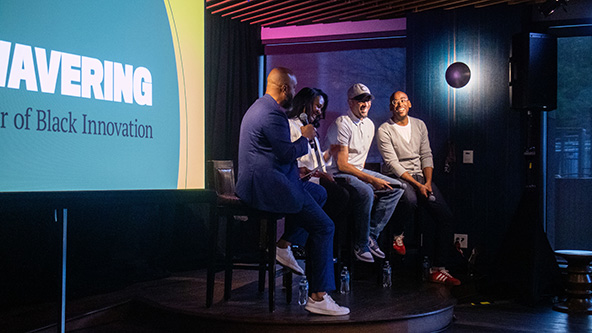 A panel discussion following a screening of the Echoing Green documentary Unwavering: The Power of Black Innovation, an example of the organization’s narrative change efforts. From left to right: Trymaine Lee with Fellows Laurin Leonard, Damon Packwood, and Jehiel Oliver. (Photo courtesy of Echoing Green)
Both Echoing Green and the Skoll Foundation support storytelling as a powerful tool for social change, amplifying voices of those closest to the challenge and shining a light on the outsized impact of social innovators. We hope these stories inspire others to act—to collectively forge new solutions to global challenges.
There are several signals this storytelling is working. We’re seeing momentum with new- and next-gen philanthropists and business leaders, a particularly encouraging development given the coming US wealth transfer of an estimated $84 trillion to inheritors over the next few decades. We’re seeing emerging philanthropists across the United States, Africa, Brazil, and India—to name a few—thinking differently about their giving, centering and supporting social innovators in their philanthropic pursuits.
Further, we’re increasingly seeing proximate social innovators—those who are either based in affected communities and/or have lived experience of the challenges at hand—gaining more visibility in media, higher education, and other arenas. These trends encourage talent across sectors to embrace the lens of social innovation in their careers.
So, what’s the next step?
Ideas include supporting proximate storytellers with grant dollars to highlight the incredible work being done in every corner of the globe, developing media partnerships to connect more mainstream reporters to the impact, or dedicating resources to developing and disseminating case studies and research briefs that can demonstrate the efficacy to others.
It also includes making the case to government and helping those in the public sector understand how social innovation can achieve their goals. Working with government is a two-way street, of course, and both sectors can do more to meet in the middle. While there is certainly opportunity for government to create a more enabling environment for social innovation to proliferate, innovators and funders have a responsibility to build bridges with government agencies and civil servants to advance shared goals.
To do so, it will be incumbent upon us to understand governmental priorities and incentives, better translate the way we talk about our work so it resonates with our public-sector peers, and build the capacity of social innovators to tell stories about how their solutions can achieve governmental goals.
The global people-centered climate action movement is instructive here. Global and regional coalitions of Indigenous Peoples have successfully found common ground with governments in the Amazon, Congo Basin, and Indonesia by highlighting the fact that recognizing Indigenous land tenure is a highly effective—and comparatively affordable—way to halt deforestation and fulfill climate change reduction targets.
Finally, investing in novel ways to measure the impact of social innovation will support efforts to tell our story. The field lacks universal metrics of success; developing robust impact measurement frameworks—both quantitative and qualitative—is essential for building trust and attracting investment. We can’t move our field forward if we can’t convince decision-makers of its value.
Opportunity 2: Get resources off the sidelines.
Funding remains a critical barrier to scale in our field. A comprehensive toolbox of different types of capital is simply not available to the social innovation community. Founders pursuing social change require risk capital across borders, across tax statuses, and on flexible terms that allow experimentation and adaptation. This dearth of financial tools has prevented desperately needed social change models from breaking through or achieving their full potential impact.
There are several ways to apply existing financing practices, mechanisms, and approaches to better support and extend the reach of social innovation.
First, philanthropy can tap into and extend public funding streams by joining forces to unlock resources from governments and major global institutions, bringing significant and influential resources off the sidelines. At a time when government funds are decreasing, collaborating to better coordinate and leverage these funding flows is even more essential.
As discussed above, doing so will require understanding the constraints and goals of government, bilateral, and multilateral entities in a fast-changing and uncertain time. The rewards of such inquiry could be vast: finding ways to meet government where they are can unlock significant funding contributions to support joint priorities.
Advocates for community health workers have executed this playbook beautifully by developing new financing mechanisms that aggregate private funding from corporate and philanthropic partners, which major institutions like the Global Fund then match. This approach drives significant resources to the issue and establishes new paradigms—that is, models for thinking about and approaching a problem—for how solutions get funded going forward.
Second, philanthropy can extend the capital stack. By delivering on our mandate to provide more flexible capital and overcoming our reluctance to think beyond traditional grants, our funding can go much further. Philanthropy will need to continue providing the risk capital that allows innovators to pilot new approaches and models.
Funders can leverage investment capital through mission-aligned, program-related, and impact investing to buoy philanthropic donations. Supplementing grant dollars with investment capital can accelerate and amplify the work, magnifying the impact of social innovations and increasing the pool of available capital to support the field.
The global impact investing market is valued at $1.57 trillion and growing. Echoing Green and Skoll have doubled down on this funding approach in recent years, and there is ample room for more foundations to increase their knowledge of and comfort and experience with mission-aligned investing.
For example, last year, Echoing Green launched a catalytic capital fund, the Signal Fund, which aims to test a new set of financial mechanisms and model how more accessible investment vehicles can fuel transformational social change and innovation globally. The idea is to disrupt the current funding landscape, which is misaligned with the needs of social innovators and leaves impact on the table. The fund provides patient, flexible, and “founder-focused” capital that is designed to meet the organizational and structural needs of each social entrepreneur investee.
At Skoll, we’ve been partnering with Capricorn Investment Group (CIG), our sister organization within the Jeff Skoll Group, to bring more of our balance sheet to bear toward our mission. As Skoll Foundation President Marla Blow and CIG Partner Michaela Edwards recently described in SSIR, the two organizations developed impact-investing portfolios several years ago that could drive social change alongside financial returns. Working together, we achieved net-zero status within the Foundation’s endowment by investing in nature-based carbon-offset projects, complementing and extending the impact of our grantmaking.
Finally, collaborative philanthropy can more regularly coordinate funding for innovators to ensure our partners can access financing at different stages in their growth trajectory. With this kind of “relay” funding, philanthropists ensure support for an organization throughout its life cycle, minimizing the dreaded funding cliff. Activities like exposing one another to promising organizations, sharing due diligence, and consolidating reporting processes become even more urgent in our current environment, as the level of need demands we shelve our own preferences to advance solutions as efficiently as possible.
For example, Echoing Green focuses on supporting promising, early-stage ideas while Skoll zeroes in on more established, “mezzanine-level” innovations. We both intentionally consider where the next sources of funding for proven social innovations will come from. We then rally the field to generate those resources and unlock capital at scale.
Echoing Green does this by sharing due diligence and co-investing with similarly situated early-stage ecosystem players. Skoll has partnered with leading collaborative funders like the Audacious Project and Co-Impact, as well as made the case to institutions like the Global Fund to provide subsequent resources. Greater, more intentional collaboration can provide our partners with more predictable funding streams as they scale.
Opportunity 3: Build the ecosystem.
Story after story of scaled-up social innovations at their best demonstrate the power of a collective action ecosystem. But such an ecosystem cannot build itself.
Enter system orchestrators.
 Skoll Foundation employees visit the Centre for Exponential Change in India. (Photo courtesy of Skoll Foundation)
System orchestrators provide the connective tissue that knits together a movement. They build a web of support, resources, and connections across players—creating greater impact, faster, than any individual organization could on its own. Crucially, system orchestrators not only harmonize efforts within one field, they help to build bridges and trusting relationships among stakeholders across issues, sectors, and geographies.
Because of these vital roles, research shows that supporting system orchestrators is one of the highest-leverage investments philanthropy can make.
And, because system orchestrators are grounded in the needs of all stakeholders, including grassroots communities, funding these anchor organizations helps ensure resources reach traditionally underserved populations and leaders.
There is also a need for mentors, funders, and social innovators to engage in collective action geared toward building the field of social innovation. One example is the formation of Catalyst Now, a global movement of individuals and organizations committed to social innovation. It’s supported by Ashoka, Echoing Green, the Skoll Foundation, and the Schwab Foundation for Social Entrepreneurship.
Another example is the Centre for Exponential Change, which functions as a sort of “orchestrator of orchestrators.” The Centre, launched last year by the Skoll Foundation, Nilekani Philanthropies, New Profit, Waverley Street Foundation, and Instituto Beja, provides mentorship, incubation, and opportunities for learning and collective action to build the capacity of system orchestrators working in diverse issue spaces.
A New Paradigm for Mainstreamed Innovation
Cultivating a social innovation field—where bold thinkers and doers have the resources and connections to bring their ideas to life, where good ideas can take root and thrive, and where fruitful partnerships can emerge with less effort—is essential behind-the-scenes work that will fuel progress along the journey to transformation in multiple issue areas.
For the social innovation field, scale is not about chasing so-called hockey-stick growth in funding levels. The scale we’re after will be evident in our ability to form and grow powerful coalitions of proximate innovators across geographies, build paradigm-shifting partnerships that can foster trust, lead large-scale narrative change work, and leverage funding to support the best innovators and ideas. Through these advancements, we will fulfill the promise of social innovation: driving more accelerated change on the challenges we face as people and planet.
Though Echoing Green and Skoll sit in different parts of the ecosystem, we strive to stay focused on a shared North Star: elevating social innovation on the global stage by attracting greater resources, more champions, and additional opportunities for engagement. We believe such alignment across our sector is essential if we are to go mainstream.
And go mainstream we must. If we marshal and align our collective resources and ingenuity, we know social innovation can propel our best ideas forward much faster than other approaches to solving problems—and in a more durable, lasting way.
Housed at TED, the Audacious Project is a funding initiative that encourages the world’s greatest changemakers to dream bigger.
Read more stories by Cheryl Dorsey & Shivani Garg Patel.