


Innovations that make the world a better place come in many forms. In the past decade, new technologies have emerged that provide urban populations with clean water, that enable doctors in rural areas to give patients life-saving medications, and that connect pregnant mothers with the care they need to reduce childhood mortality. At Days for Girls, a nonprofit organization that I founded in 2008, we use a different kind of technology to improve the lives of people in developing countries: We make washable menstrual pads and distribute them as part of a comprehensive feminine hygiene solution.
The Days for Girls pad, which is part of a feminine hygiene kit that we provide, features a special design. Women can wash the pad using very little water, it dries quickly, and it lasts up to three years. (The hygiene kit also includes an instruction sheet, supplies for cleaning the pad, and other items.) Washable pads may not seem like a big deal. Yet they can make a big impact. They allow women and girls to reclaim the most valuable commodity that they have: time.
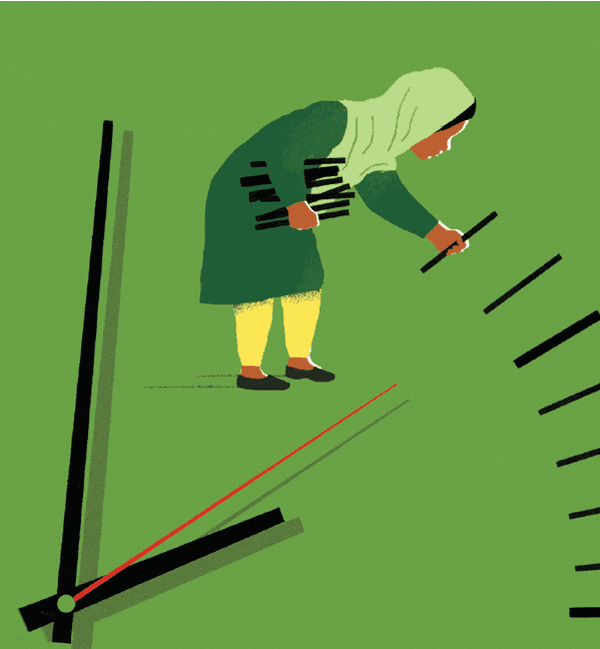 (Illustration by Justin Renteria)
A hygiene solution can save a girl from losing valuable time in school. (Over the course of three years, by our calculation, it will give a girl up to 135 days of schooling that she might otherwise miss.) Millions of girls worldwide miss classes during menstruation because they lack access to effective feminine hygiene products. In Kenya alone, according to UNESCO, half of all schoolgirls fall into that category. Data from UNESCO also highlight the benefits of removing this barrier to regular school attendance: With each additional year of education, a girl is more likely to have healthy children, more likely to earn an income, and less likely to die in childbirth.
A hygiene solution can give a woman the time that she needs to care for her family. When a woman cannot move about freely, she loses the ability to earn income. She also loses the ability to gather provisions such as firewood. According to one study, 56 percent of women in Sindh, Pakistan—many of whom engage in agricultural labor for their livelihood—report that it’s difficult for them to work outdoors during menstruation.
Equally important, a hygiene solution can help girls retain their sense of dignity. For many girls in many communities, the onset of menstruation can be scary. People in those communities don’t talk about menstruation; they regard it as a taboo subject. In a study that covered a population of girls in India, researchers found that 70 percent of that group did not know about menstruation before their first period.
The Days for Girls solution includes a health education component that aims to remove the sense of shame that often attaches to this natural part of a woman’s life. We offer training that combines information on menstruation, reproduction, and personal hygiene with information that promotes leadership. Our goal is to let girls know that they are worthy of good health and personal dignity.
A reliable feminine hygiene solution, in short, can serve to break taboos, improve access to education, and help lift communities out of poverty. When women cannot work and girls cannot go to school, a country loses half of its social, political, and economic potential. At Days for Girls, we are working to reverse that dynamic. To date, our organization has reached more than 200,000 women and girls in more than 85 countries on six continents. And we’re not done.
Designed for Reuse
The evolution of the Days for Girls hygiene kit wasn’t a straightforward process. It was only through a commitment to continuous improvement that we reached the place where we stand today. By eliciting feedback and learning from those we serve, our organization developed a solution that has helped close a crucial health gap.
Days for Girls began almost by accident. In 2008, I was working with a private foundation that provided fuel-efficient stoves to an orphanage on the outskirts of Nairobi, Kenya. Following an outbreak of political violence, the population of the orphanage suddenly swelled, and meeting the basic needs of its residents became a daily challenge. Girls who had reached puberty, my colleagues and I discovered, faced a special kind of vulnerability in this environment. Lacking access to feminine hygiene resources, they would stay in their beds and sit on pieces of cardboard for several days each month. Often they would go without food, or even water, unless someone brought it to them. We later learned that girls at the orphanage could access menstrual pads through the director of the facility—but he would provide pads only to girls who were willing to provide sex in return. Subsequently, we confirmed that a strong link between menstruation and girls’ vulnerability exists in many parts of the world.
When we first sought to address the lack of feminine hygiene options in this part of Kenya, we focused on the kind of solution that women in developed countries would typically seek: We provided disposable pads. But we quickly discovered that in areas without access to reliable waste facilities, disposable products were not a practical solution. Girls rolled up used pads and placed them in chain-link fences or hid them between roof tiles. Or they deposited them in latrines, thereby causing the latrines to clog up. In any case, using the disposable items only added to the stigma of menstruation. The use of disposable pads posed an additional challenge: If we provided funding to buy them, we had no way to ensure that the money would go toward that purpose.
A reliable feminine hygiene solution can serve to break taboos, improve access to education, and help lift communities out of poverty.
For these reasons, we shifted our efforts to the creation of a reusable product. Over the next five years, Days for Girls developed 27 iterations of a washable pad before we arrived at a design that responded to the social, cultural, and environmental needs of women and girls in our target population. Ultimately, we decided to file a patent application for the final product. (We did so partly in order to support local enterprises that manufacture Days for Girls Pads.)
Women told us that they needed a pad that would be easy to wash, that would dry quickly, and that they could care for without experiencing embarrassment. In response to their input, we created a pad that has two main components—a liner and a shield. The liner provides an absorbent layer, and the shield guards against leaks. We designed the liner to resemble a washcloth; users can fold it into three parts and fit it inside the shield (just as they would fit a letter inside an envelope). When it’s unfolded, the liner has a large surface area, so it requires less water to clean and dries more quickly than other washable pads. Because the liner doesn’t look like a traditional feminine hygiene product, women can hang it outside to dry without calling attention to it. Hanging the liner outside allows it to dry completely. That feature enables women to care for their hygiene pad even in areas without consistent access to clean water. It also helps to ensure that each pad will last up to three years.
Developed for Impact
Our goal is to ensure that women and girls in all parts of the world have access to a feminine hygiene solution that they can count on, month after month. The tagline on our website makes this point simply: “Every girl. Everywhere. Period.”
To help meet that goal, Days for Girls has built a global distribution network that includes more than 450 volunteer chapters and teams. These chapters and teams partner with local organizations to bring hygiene kits to areas where women and girls are most likely to benefit from them. Complementing this chapter-and-team system are in-country enterprises that give women an opportunity to make and sell hygiene kits in their communities. This social enterprise model has several advantages: It supports local economies (the enterprises use locally sourced materials), it provides income-generation opportunities for women, and it allows us to reach women and girls even in remote areas.
Providing an effective feminine hygiene solution can directly affect outcomes for women and girls in the areas of education, health, economic participation, and social status. A growing body of research, for example, shows a clear link between reliable menstrual hygiene and increased school attendance rates for girls. Our own monitoring and evaluation efforts highlight that link as well. We surveyed a group of girls in Uganda both before and after we distributed hygiene kits to them. Before kit distribution, 36 percent of the girls reported missing school one or more days each month. After distribution, that number dropped to 8 percent.
Measuring school attendance is relatively simple. Quantifying the broad social impact of a feminine hygiene solution is more difficult. How does access to our hygiene kits shift the way that women and girls think about their leadership abilities, or about the roles that they fill in their families and communities? We at Days for Girls are eager to collaborate with global health professionals and experienced program evaluators who can help us measure this kind of impact.
Even apart from such studies, however, we know that our work has the potential to catalyze real change for women and girls. Once, after we distributed kits at a school in Zimbabwe, we learned that one person there had trained other girls at the school in how to sew their own hygiene kits. When we came to the school to thank this person directly, a school administrator introduced her to us: “Here she is. This is Kgotso, and she’s 12 years old.” Kgotso’s parents, we learned, had passed away many years earlier. But the experience of engaging with the Days for Girls solution had changed how Kgotso viewed her place in the world. “I no longer consider myself an orphan,” she told us. “I am now a leader of women.”
Read more stories by Celeste Mergens.