


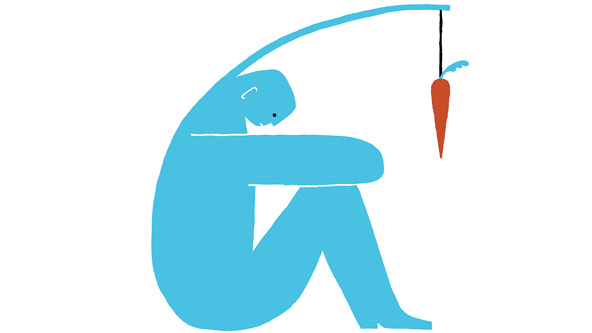
 (Illustration by Adam McCauley)
Many companies use performance-based pay to motivate their employees and attract talent. But there may be hidden costs to this policy: The added stress of pay-for-performance can lead to workers’ suffering mental health problems, a new study finds.
In a forthcoming paper, Michael S. Dahl, a professor of management at Aarhus University in Denmark, and Lamar Pierce, of the Olin Business School at Washington University in St. Louis, found that prescriptions for medication used to treat depression and anxiety went up once a company instituted pay-for-performance (P4P) compensation programs.
Firms adopt P4P often because they hope to operate more efficiently, rewarding those who work harder and are more productive, and penalizing less-productive employees and encouraging them to improve their performance. This is supposedly better for shareholders, who get more out of their compensation-expense dollar. But it can be worse for individual employees who are vulnerable, and increases in workplace anxiety and depression can exact added productivity and health-care costs on the company.
“Although we cannot claim a causal relationship, collectively our results suggest a model where performance-based pay forces many employees to choose between leaving or else depression and anxiety,” the researchers write.
Dahl and Pierce looked at a data set of 1,309 firms in Denmark that employed 318,717 people. They examined records on the workers’ pay and demographics, as well as what drugs they were being prescribed. By comparing the periods before and after a firm started compensating employees based on performance measures, they found an increase of 4-6 percent in the amount of prescriptions employees received to treat depression and anxiety. The most pronounced effects were among older employees and those with below-average performance.
“What this suggests is that implementing a pay-for-performance system is going to generate mental health problems in some portion of the population,” Pierce says.
The study also found a P4P effect on whether workers choose to stay with a firm or quit. When a firm launches a P4P compensation system, employees who receive poor evaluations—and thus lower pay—tend to leave the firm, the study finds. Such departures can also be exacerbated by those employees concerned about their mental health who also choose to leave rather than work under a system that may worsen their depression or anxiety. This exiting effect is more pronounced for women than for men.
The phenomenon of workers leaving a firm because they want to avoid its compensation system produces a logical sorting effect, Pierce says. People who have labor mobility will choose to “sort out” of a firm if working there will make them anxious about their ability to earn money. Older workers—those older than 50—have less labor mobility and are therefore less likely to leave.
When firms adopt pay-for-performance, the average wage of the workforce rises, as does the variance in what people get paid. This inequality can lead to feelings of inadequacy and competitive failure. “It appears that the people who have the most negative change in wages are the ones who are most likely to develop mental health issues, so some of this is tied to their wage change,” Pierce says.
The effect of the pay change on workers’ mental health could be stronger than the study shows, Pierce says. Because the study looks at prescriptions, it misses workers who have minor cases of depression or anxiety but don’t receive medication.
“You may get some really good benefits out of this,” Pierce says of pay-for-performance, “but you’re likely to raise stress levels.”
“This does suggest that pay-for-performance is a shock to the system that’s causing stress, anxiety, and social-comparison effects,” says Todd Zenger, Presidential Professor of Strategy and Strategic Leadership at the University of Utah’s David Eccles School of Business.
One problem Zenger sees in his own research, he says, is that employees overwhelmingly tend to have an inflated sense of how well they perform at work. Bursting this bubble of self-delusion by paying them according to how they actually perform could make them unhappy or even cause them to switch jobs.
“Pay-for-performance has an effect on people’s psychological well-being because it tells them [their self-conception] is not true,” he says.
Michael S. Dahl and Lamar Pierce, “Pay-for-Performance and Employee Mental Health: Large Sample Evidence Using Employee Prescription Drug Usage,” Academy of Management Discoveries, forthcoming.
Read more stories by Chana R. Schoenberger.