


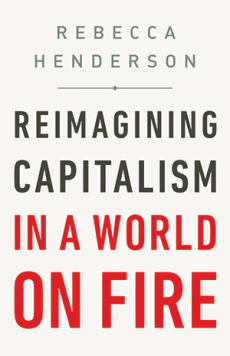
Reimagining Capitalism in a World on Fire
Rebecca Henderson
336 pages, PublicAffairs, 2020
A certain schizophrenia has lately taken hold in the field of social impact when it comes to capitalism. On one hand, impact investors, social entrepreneurs, and corporate leaders are increasingly embracing the power of profit to find and scale solutions to the world’s problems. At the same time, others have proclaimed capitalism an irredeemable failure based on its environmental destruction, oppressive and underpaid jobs, racial and gender biases, and production of massive economic inequality. The massive global disruption caused by the COVID-19 pandemic has further exacerbated the disagreement, highlighting the fragility and merciless inequities of capitalism.
Rebecca Henderson enters this debate with her new book, Reimagining Capitalism in a World on Fire. In engaging and refreshingly candid writing, Henderson sets out her vision of equitable and sustainable capitalism and enumerates the changes needed to get us there. Companies need to embrace a sense of purpose beyond maximizing profits, find new business opportunities to meet society’s needs, and consider the welfare of all stakeholders. Investors need to focus on the long term and consider social and environmental impact. Governments need to regulate the market more strictly and impose a tax on carbon. Finally, all sectors need to work together to address global challenges through collective action. Not only would these changes create a better world, Henderson asserts, but also they would lead to more profitable companies and a stronger economy.
Her blueprint may sound impossible, yet Henderson’s optimism is founded on deep expertise as a scholar who has worked closely with corporate leaders. A highly distinguished professor at Harvard Business School (HBS) and a longtime consultant to global corporation CEOs, Henderson brings a thorough understanding of the way corporations, investors, and our capitalist system operate. Her MBA course on “Reimagining Capitalism” (developed with her colleague, George Serafeim) inspired this book.
There is considerable evidence that the changes Henderson proposes are already beginning to emerge. Larry Fink, CEO of multinational investment management corporation BlackRock, the largest stockholder in the world, has been insisting that companies must have a purpose beyond making a profit. Many companies have embraced the idea of creating shared value by pursuing competitive strategies based on social impact (an approach initially described by my colleague HBS professor Michael Porter and me in a 2011 Harvard Business Review article). There is growing momentum for investors and corporate leaders to focus on long-term performance. Collective impact initiatives and public-private partnerships are increasingly common.
But if all these recommendations are good for business, why do so many companies strenuously resist change? Henderson’s early work is relevant, here. She is an expert on how companies confront radical change. For example, why did Kodak, which was the first to invent digital photography, end up in bankruptcy? Or how did Nokia, which produced more than half of the cell phones in the world, get blindsided by Apple?
Henderson’s answer distinguishes between incremental innovation, which is easy, and architectural innovation, which requires profoundly rethinking the relationships among components within the system. Kodak could build a better camera but could never grasp the idea that a camera might become part of a phone, which made almost all of the company’s operations obsolete. In the face of day-to-day pressures, no one has time to reimagine an entire company. It is difficult even to see what changes would be required, as architectural knowledge becomes deeply and invisibly embedded in the company’s structure.
Architectural innovation sounds a lot like what we in the social sector have been calling “systems change.” In fact, one way to describe this book is as a comprehensive systems change approach to remaking capitalism from “destroying the world and the social fabric in service of a quick buck,” as Henderson writes, to “building prosperity and freedom in the context of a livable planet and a healthy society.”
Skeptics of capitalism will identify with Henderson’s sharp criticism, while supporters will appreciate the future vision she paints of a noble and more constructive capitalism. The book’s promise is to move beyond the shallow and reductive debates about whether capitalism is good or evil to a deeper discussion of what it would take to redirect its undeniable power toward equity and sustainability. After all, capitalism has lifted more than a billion people out of extreme poverty and brought technologies that would have been unimaginable a century ago. If there is a way to harness this beast in service of a better world, it is surely worth the attempt.
Unlike other recent critiques of capitalism, such as Anand Giridharadas’ Winners Take All, Henderson focuses on the solutions. Drawing from the HBS case method, she teaches through complex real-life stories. She does not promise that the solution will be easy or even achievable, and not all stories have a happy ending. Yet, even if the transformation we need is neither easy nor certain, it is still extremely helpful to give us a clear vision of the interdependent changes that would align companies, investors, activists, and government in service of an equitable and sustainable capitalism. It is hard to aim for a goal without knowing what it looks like.
Henderson sees climate change, extreme wealth inequality, and the crumbling of the institutions of family, faith, and government as the world’s three greatest challenges. Global capitalism has “gone off the rails,” she contends, and shareholder primacy has reached a point where “many of the world’s companies believe that it is their moral duty to do nothing for the public good.”
Henderson explains the fallacious reasoning that led us into this trap: why CEOs are mistaken to think their only responsibility is maximizing shareholder wealth, what motivates investment managers to focus on the short term, and how campaigns by the elite to free themselves from taxes and their companies from regulation have destroyed our faith in government.
Henderson sees climate change, wealth inequality, and the crumbling of the institutions of family, faith, and goverment as the greatest challenges.
Achieving equitable and sustainable capitalism requires five changes, and most of the book is devoted to showing by example how those changes could happen and, to a degree, already are happening. First, companies can create shared value by pursuing business models that simultaneously create value for the business and for society. Innovative companies that have rethought their strategies to create positive social and environmental outcomes actually do better than those stuck in more conventional approaches.
So, too, “high road” companies that trust employees, pay well, provide benefits, and offer autonomy and opportunities for advancement are more profitable than “low road” companies that treat employees as faceless cogs in a machine, prescribe their every move, and pay the minimum.
Why don’t all companies create shared value and pick the high road? Are we just too mired in our old-fashioned thinking to recognize the opportunity, just as Kodak was unable to switch to phone cameras?
The answer, and Henderson’s second proposition, is that the only companies that are able to make such radical architectural change are those that have committed to a purpose beyond profit. It is that sense of purpose that gives corporate leaders the vision and courage to make systemic changes. Committing to a corporate purpose, Henderson asserts, is itself an architectural change.
Third is rewiring finance, which requires that our financial accounting systems include social and environmental metrics, that impact investing continue its growth, and that company management be more insulated from short-term investor pressure.
It may seem impossible to change investor behavior, but Henderson points out that the concentration of investment power is so great—the 15 largest investment managers together direct half the world’s wealth—that a handful of people could change global investing practices overnight.
Fourth is building cooperation, because no single company can address the world’s challenges alone. Industry consortia can create solutions, such as Unilever’s efforts to unite consumer goods companies to combat deforestation from palm oil production. But Henderson is candid about the limitations of such self-regulation, and the palm oil fight has had mixed results. Self-regulation only works when the benefits are clear to all, participants are committed for the long term, and cheaters are punished.
Finally, these problems cannot be solved without government. Inclusive models of government that are democratic and prioritize citizens’ well-being create greater prosperity and stronger economic growth than do extractive models, where government functions only in the interests of the elite. Henderson uses the admittedly homogeneous examples of Denmark and Germany to make this point, but also adds Mauritius. The island had a highly diverse society and a history of slavery, but after riots overthrew the extractive regime, an inclusive model of governance has led to decades of strong economic growth, reduced income inequality, and a poverty rate that fell from 40 percent to 11 percent.
Can these five elements of a reimagined capitalism really take hold in the world we have today? Sometimes the case studies suggest that all we need is a leader with clear vision to step in and take charge. In most examples, however, a crisis of some kind triggered the change—such as a personal tragedy, a financial downturn, a spectacular Greenpeace protest, or, in the particular case of Mauritius, a revolution. Even then, the transition sometimes took 5 or 10 years.
If crisis is needed to trigger a fundamental reform of capitalism, might the coronavirus be the catalyst? The pandemic certainly demonstrates the essential role of government and collective action to sustain capitalism. If corporate leaders and investors ever fooled themselves into thinking that their success did not depend on the well-being of society, their mistake is now plain to see. It would be hopeful to think that the dreaded toll the virus is taking on human life could lead to a fundamental reshaping of capitalism along the lines that Henderson suggests. If the global economy remains moribund, it might actually give rise to renewed faith in government and a more beneficial version of capitalism. Conversely, if this disaster is not enough, it is truly frightening to think about the crisis that might be necessary.
But a crisis alone isn’t enough; we also need to be inspired, and Henderson’s vision is so compelling that the reader is drawn to help bring it about. The final chapter, “Pebbles in an Avalanche,” offers six simple things that each of us can do to contribute to the effort: discover your own purpose; collaborate with those who share your goals; bring your values to work; work for an NGO to shame companies into action or for an impact investor to finance change; and remember that you can’t change the world by yourself. You can only do your part. I’m trying to follow her advice myself, promoting the changes she outlines among companies and investors through my work at FSG and HBS. Those changes can’t come soon enough.