


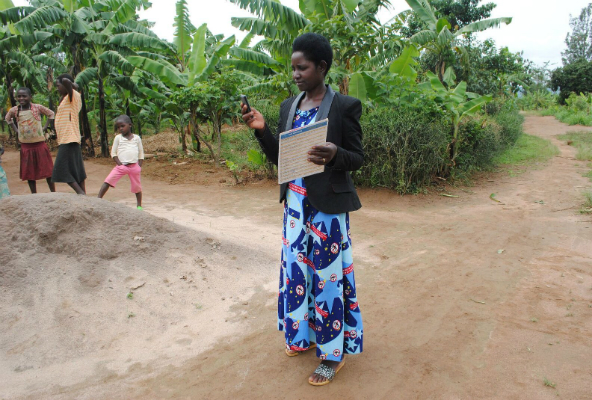
 Liberate Musabyimana, a community
health worker, offers advice
and care to people in the
Rwandan village of Gatare. (Photograph by Amy Yee)
Liberate Musabyimana, a community
health worker, offers advice
and care to people in the
Rwandan village of Gatare. (Photograph by Amy Yee)
In Gatare, a rural village in eastern Rwanda, Liberata Musabyimana stands out. She wears a distinctive uniform: a long, brightly colored dress patterned with anti-malaria slogans. She is one of 45,000 government-sponsored community health workers who serve the villages and towns of this East African country.
Musabyimana, a 35-year-old mother of two, is a primary school graduate. A village committee elected her to become a health worker, and the Rwandan government then trained her to provide basic care. Among other services, she can offer prenatal care, recognize the symptoms of malaria and tuberculosis, and refer people with serious illnesses to clinics and hospitals.
Health workers like Musabyimana play a central role in a health-care system that features a national insurance program—Mutuelles de Santé—that is a model of its kind. Through the program, even the poorest Rwandans can get professional medical care. In fact, Musabyimana herself was able to deliver her children in a hospital only because of her enrollment in the insurance plan. Not long ago, home delivery of babies was the norm in rural Rwanda. Hospital delivery, for people in villages like Gatare, was prohibitively expensive. Now, under Mutuelles de Santé, giving birth in a hospital costs just 400 Rwandan francs (about 53 cents); without insurance, it costs 4,000 francs (about $5.30).
The Rwandan government relies on frontline health workers to raise awareness of Mutuelles de Santé and to direct people to medical facilities where they can obtain services covered by the plan. For Musabyimana, helping people in her village to join and use the insurance program is a core part of her mission. “When you have easy access to health care, you don’t die at home,” she says.
Today, more than 90 percent of Rwandans have health insurance coverage. Mutuelles de Santé covers 81 percent of the country’s 11.2 million people, and about 10 percent of the population receives coverage from programs that serve government workers and military personnel. That coverage rate is by far the highest in Africa. And it is especially impressive for a country like Rwanda, where the per capita income is equivalent to less than $700 per year.
Musabyimana recalls the case of a pregnant woman who needed a cesarean section. The woman, who had coverage under Mutuelles de Santé, went to a hospital and delivered her baby safely. She paid 18,000 francs for the procedure. For a patient without insurance, the surgery would have cost 180,000 francs. “If she did not have insurance, she wouldn’t go to the hospital,” Musabyimana says. Under the insurance plan, patients can visit a doctor for about 225 francs per visit, and they pay only 10 percent of a hospital bill.
Mutuelles de Santé has played a vital role in transforming Rwanda from a tragic disaster into an unlikely public health success story. In 1994, genocide broke out in Rwanda and killed an estimated 1 million people, including 300,000 children. One year later, the country had the world’s highest maternal mortality rate. Yet over the past two decades, it has made great improvements on this front: Between 1990 and 2013, the rate of death among new mothers plunged by 77 percent. Indeed, Rwanda was one of only four countries in Africa to meet the United Nations Millennium Development Goal to reduce maternal mortality by two-thirds or more by 2015.
Treating a Nation
In the aftermath of the 1994 genocide, international aid flooded into Rwanda, and much of that support went toward providing health services. But aid agencies withdrew from the country over the next two years, and access to care deteriorated. In 2000, Paul Kagame became president of Rwanda and took steps to overhaul the country’s health services. His government opened clinics, trained medical personnel, and boosted the number of community health workers.
Kagame is a controversial figure. Critics accuse him of stifling opposition, and the health statistics issued by his administration may be exaggerated. But public health experts credit his careful use of donor money with revitalizing health care in Rwanda. “He didn’t tolerate corruption,” says Alex Coutinho, executive director in Rwanda for Partners in Health, a Boston-based nonprofit that has worked in the country since 2005. “The government is very disciplined.”
Yet few Rwandans were able to use the expanded government health facilities. “People were deterred from using health services because of cost,” says Jean-Olivier Schmidt, who leads health and social protection programs at the German aid agency GiZ. The government facilities charged fees that most citizens couldn’t afford. To pay those fees, people “had to sell livestock or land or to borrow money,” Schmidt says.
The challenge of affordability led government officials and their funding partners to explore the idea of offering health insurance. Back in 1999, the Rwandan Health Ministry had launched a health insurance pilot in a single district with help from international aid agencies such as GiZ and the World Bank. To many Rwandans, the health insurance model was unfamiliar. Schmidt recalls that some people expected to get a refund on their premium if they stayed healthy during the coverage period. But eventually people embraced the model. “We explained risk pooling—that it’s better to pay in advance. Then they understood,” says Schmidt, who served as an adviser to the Health Ministry at that time.
In 2005, the Rwandan government expanded Mutuelles de Santé to the entire country. Several factors enabled broad implementation of the program to succeed. “Good governance at both central and district levels was key,” says Osian Jones, senior fund portfolio manager for Rwanda at the Global Fund to Fight AIDS, Tuberculosis and Malaria, which helps fund Mutuelles de Santé. Schmidt recounts the story of a top Health Ministry official who would immediately call or visit local officials if she heard about any problems in their district that might “tarnish” the insurance program. “She took a personal interest,” Schmidt says.
The role played by community health workers like Musabyimana was equally important. Their “ability to mobilize and educate the population about the benefits of subscribing to [Mutuelles de Santé] undoubtedly contributed to its success,” says Jones.
Conditions in Rwanda also made it feasible to roll out Mutuelles de Santé as a nationwide program. The country is geographically small, it has the highest population density of any nation in Africa, and it has fairly good infrastructure. So community health workers can reach villages and patients can reach health facilities with relative ease. “From one hilltop, you can practically see the next [clinic],” says Schmidt.
Enrollment in Mutuelles de Santé rose steadily for several years, but then it reached a plateau. In 2011, the government introduced a new payment system that aimed to make the plan accessible to more people. Previously, all subscribers paid an annual premium of about 1,500 francs. Under the revised system, people pay on a sliding scale that varies by income. The poorest segment of the population receives coverage for free, whereas people at higher income levels pay 3,000 francs to 7,000 francs annually to subscribe to the plan. International donors subsidize the provision of the free coverage to poor citizens.
Insuring the Future
Donor support remains critical to sustaining Mutuelles de Santé. As of 2014, annual income for the program came to about $38 million, and premiums made up only a portion of that sum. “Today, [the program] wouldn’t pay for itself,” says Erica Barks-Ruggles, US ambassador to Rwanda. Yet donors overall, including the US government, have gradually been lowering their level of aid to Rwanda.
So the country will need to find other ways to fund health services. Rwandan officials are exploring options that include targeting the medical tourism market and creating social markets for health products such as mosquito nets. Raising revenue through taxes on tobacco, alcohol, and processed food is also under consideration.
Another challenge in managing Mutuelles de Santé is that Rwandans’ health needs are growing more complex. Their country has made substantial gains in combating ailments associated with poverty, from malaria and tuberculosis to pneumonia and childhood diarrhea. But as basic health improves, more and more people suffer from disease that are harder and more expensive to treat, such as cancer and heart disease. Two decades ago, life expectancy in Rwanda was 42; today it’s 66. “Growing old is success,” Coutinho says. “Now Rwanda faces noncommunicable diseases, degenerative diseases, mental health issues. And the population expects a higher standard [for health care].”
Thanks to assistance from international donors, Rwanda is developing the means to provide advanced forms of care. In 2011, Partners in Health spearheaded the establishment of Butaro Hospital, a 150-bed facility in the mountains of northern Rwanda. A year later, the hospital opened a cancer treatment center—one of the few centers of its kind in East Africa. That unit provides services to poor Rwandans for free.
Many Rwandans, however, continue to receive life-saving health care through simpler means. In Mushishira, a village in central Rwanda, Rubarura Theoneste walks down a red dirt road lined with banana trees. He wears a colorful collared shirt that is the uniform for male community health workers. Like Musabyimana’s dress, the shirt is patterned with anti-malaria slogans. A few months earlier, he diagnosed a 19-year-old villager named Ernestine Ituze with tuberculosis. Because she has health insurance through Mutuelles de Santé, Ituze received free treatment for that condition. It wasn’t the first time that Theoneste had helped the young woman. In 2009, he diagnosed her with malaria and sent her to get treatment at a local clinic.
Theoneste, a 40-year-old farmer with a primary school education, spends about two hours each day attending to the health needs of people in his village. He says that he became a community health worker because he “wanted to save lives.” He feels “satisfied” by knowing that patients like Ituze are doing well.
As Theoneste walks down the dirt road, a fine rain begins to fall over the lush landscape. But even in the rain, passing villagers—young and old, men and women—all stop and take a moment to greet him warmly.
Read more stories by Amy Yee.