


 (Illustration by Lucy Jones)
Philanthropists and social investors recognize that systems change is necessary to address a range of social problems. Initiatives aimed at individuals and implemented in a piecemeal fashion have repeatedly come up short. By seeking to address specific problems—or even particular aspects of specific problems—at the level of the individual, these initiatives ignore the underlying drivers responsible for the problems.
Efforts to improve safety, education, health, and work prospects depend on improving the social system—and this system can differ neighborhood by neighborhood, as economist Raj Chetty and others have shown. Moreover, such systems are complex and their problems resist quick and easy solutions. “System work seeks to address social problems by making substantive and lasting changes to the system in which the problems are embedded,” writes Christian Seelos, systems theorist and director of the Global Innovation for Impact Lab at the Stanford Center on Philanthropy and Civil Society. “Doing such work requires thinking about causal architecture.” 1
One of the main drivers at work in such causal architecture is relationships. They forge an interrelated and mutually reinforcing cycle that affects a person’s ability to manage or take advantage of his or her challenges and opportunities. For example, can this person find help looking for a job? Does she have access to a mentor who can help her complete school and go to college? Do the norms in her neighborhood promote long-term relationships and marriage? The answers to such questions shape lives.
Most nonprofits operate in sector silos and focus on one social issue, considering any work on the underlying social dynamic beyond their scope of responsibilities. But a handful of organizations seek to reform underlying architectures by addressing the web of relationships neighborhood by neighborhood. They begin with the assumption that individual well-being and social outcomes depend on a foundation of healthy, place-based relationships, and they seek to build up social capital step by step as a prerequisite for efforts to improve housing, education, and health.
Community Renewal International (CRI) and BakerRipley (formerly known as Neighborhood Centers) see the connections between people as each neighborhood’s most critical asset. By identifying, empowering, and connecting a network of local leaders across a neighborhood and linking them to leaders elsewhere, they build new models of behavior, new connections to opportunity, and capacities for collective action that previously did not exist. Such efforts establish a stronger social foundation that is valuable in itself and essential for addressing other social problems. “People are not the problem, people are the asset,” Angela Blanchard, former head of BakerRipley, writes. “Community development is about unlocking that asset, releasing people’s potential to move forward together.” 2
Systems thinking can be invaluable in this effort. But we need a different approach than the one most organizations use. If social systems are based on relationships—and the institutions, trust, and norms that drive them—only solutions that address social systems at this foundational level are likely to prove effective. This insight requires shifting goals, changing priorities, and thinking much more holistically about context and how change comes about—and stepping back from a focus on short-term, quantitative achievements. It also requires faith in the process. Are we prepared to take the leap?
Social Capital
In recent years, interest in social capital has grown among academics, philanthropists, and policy makers. Political scientist Robert Putnam, who did much to popularize the concept, warns in his 2000 book, Bowling Alone, “Our stock of social capital—the very fabric of our connections with each other—has plummeted, impoverishing our lives and communities.” Scholars, journalists, and other commentators have linked seemingly disparate phenomena to declining social connectedness—from the rise in mortality rates from suicide, alcohol, and drug overdoses to the decline in social mobility to the rise of former president Donald Trump. As journalist Timothy Carney writes in his 2019 book, Alienated America, Trump supporters were the “unattached, unconnected, dispossessed,” in sharp contrast with the idealism, engagement, and cohesion that were much more common at the rallies of other presidential candidates.3
Social capital is not as well established as its cousins financial capital and human capital, and the definitions commentators use for it are inconsistent and often vague. Although it is often considered a source of help for people in need—in Chetty’s words, “where someone else might help you out if you’re not doing well” 4—social capital is much more than a safety net. At the individual level, relationships, trust, and shared expectations make everything, from finding a job to getting married to staying healthy to conducting business, easier. On a larger scale, political scientists Bo Rothstein and Dietlind Stolle conclude that social capital produces “well-performing democratic institutions, personal happiness, optimism and tolerance, economic growth, and democratic stability.” 5
Social capital may be best thought of as inhering in relationships themselves—as Carrie Leana described in her 2011 article on its role in school reform in Stanford Social Innovation Review.6 It must be built by more than one person and is most valuable when it is a product of permanent associations or a set of overlapping, linked, and mutually reinforcing social ties. This perspective explains why social institutions—such as families, churches, bowling leagues, schools, and unions—and neighborhoods matter so much to social capital’s creation, maintenance, and impact. Friendships and informal social networks also produce social capital, but their heterodox and less institutionalized nature lowers their capacity and influence. Indeed, weak but structured social ties may be of greater value to social capital than strong, unstructured relationships, at least when it comes to large groups of people (any individual can be an exception).7
Of course, not all networks are constructive. Organized crime and drug gangs depend on strong social ties and mechanisms to achieve their aims—a form of social capital used for negative purposes. Social connections can also be used by elites to maintain their positions, perpetuating inequality. Social norms can constrain certain freedoms. Distinguishing between bonding social capital, based on in-group relationships, and bridging social capital, which connects people across groups, can help identify and address divisions in a given population.
Collective Efficacy
Sociologist Robert Sampson’s 2011 work, Great American City: Chicago and the Enduring Neighborhood Effect, offers perhaps the most comprehensive attempt to methodologically appraise social capital in neighborhoods. In it, he argues that each neighborhood has more or less collective efficacy to exercise control, extract resources from the government, and meet the day-to-day needs of residents. The concept of collective efficacy is similar to social capital but used mostly by scholars, and so is less well known. While collective efficacy does not incorporate every possible source of social capital, it offers a useful proxy to assess dynamics at the neighborhood level. Collective efficacy measures social cohesion (the “collective” part of the equation) and shared expectations for control (the “efficacy” part).8 Collective efficacy, Sampson writes, is a product of “repeated interactions, observations of interactions, and awareness of potential interactions that … establish shared norms (a sense of the ‘we’) beyond the strong ties among friends and kin.” As such, intimate ties matter less than trust and shared expectations.9
According to Sampson’s research, a number of factors strengthen or weaken collective efficacy. They include socioeconomic resources (or level of concentrated deprivation), residential stability, spatial interdependence, reputation, organizational infrastructure, involvement in voluntary activities, identity, and cohesiveness of leadership.10 Sampson describes how “a communality that stands out beyond residential stability in housing and socioeconomic resources is durable organizational density (or capacity) combined with a strong community identity and commitment to place.”
Although collective efficacy can change, it is relatively stable over time even as residents move into and out of a neighborhood because of a “reciprocal feedback loop” 11—relationships affect institutions, which affect norms, which in turn affect relationships, and so forth into the future. What happens today shapes the social ecology and even culture that shapes what happens tomorrow.12
Collective efficacy directly influences rates of crime in a neighborhood, according to data Sampson cites. It is also linked to a wide range of health indicators, such as birth weight, teen pregnancy, rates of asthma, and heat-wave deaths, as well as self-reported health. One study even argues that it reduces domestic violence by increasing the risk of disclosure. Collective efficacy also partly mediates for negative characteristics, such as concentrated poverty and residential instability. But while it suppresses violence, collective efficacy can also be undermined by it: Higher levels of violence today mean less efficacy in the future because it reduces cohesion and lowers expectations.13 These results have been reproduced in a wide range of settings.14
The wealth of “organizational life”—the various formal and informal institutions and neighborhood activities that bring people together around joint activities—is especially important, because it undergirds the informal social control and shared expectations that make up collective efficacy. Much of organizational life is unofficial, such as neighborhood watch groups, residential associations, and weekly children’s activities.15 These groups and activities, according to Sampson, “generate a web of ‘mundane’ routines that lubricate collective life, although seldom planned as such.” 16
Differences in collective efficacy can generate wildly unequal outcomes. For example, during a 1995 heat wave in Chicago, North Lawndale saw more than six times as many people die as South Lawndale, even though the two places were socioeconomically similar. In Heat Wave: A Social Autopsy of Disaster in Chicago, sociologist Eric Klinenberg blames “a number of surprising and unsettling forms of social breakdown” that allowed people to “die behind locked doors and sealed windows, out of contact with friends, family, community groups, and public agencies.” Comparing various neighborhoods and ethnic groups, Klinenberg concludes that places with more commercial life in the streets, more vibrant public spaces, and higher population density fared better because of their stronger social ties.17
The efficacy of any individual neighborhood affects surrounding neighborhoods through a series of spillover effects. Crime and other antisocial norms, for example, are not easily contained in a specific locale, contributing to a spreading set of concentrated disadvantages, spatial risks, and vulnerability—and reducing the chance of a turnaround. Given that majority-white neighborhoods with low efficacy are more likely to be situated near neighborhoods with high efficacy, and majority-black (and, to a lesser extent, majority-Latino) neighborhoods with high efficacy are often nearer neighborhoods with low efficacy, the latter are more spatially vulnerable, even when the former are socially disadvantaged and the latter have high levels of collective efficacy and middle-class incomes.18
Three Tiers of Renewal
While Sampson’s work highlights the ingredients that build collective efficacy, it says little about how it can be systematically built. If collective efficacy can help us assess dynamics in a neighborhood, then the broader concept of social capital—lessons from systems thinking—can help us move forward. Very few organizations see it as their raison d’être to renovate relationships in such a way that the social capital of an area or neighborhood or community is significantly enhanced. As Anne Snyder, a former director at the Philanthropy Roundtable, comments, “The message of studies like Robert Putnam’s Bowling Alone is that social capital just grows up naturally and is hard to replace once stripped away.” 19
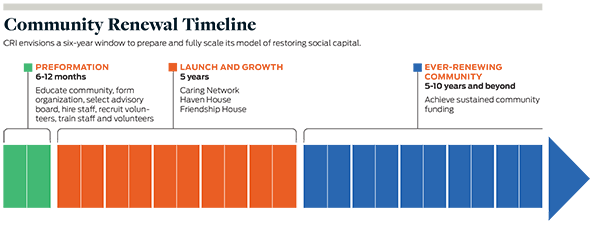
A few organizations are working to fill this gap by making the growth of social capital the central pillar of their work. Among these, CRI is arguably the most systematic. Over several decades, it has gradually crafted a unique model based on what it learned firsthand in local communities around Shreveport, Louisiana. Today, the organization uses a three-tier structure to refashion relationships at the micro, meso, and macro levels across streets, neighborhoods, and whole cities, based on what it calls Haven Houses, Friendship Houses, and a Renewal Team.
CRI’s decentralized structure ensures that the focal points are very local and that the initiatives come from the bottom up.
Haven Houses are established around a small number of individual blocks, building a coordinated neighborhood network that works to strengthen and restore relationships. In each area, a block leader (there are 1,500 volunteers so far) is trained to reach out and develop friendships with neighbors; his or her home is designated as a Haven House. Block leaders organize community events, help the sick, and counsel those in need, performing “intentional acts of kindness” with the goal of “remaking their city by making friends on their street—one neighbor at a time.” CRI staff encourage and support their efforts, sharing best practices, helping them solve problems, and connecting them to other CRI networks across the city.
Friendship Houses work on a larger, 30-block neighborhood of 1,500-2,000 people. Constructed in the areas with the highest levels of poverty and crime and hosting a paid, live-in staff member and his or her family, these centers focus on building trusting, caring, nurturing relationships across their area and then using the new social context to enhance the health care, education, housing, and work of residents. A long-term commitment is essential; the average length of service is currently an impressive 13 years. The Friendship House is designed to include a large, open community room, front porch, and playground, and to be used for tutoring, family counseling, mentoring, character-building activities, life-skills programs, and conflict-resolution assistance.
The Renewal Team, which so far has enlisted more than 50,000 volunteers in metropolitan Shreveport and Bossier City, seeks to change norms of caring throughout the city. In their front yards, team members plant “We Care” signs—evident all across the city—in order to make visible the silent majority who want to care about others but feel too intimidated or shy to do so normally. They are encouraged to become more proactive and to make connections with one another, as well as to encourage other individuals, faith groups, businesses, and schools to do more for their communities. Over time, a series of organic networks emerges, forging new friendships and developing new activities to bring associational life to places where it was previously limited.
Each of the levels, which complement and reinforce each other, create mediating structures designed specifically to nurture healthy relationships. They encourage caring and trusting norms, promote mutually beneficial relationships, and discourage unconstructive behavior—building social capital and collective efficacy in the process. As CRI’s founder, Mack McCarter, says, “Relationships wither if they are not nourished” in this fashion. CRI also supplements existing mediating structures (or institutions) in society—some formal, like families, churches, and schools, others informal, like neighborhoods, informal associations, and the media—that are less effective today than in the past.
CRI’s decentralized structure ensures that the focal points are very local—usually centered on a few dozen households—and that initiative comes from the bottom up, giving people a sense of responsibility and ownership. The goal is to ensure that enough people in any neighborhood act intentionally to treat others more positively and cooperatively, improving and, where necessary, reversing the ratio of caring to uncaring behavior.
While its focus is always on strengthening social capacities and building a network of leaders who can model new behavioral norms, CRI also offers a variety of services. For example, it partners with some 200 organizations to help adults get their GED and search for work, improve preventive health care, and upgrade housing stock. But it provides these services after or in conjunction with the fundamental transformation of relationships and investments in social capital. The organization—through its “We Care” network—has even partnered with a local primary school in order to transform the relationships in and around it.
By bringing the Shreveport area closer together, neighborhood by neighborhood, CRI seeks to “revillagize the city.” Revillagizing means encouraging each locale to mold its identity and tell its history through a series of activities among residents. The effort generates centrifugal forces that help draw neighbors together and counter the various pressures in contemporary society that work to draw them apart. Such change is important in even the wealthiest areas because associational life in these places has also withered, leaving residents more isolated and unhappy than in the past.
Much of this effort echoes Sampson’s conclusions about the importance of a rich organizational life. CRI’s multidimensional set of activities fosters such culture in a way that a typical nonprofit, focused on specific services and removed from the immediacy of the streets where people live, cannot. In addition, by building pride in and a sense of identity around people’s neighborhoods, fostering residential stability, improving an area’s reputation, encouraging volunteering, reducing spatial isolation, and strengthening leadership and ties both between leaders and with others in the urban area, the endeavor affects the great majority of factors that he cites as important to collective efficacy.
The complete system—consisting of two Friendship Houses, at least a dozen Haven House leaders, and more than 50 “We Care” households—is saved for the 30-block neighborhoods that have the greatest need. Each was originally high-crime and impoverished. The Friendship Houses become anchors in neighborhoods that previously had none (better-off areas have such anchors, even if those anchors are relatively inactive). Ten Friendship Houses now exist in five different neighborhoods across greater Shreveport (including Bossier City), an area with more than 300,000 people. CRI’s goal is to have 60 Friendship Houses initiating, developing, and sustaining “safe and caring communities” across 15 neighborhoods (four houses per neighborhood).
These five neighborhoods have seen major drops in crime, gang membership, and drug use and marked improvements in educational trajectories, housing quality, job opportunities, property prices, and satisfaction. Significantly less conflict occurs on the streets and in the homes, yielding better family dynamics. In Allendale, a neighborhood west of downtown Shreveport, major crime has declined by three-fifths over the two decades that CRI has been engaged in the neighborhood (the Friendship Houses opened in 2002); drug dealers are gone, while former gang leaders are now block leaders. Children who used to avoid the streets can now play in them. Residents who used to avoid neighbors now reach out to them.
Replicating the Model
A number of organizations have bought into CRI’s three-tiered approach and replicated its model in other parts of the country. While impoverished neighborhoods have the most obvious need, these organizations—like CRI itself—believe that its model addresses a broader problem; many well-off areas also have far less social capital than they did a few generations ago.
Shawnee, Oklahoma, is the site of the most advanced replication effort. After the Shawnee Economic Development Foundation searched for ideas to address growing social isolation and fragility in the community and presented its findings, the Avedis Foundation, a local philanthropy dedicated to the health and well-being of the region’s residents, provided the seed capital to establish Community Renewal of Pottawatomie County (CRPC). CRPC is an independent initiative covering a region of 70,000 people. Dedicated to “helping neighbors restore their communities through intentional relationships,” CRPC uses the CRI model, even extending it into schools to ensure that youth will grow up immersed in the culture it is building.
Like CRI in Shreveport/Bossier, CRPC has an extensive neighborhood network composed of “We Care” members (more than one-tenth of the total population) and block leaders (what CRI calls Haven Houses), as well as Friendship Houses, in the areas most in need of support. The goal, the organization says in an overview presentation, is to “recalibrate the culture of our city and county towards connection and care” by identifying “caring people,” connecting them to one another, and then equipping them with the tools to nurture “healthy, caring relationships” neighborhood by neighborhood—yielding more social capital and collective efficacy in the process. The idea is to systematically nurture a culture that can extend “across political, racial, and socioeconomic divides to produce a domino effect that reduces crime, increases economic opportunity, and lowers loneliness and isolation.”
The Friendship Houses direct the relational work to where it is most needed and provide a wide range of services to neighborhood members. They hold after-school and GED programs and parenting classes, organize community gatherings, provide a community space and garden, and partner with a wide variety of organizations to bring resources and assistance to those most in need.
A close partnership with the local school district enables CRPC to infuse school campuses, from preschool through 12th grade, with CRI principles. For example, deserving students, teachers, and staff are awarded special “Caught You Caring” cards by their peers and then celebrated publicly. The curriculum incorporates “We Care”-centered character development, including grade- and subject-appropriate assignments. Trained mentors help those struggling in the classroom because of their difficult social contexts at home. CRPC tackles absenteeism through a daily class focused on life skills. Lastly, a leadership development program uses clubs and mentors to nurture civic engagement. In middle and high school, for example, Locker Leaders learn to be good neighbors by caring for the five peers whose lockers are nearest theirs (paralleling what block leaders do).
CRPC works with an external evaluation expert to measure its success. Metrics for each program are carefully tracked (e.g., individuals taking leadership roles, block gatherings organized, students involved in school programs). Surveys measure five competencies—self-awareness, self-management, social awareness, relationship skills, and responsible decision-making—as well as levels of trust, satisfaction, and hope, in order to track social-emotional skills and relational health. The expert then compares these results with crime and other quality-of-life indicators to qualify correlations.
Lead For America, a rapidly growing nonprofit based in Dodge City, Kansas, is also incorporating the CRI model into its programming. The organization selects, trains, and places two-year fellows in public-serving institutions in towns and counties across the country and tries to recruit youth who “prioritize humility, service, and collective impact over self-advancement.” It then encourages them to stay on after their fellowships and “build place-based initiatives, start entrepreneurial social ventures, and act as community hubs to broaden and deepen local connection,” using replication of CRI as one possible template. In Dodge City, for example, LFA is rolling out the full CRI package; the first Friendship Houses are due to open soon after the pandemic ends, and leadership development programs along the lines of CRPC are being introduced into schools.
There are also CRI “franchises”—which use CRI’s social technology and receive its training but operate independently—on the Texas Christian University campus and in Abilene, Texas, and the organization is working to both expand into larger metropolises, such as Minneapolis and Washington, DC, and recruit military alumni (who fit the work exceptionally well) to apply their skill set to replicating the CRI model in new places.
Empowering Leaders From Within
There is more than one way to build up social capital systematically. Although its model is quite different from CRI’s, BakerRipley, which operates in and around Houston, also emphasizes the necessity of growing social capital neighborhood by neighborhood for improving quality of life. It focuses on low-income neighborhoods—places typically seen only as a collection of problems that need solving and not as sources of leadership and assets for promoting change. Angela Blanchard grew the organization multifold over 20 years as its leader, making it the largest charitable organization in Texas. She writes:
You can’t build on broken. In the past, many communities were demoralized by formulas that forced them to show up on the bread lines of government assistance, proving first that they were sufficiently broken to require help. It did not work. It will not work. We have to capture instead the deep longing of people to better themselves, to nurture their children, to learn and to contribute—that is what fuels a sustainable approach to community development.20
The organization uses what it calls Appreciative Community Building to uncover each neighborhood’s strengths, before working side by side with residents to connect them with their neighbors and develop a plan to advance their area. It starts with hundreds of hours of individual and focus-group interviews and community meetings with a wide range of people in a neighborhood: long-term residents, new arrivals, elected officials, religious leaders, business owners, and school educators. This research ascertains what issues a neighborhood prioritizes and what relationship networks, skills, and leaders already exist. BakerRipley then publishes a “Community Voices Report” with the findings and presents them in a public meeting. This effort helps reframe the way people inside and outside the neighborhood perceive it, raising expectations and changing norms in the process.
The organization then asks leading members of the neighborhood to come together to forge a common vision and create action teams that, with the help of staff, plan how that vision can be fulfilled. BakerRipley trains the leaders who emerge from this process and gives them important roles, such as providing input into projects as they are planned and implemented. It emphasizes leadership development to bolster the neighborhood’s capacity to work together internally and to reach out to other parts of the city to advance its goals. BakerRipley trains local leaders to navigate and take advantage of politics. This marks a cultural change among the residents it works with, who tend not to get involved politically. They can now pursue local politics to better their communities—another way to build social capital.
Only after social capital is in place does BakerRipley invest its resources and develop targeted funding streams to meet the needs of a neighborhood. Across all its locales, the organization agglomerates money from 37 different federal, state, and local programs (including education labor, health, housing, and urban development)21 to serve its neighborhoods with a wide range of services, including, in many cases, the construction of a multipurpose community center. “First you build the community, then you build the center,” Blanchard says.22
In East Aldine, for example, BakerRipley’s interviews discovered a cohesive neighborhood with a clear identity, but one that had been marginalized, because the city of Houston annexed the better-off areas nearby and left it to take care of itself. (East Aldine is a state management district north of Houston.) Residents were self-reliant and cooperative—neighbors helped each other, businesses lent to each other, volunteers were plentiful, and those who prospered invested in the area and supported communal activities. Residents possessed a lot of resourcefulness and entrepreneurism and exhibited pride in the products and services that local businesses created. Children were dropping out of school, not because of a lack of interest or because they had academic or behavioral problems, but because they worked in the family business as translators and cashiers.
These findings led BakerRipley to help neighborhood businesses with training and connections to additional resources. In partnership with Chevron and the Fab Foundation, BakerRipley established a fabrication laboratory (first in Houston) to enable entrepreneurs to use better tools, learn from each other, and connect with professionals from elsewhere in the region. The organization also developed educational programs that enabled the kids to participate in ways that did not disturb the contributions they were making outside school. A three-building, eight-acre site will (in addition to its other services) house all the economic opportunity expansion programs, including adult education, small-business development, STEM classes for youth, and workforce skills training. It will be a community center unlike any other in Houston.23
BakerRipley has successfully replicated its model across the city and surrounding suburbs, reaching a scale that few, if any, place-based nonprofits ever achieve. It now has more than 60 sites that serve more than half a million people, and an annual budget of more than $250 million. In 2016, its career offices found employment for more than 125,000 people. It opened a credit union and established a matching program to help with savings: Families that save part of the tax refund are eligible for a free 25 percent match (up to $250). In response to requests from neighborhood residents (whom tax preparers often overcharge), the organization has filed more than 374,000 returns since 2009—“putting over $510 million back in the pockets of working families,” BakerRipley says. It has about 5,000 students in its many prekindergartens and charter schools, and it has also established intergenerational programs to help seniors and youth connect, learn from, and help each other.24
A New Approach
Despite significant differences, CRI, CRPC, and BakerRipley have some common elements. Combined, the models highlight where social capital is most needed and how it can be expanded.
Building up neighborhood strengths instead of trying to overcome perceived weaknesses respects the dignity of the people targeted.
First, they focus on neighborhoods because they are the size at which the most important, micro-level social dynamics take place—as Sampson, Chetty, and others have concluded. Efforts to build community are most likely to work at this scale. While broader factors, such as the national economy and urban governance, are important, neighborhoods have an outsize influence on their residents because of their direct and continuous presence. This effect holds especially for infants, children, and youth because, as Chetty and his colleagues write, “neighborhoods have substantial causal effects on children’s long-term outcomes at a highly granular level.” 25
Second, the three organizations see low-income neighborhoods as those most in need of greater social capital. Although Americans are more isolated than they were a few generations ago, only some neighborhoods face the kind of disconnectedness and social breakdown that severely hamper their lives. The people in these places not only have fewer resources but are more dependent on their neighbors. Sociologist and physician Nicholas Christakis notes that working-class and poor Americans “report relying on their friends and neighbors for practical help such as child care, spiritual advice, car and home repairs, and cash gifts or loans more often than middle-
class Americans do.” 26
Third, they all see establishing a physical presence as crucial to building social capital in the neighborhoods where it is most depleted. Such presence and full-time staffing enable the organizations to develop long-term relationships with residents and work to improve social ties, expectations, and norms—all of which contribute to improving individual outcomes. They then use the physical locales to fill an important gap by acting as an intermediary, bringing together a variety of public and private services in one location. These subsequently help them deepen relationships and better reach residents. The centers help poor people navigate government bureaucracies, file paperwork, and fill out applications; avoid being overcharged or cheated; and save time and money by eliminating the need to visit distant offices. CRI and CRPC see the relational goals as paramount, and services as possible only after the goals have been advanced. BakerRipley, by contrast, sees these goals as a mechanism to achieve outcomes more effectively.
Fourth, all three organizations prioritize relationships and bolster them systematically. They employ intricate, multifaceted frameworks for strengthening and rewiring social networks in neighborhoods. Identifying, developing, and connecting local leaders is an essential part of this goal. CRI and CRPC seek leaders who will model constructive behavior, set new norms for the area, and gradually shift the culture to make it more trusting and cooperative. BakerRipley envisions leaders using their networks to bring people together to solve problems, set narratives, and ensure they take advantage of opportunity. In each case, the organizations train scores of volunteers to help connect neighbors and reshape the community.
Together, the approaches of CRI, CRPC, and BakerRipley overturn the assumptions driving many mainstream attempts to help low-income people and disadvantaged areas. Too often, government and nonprofits consider their assistance the starting point of change. Needs are mapped, deficiencies are identified, and outside money is sought, turning local people into clients and dependents. Individuals best able to harness outside resources emerge as the leaders. Ushering in service providers, experts, and money becomes more important than building strong internal relationships among neighbors who can help each other. This standard method of intervention undervalues individual and communal capacities and encourages residents to think of themselves as essentially deficient, incapable of improving their and their community’s futures.
The three organizations may draw comparisons to the collective impact model, but important differences remain. Collective impact models have gained acclaim in recent years by bringing together organizations and institutions from different sectors to achieve shared goals. Such models may make existing interventions more effective, but they will inevitably come up short when targeting the neighborhoods whose problems are highly relational. These initiatives typically focus on individual outcomes and not on social relationships and catalyzing local leadership, limiting their ability to reach those most affected by social impoverishment. Moreover, they tend to focus on larger areas, not specific neighborhoods—where the greatest problems are likely to emerge because social dynamics can change dramatically within a few blocks.
CRI, CRPC, and BakerRipley approach social problems such as poverty, crime, and education shortfalls differently. They prioritize the need to build social capacities and local leadership first and foremost, operating on the assumption that “mutually enhancing relationships” are necessary to achieve better security, jobs, health, and affordable housing. “The cancer is disconnection,” CRI’s McCarter says. “We need reconnection.” 27
Relationship building is not easy. The work of these organizations is labor-intensive and requires long time horizons to succeed. Reconfiguring a neighborhood’s social system requires vision, patience, and risk-taking, especially given the up-front costs and slow progress that may be difficult to track. Such demands might discourage many nonprofits and philanthropies. But achieving real systemic change may require a reordering of priorities. As Seelos suggests, “Reducing the pace of decision-making, of driving change, of disrupting social orders, and of fueling our appetite to report numbers that demonstrate how good, how smart, and how responsible we are may well be the most useful contribution to making philanthropic work more effective.” 28
In fact, building up neighborhood strengths—even in the poorest areas—instead of trying to overcome perceived weaknesses not only respects the dignity of the people targeted but is more likely to succeed in the long term. Communities need “the development of policies and activities based on the capacities, skills, and assets of lower-income people and their neighborhoods,” as John Kretzmann and John McKnight write in their 1993 book, Building Communities from the Inside Out.29 Such assets include leadership from within the community: connectors, role models, norm setters, institution builders, and community organizers. When communities foster leadership from within that can better connect people, they develop the social capital and collective efficacy necessary to address the social problems they wish to tackle.
Read more stories by Seth D. Kaplan.