


 Students work together in small groups using a tablet during a classroom lesson at Noonkopir Primary School in Kitengela, Kenya, in 2023. (Photo courtesy of Giga/UNICEF-ITU)
In 2017, Christopher Fabian arrived at a friend’s office in San Francisco for an unexpected meeting with Rwandan President Paul Kagame. Fabian, working at the United Nations Children’s Fund (UNICEF), was joined by its executive director, Henrietta Fore, and Doreen Bogdan-Martin from the International Telecommunication Union (ITU). Fabian brought a map of Rwanda marked with dots representing the country’s schools: green for those connected to the internet, red for those that were not.
Kagame studied the map and immediately noticed something. Rwanda had recently connected health centers across the country’s northeast. Why, he asked, were the schools in the same area still unconnected? For Fabian, the question pointed to something larger than school connectivity itself. “It set us off on thinking about all of the other network effects of connecting one thing and another,” he says.
The encounter crystallized a problem Fabian had been confronting for several years. While running UNICEF’s Innovation Fund, he had pioneered early-stage financing to technology ventures in emerging markets, from drone operators in Malawi to chatbot developers in Cambodia. Again and again, promising ventures would reach a certain point and then stall.
“They kept not scaling,” Fabian recalls. “They would hit these barriers.” The constraint was often not the innovation itself, but the digital infrastructure surrounding it. Entrepreneurs could build promising products in capital cities, yet struggled to reach people beyond urban settings, because connectivity deteriorated quickly outside these better-served areas.
Schools offered a powerful entry point into this broader infrastructure challenge. They directly served children distributed across cities, towns, and remote communities. Connecting them could expand access to digital education while potentially bringing digital infrastructure closer to populations that remained underserved. Kagame’s question therefore raised a possibility that would become important to Fabian’s thinking: Could connecting schools provide a way of extending the benefits of digital infrastructure beyond schools themselves?
Yet pursuing that possibility exposed an even more fundamental problem. Governments often did not know exactly how many schools they had or where they were located. Fabian recalls that when his team later received Colombia’s national database of roughly 32,000 schools, satellite imagery and artificial intelligence identified around 5,000 additional schools. In Sudan, a database error had placed roughly one-third of the country’s schools in the Indian Ocean. “The majority of countries don’t know where every school is in their country,” he says. Mapping began to make this largely invisible infrastructure gap visible.
In 2019, UNICEF and ITU launched Giga to connect every school in the world to the internet. “Giga was born from that desire to make sure that the entire world is green,” Fabian says. Rather than funding school connectivity in countries directly, Giga helps governments access financing from international and development finance institutions and other partners, while providing the technical support needed to prepare and implement connectivity investments. But the ambition immediately raised a scaling challenge. Connecting millions of schools—many in remote and commercially unattractive locations—would require more than technology or financing alone. Responsibilities for education, telecommunications, infrastructure, and financing were dispersed across institutions, and the organizations whose capabilities and resources were needed to connect schools operated under different mandates and incentives.
In what follows, we tell the story of how Giga confronted this scaling challenge through its work in Kenya, one of its earliest engagement countries. The Kenyan experience traces how an initial effort to expand access to digital education progressively encountered questions of infrastructure, investment, and sustainability—and how addressing those questions revealed different forms of value around connected schools. It shows how scaling school connectivity can transform not only the reach of an intervention, but also the reasons different actors have for participating in it.
Giga’s Approach to School Connectivity
What does it take to connect every school in the world to the internet? The necessary technologies already exist. The difficulty lies in scaling them nationally, where decisions about education, infrastructure, regulation, financing, and service delivery are distributed across multiple institutions and outfits. Governments set education and infrastructure priorities, telecommunications authorities shape the regulatory environment, internet service providers (ISPs) build and operate networks, and development partners and financial institutions provide expertise and investment. Each party controls only part of the solution and operates under different mandates, incentives, and decision-making processes. The challenge is therefore not simply technological, but organizational.
This fragmentation is visible in practice. Ministries of education understand the needs of schools but typically have limited influence over telecommunications deployment. Information and communications technology (ICT) ministries oversee broadband policies and infrastructure expansion but may have limited insight into schools’ requirements. ISPs possess the technical capability to build networks but often lack reliable information about demand and commercial incentives in underserved areas. International financial institutions (IFIs), meanwhile, may be willing to invest but require credible evidence on costs, feasibility, and potential impact. Even where these actors share the ambition of connecting schools, they may lack a common basis for deciding how to do so.
Giga approaches school connectivity as a collective undertaking instead of something to be delivered by any single entity. Its role is to support governments and their partners in assembling the information, implementation options, financing, and contractual arrangements needed to move from ambition to delivery. This task extends beyond bringing actors together. Equally important are advocacy with governments, engagement across ministries, bringing in partners and financing institutions, and equipping actors with the evidence needed to mobilize resources.
The process begins with deceptively simple questions: How many schools are there, where are they located, and are they connected? Answering these questions, however, is often difficult. School-location data may be incomplete, connectivity records outdated, and relevant information dispersed across institutions. Once the underlying connectivity gap is visible, a new set of questions follows: Which schools should be prioritized? Which technologies are most appropriate in different locations? How much will deployment cost? Who will finance infrastructure and recurring service? And how should providers be selected and held accountable?
In order to help governments navigate these questions, Giga developed an approach built around four complementary capabilities: Map, Model, Finance, and Contract. Rather than providing a fixed technical blueprint, these capabilities help countries organize the evidence, decisions, resources, and relationships required to move toward implementation.
As a first step, Map establishes a shared picture of the connectivity challenge. Giga combines national school datasets with geospatial analysis employing satellite imagery to identify and verify school locations, while connectivity status is derived from government and monitoring data. “One of the main things that makes us different from others is that we leverage new datasets as well as new technologies like AI, blockchain, and others to do our work better and quicker,” says Naroa Zurutuza, Giga’s chief technology officer. The resulting map gives ministries and IFIs a common reference point for identifying connectivity gaps and planning deployment.
Model translates this evidence into implementation options. Giga combines information on geography, nearby telecommunications infrastructure, technologies that are available and affordable, and deployment costs to help governments assess which connectivity solutions are most viable in different locations. The aim is to understand what infrastructure and investment different school contexts require.
Finance turns these options into credible investment opportunities. Mapping and modeling generate realistic cost estimates and implementation scenarios that governments, development banks, IFIs, and companies can use to decide where and how to invest. “Infrastructure companies have all those assets,” says Elena Ogram, finance lead at Giga Finance. “Quite often they are underutilized, maybe because they price them too high, maybe because they don’t know where the customers are.” Pilot projects can further reduce this uncertainty by showing whether proposed arrangements are technically feasible, financially realistic, and compatible with existing institutions.
Contract translates the implementation plans and joint financing into delivery. Giga supports governments in defining service requirements, designing procurement processes, evaluating offers, and developing contractual arrangements that clarify responsibilities and encourage transparent competition. “The objective is not simply to prepare tender documents but to help governments better analyze the offers that they have received and assess the technical validity of offers and their financial efficiency before contracts are awarded,” says Jaime Archundia, Giga’s procurement lead. Here contracting becomes more than an administrative exercise. It can reduce implementation risks, strengthen competition among ISPs, and improve the likelihood that schools, regardless of their location, receive reliable service at an affordable price.
These four capabilities, however, do not form a linear or fixed pathway to scale. New mapping data may alter implementation models, revised cost estimates may change financing requirements, and procurement results may reveal the need to reconsider technologies or school groupings. Scaling projects iterate between Map, Model, Finance, and Contract as needs and conditions evolve. Giga contributes the same underlying capabilities across countries, but the individual pathways toward scale emerge through their application in each national context.
In Kenya, the scaling pathway unfolded through four phases that presented increasingly demanding challenges. The initial task was to understand the extent of the school connectivity gap and establish it as a shared national concern. Connecting the first schools then exposed the infrastructural, technological, and organizational differences that had to be addressed to move beyond individual projects. Evidence generated through implementation subsequently created a basis for mobilizing larger investments, while continued expansion began to reveal latent value extending beyond schools themselves that could be realized through the schools as anchors for connectivity.
Phase 1: Connecting Schools for Digital Learning
By the late 2010s, Kenya had established itself as one of Africa’s digital front-runners. M-Pesa, the mobile money service launched in 2007, had become deeply embedded in everyday economic life, government services were increasingly digitalized, and sustained public investment was expanding the country’s fiber-optic infrastructure.
 Students hold tablets alongside traditional textbooks during a classroom lesson at Nairobi’s Ngei Primary School in 2023. (Photo courtesy of Giga/UNICEF-ITU)
Education was part of this ambition. Through its Digital Literacy Programme (DLP) launched nationwide in 2016, Kenya had distributed computers and tablets to public primary schools and was progressively digitalizing curriculum and educational services. Yet these investments exposed an important gap: Only around 19.7 percent of Kenya’s approximately 23,400 public primary schools had some form of internet access. Devices had reached schools, but the connectivity needed to make them effective was still largely missing.
The COVID-19 pandemic made this gap impossible to ignore. When schools closed, millions of learners lost access to in-person education, while the limitations of earlier investments in educational technology became particularly visible. What had previously appeared primarily as a gap in digital education was increasingly becoming a question of the infrastructure required to make digital education possible.
Yet understanding the scale of that challenge was difficult. Kenya was not starting from scratch. Government agencies, development partners, and private companies were already supporting connectivity. However, their efforts were often pursued independently, without a systematic picture of where connectivity was most needed, where investment was most feasible, or where existing initiatives could be leveraged. “Organizations working on connectivity often operated separately, resulting in duplication of effort, fragmented information, and uncertainty over roles and responsibilities,” says Charles Otine, innovation manager at the UNICEF Kenya Country Office.
Giga’s mapping capability provided a way to make these fragmented efforts visible as parts of a common challenge. By bringing together information on school locations, connectivity, and surrounding infrastructure, mapping shifted attention from individual projects toward the remaining national connectivity gap. The question was no longer whether particular schools could receive devices or connectivity, but which schools remained disconnected, where they were located, and what existing infrastructure and initiatives could be mobilized to reach them.
Seeing the problem in this interconnected way also changed who had a stake in addressing it. Connecting schools could not be addressed by the Ministry of Education alone. The capabilities and responsibilities needed were distributed across organizations with different mandates. Education authorities understood schools and their learning needs, but ICT institutions controlled important digital infrastructure and implementation capabilities. The Communications Authority, in turn, regulated providers and managed the Universal Service Fund—the government fund devoted to expanding ICT access nationwide—while ISPs could deliver last-mile connectivity and UNICEF and other development and financing partners could contribute resources and expertise. The connectivity gap increasingly appeared not as one institution’s problem, but as a challenge spanning education, infrastructure, regulation, and development.
The first pilot to connect schools gave the diverse set of actors a concrete opportunity to act on this shared understanding. Implementation contracts were signed in 2020. UNICEF Kenya led the effort, Giga implemented it, and both provided technical support and organized financing. The government identified the schools to participate in the pilot, and approximately 110 primary schools were subsequently connected in 2021 through UNICEF funding and a further 200 through funding mobilized by Giga. The pilot was modest relative to Kenya’s overall school-connectivity gap, but it provided a tangible focal point around which institutions that had previously approached connectivity from different perspectives could begin working toward the same objective.
This emerging coordination became progressively formalized. Giga facilitated the establishment of a national steering committee and technical working group on connectivity, bringing together the Ministry of Education, ICT institutions, regulators, UNICEF representatives, and other partners. These governance structures reflected a shift from treating connectivity as a series of separate initiatives to treating it as a shared national challenge requiring coordination across institutions.
“Another role we played was that of convener,” Otine says. “Many of the stakeholders working on connectivity were operating separately, but we were able to bring them together.”
By the end of 2021, Giga had supported the connection of approximately 200 public primary schools. While this represented a small number relative to Kenya’s approximately 23,400 public primary schools, the relationships and coordination structures needed for collective action were beginning to take shape.
Phase 2: Connecting Schools as Part of a Wider Network
Connecting the first schools demonstrated that school connectivity was possible. However, it also exposed the limits of thinking about connectivity one school at a time. If Kenya was to move from roughly 200 connected schools to thousands, the challenge became understanding the infrastructure needs for a faster rollout and how these could be translated into an infrastructure model capable of operating at national scale.
The scale of that infrastructure challenge was substantial: Giga’s 2020 Kenya Opportunity Brief estimated that connecting all public primary schools would require approximately $124 million in capital expenditure and $67 million annually in operating costs. Primary and secondary education in Kenya is primarily a national government responsibility, rather than one devolved to county governments or local school districts. The differences between schools quickly became consequential. Their geographic context affected which technology was available, which infrastructure had to be built, which providers were willing to serve the location, and ultimately the cost of connecting and maintaining the service.
As Ruth Kariuki, project development officer at the Communications Authority explained, providers needed to assess conditions on the ground before they could realistically determine what deployment would entail: “In such a project that is in very far-flung areas, we require [the ISPs] to go to the sites and see where it is that they’re expected to go and do the job.”
The second pilot increasingly connected information about schools to information about Kenya’s wider telecommunications infrastructure. Rather than constructing a separate network for education, Giga worked with the National ICT Authority and UNICEF Kenya to explore how schools could be reached by leveraging existing public works, including the National Optic Fibre Backbone Infrastructure (NOFBI), Kenya’s national government fiber-optic network. Of 112 schools identified within three kilometers of NOFBI, 13 were initially connected as prototypes, providing insights into the capital costs of using the existing network. The collaboration subsequently expanded, with more than 90 schools connected to NOFBI through the ICT Authority.
This expanded the inquiry from which schools needed internet to where schools were located relative to existing infrastructure, what additional infrastructure was needed to reach them, and which connectivity solution made the most sense in each location. At the same time, the partners explored how connectivity could be procured more efficiently by bundling schools and establishing long-term agreements with ISPs. Leveraging existing public infrastructure such as NOFBI and changing how connectivity was procured helped reduce connectivity prices by around 60 percent.
Giga’s modeling capabilities, executed by ITU, combined information on school location, proximity to existing infrastructure, available technologies, and expected deployment requirements, and helped turn these differences into actionable implementation options. A school near existing fiber might require relatively limited last-mile infrastructure; reaching a remote school could require substantially greater investment or a different technological solution. Mapping made the size and distribution of the connectivity gap visible; modeling began to reveal the different pathways through which that gap could be closed.
Emerging connectivity models in Kenya illustrate how different those pathways can be. Wekkitech, a Kenyan company founded in 2022, developed a hybrid model that combined fiber backhaul—the physical infrastructure enabling the network—with point-to-point wireless connections and solar power to reach remote and off-grid schools. Such wireless infrastructure extends connectivity to schools that would otherwise be difficult to reach; solar power allows local access points to operate independently of the electricity grid. “Our hybrid backhaul model lets us reach schools that fiber alone could never justify economically,” founder Brill Okoth says.
Wekkitech has since connected 20 schools through this model, in some cases increasing speeds from as little as 0.3 Mbps to more than 20 Mbps. Such examples illustrate why scaling must go beyond merely replicating the same technical solution across thousands of schools: The appropriate configuration depends on the complex blend of geography, existing telecommunications and energy infrastructure, and the economics of reaching each location.
The second pilot also made another dimension of the infrastructure model more concrete. Connecting a school required not only a technical solution, but an arrangement for who would build, procure, operate, and pay for it over time. In this second pilot, “UNICEF would provide the capital expenditures, while the government through ICTA would absorb the operating costs using established public-maintenance mechanisms,” says Joshua Opondo, project implementation coordinator at ICT Authority Kenya. This divided responsibility for the initial investment and ongoing costs rather than relying on a single organization.
Selecting providers similarly required adapting to differences across schools. Providers needed enough information to propose realistic solutions and prices, while public institutions needed to assess whether these were appropriate. Implementation therefore generated a clearer understanding of what different schools required and how much connecting them would cost.
By the end of 2022, Kenya was beginning to develop an infrastructure model for scale: a clearer understanding of which schools could be connected in which ways, at what approximate cost, and with which organizations taking responsibility.
Phase 3: Making School Connectivity Investable
Kenya’s 2022 general election created an important opening. UNICEF advocated school connectivity as a priority with political leaders, and the incoming government placed digital transformation at the center of its development agenda. This political momentum aligned with the ambitions articulated in The Kenya National Digital Master Plan 2022-2032, which set out a blueprint to expand the country’s digital infrastructure through 100,000 kilometers of fiber-optic cable and connect public institutions across the country. School connectivity could therefore increasingly be positioned not as a stand-alone education intervention, but as part of a broader national investment agenda around digital infrastructure, public services, and inclusion.
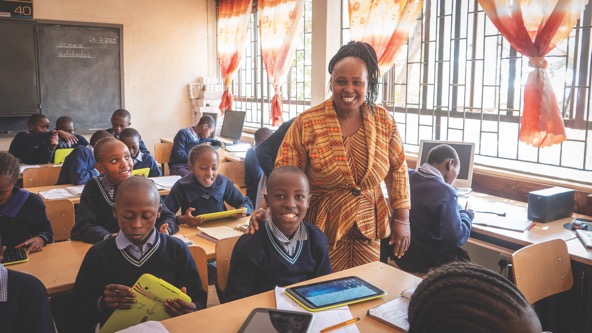 A teacher stands beside her students using tablets and computers at Ngei Primary School in 2023. (Photo courtesy of Giga/UNICEF-ITU)
Yet political alignment alone was insufficient. Moving from pilots to national scale required credible answers to more concrete questions: How much would expansion cost? How many schools could different levels of funding reach? And where could available resources generate the greatest value?
Evidence from the pilots made these questions increasingly answerable. “Because we had done 100 schools, we were able to go and just model the numbers that could be reached based on potential funding baskets,” Otine says. The pilots thereby provided a basis for showing decision makers what a given level of investment could realistically achieve. “Before, we didn’t have a unit costing model for an institution,” says Francis Karanja, head of the National ICT Innovation and Integration Centre at the Ministry of Education. “Now, if you come and ask me what the unit costs are of connecting a school, I’ll be able to give it to you.”
School connectivity was becoming calculable in terms that could inform budgeting and investment: Government could increasingly translate the ambition of connecting schools into unit costs, funding requirements, and investment scenarios. These calculations also allowed expansion to be evaluated against public priorities.
This shift mattered because the actors capable of financing at national scale required evidence they could use for their own decision-making processes. Education authorities could articulate the need for connectivity, but government budget holders, development banks, and other financing partners needed to understand what resources were required and what those resources could deliver. Giga’s finance capabilities helped translate implementation experience into propositions these actors could evaluate and act upon. Evidence generated through relatively small-scale implementation could thereby become the basis for decisions about much larger investments.
Kenya was not unique in this respect. Fabian saw a similar mechanism across what he described as the “triangle” of early-engagement countries—Kenya, Rwanda, and Sierra Leone—despite substantial differences in how the three countries approached school connectivity. In Kenya, evidence generated through Giga helped government actors make the business case for school connectivity, including which schools to prioritize and how their location relative to existing infrastructure could allow available resources to reach more schools. In Rwanda, Giga and its partners used seed funding from Dubai Cares to connect an initial group of schools. The government subsequently developed its own approach and secured substantially larger financing from China to connect around 1,000 additional schools. In Sierra Leone, after the initial pilot and with the support of Giga, the government was able to secure $5 million from the Islamic Development Bank to connect an additional 403 schools.
The inputs differed, but Fabian saw a common mechanism. Relatively limited resources—whether seed financing, technical expertise, or analytical capacity—could help local government officials argue for much larger allocations. Giga’s objective was not to finance national scale itself, but to generate and transfer evidence and capabilities that local actors could use to mobilize resources through their own institutions. “Giga had effectively provided a menu,” Fabian says of the Rwanda process. “Government actors could take what was useful, adapt it to their context, and scale it themselves.”
As the investment case became more concrete, school connectivity also became more deeply embedded in government policy and planning. Kenya’s government incorporated it into its education and digital-transformation priorities, including national ICT strategies such as the Digital Master Plan 2022-2032 and the National Education Sector Strategic Plan 2023-2027. The government’s broader digital agenda provided a political horizon within which connectivity investments could be pursued.
Policy commitment, in turn, strengthened the basis for larger resource mobilization. In 2024, funding from the European Union provided an early example of how substantially larger resources could move connectivity beyond the scale of the initial pilots. “We got an EU grant for around 10 million euros [$11.5 million],” Fabian says. “We split it like 55 percent to education … and then 45 percent for connectivity. So, there were like four, five million [euros] for connecting schools in the country. They used that to fund the connectivity of something like 700 schools.”
Through this EU-funded expansion, the Last Mile Connectivity of Schools project used a client-hub model in Kajiado and Turkana, in which a centrally connected hub school distributes secure, lower-cost connectivity to surrounding schools. By clustering schools rather than treating each as an isolated endpoint, the project could extend connectivity to multiple schools in rural and underserved areas.
World Bank financing created a further opportunity for expansion, although in this case the Kenyan government was already considering these resources for a broader connectivity project. Giga’s role was to help government officials make the case for directing part of it toward school connectivity and identify where available resources could have the greatest effect.
These larger commitments translated into a substantial expansion on the ground. By May 2025, 1,160 schools had been identified for connection through Giga’s collaboration with Kenya’s Ministries of Education and ICT, and 659 had been connected, benefiting more than 425,000 students and teachers. Expansion also reached some of the country’s most underserved populations: UNICEF Kenya helped connect 81 refugee-hosting schools in the Kakuma and Dadaab refugee camps. The shift from an initial pilot of roughly 100 schools to hundreds of connected schools demonstrated that the evidence and investment arrangements developed through implementation could support expansion well beyond the original pilots.
By summer 2025, school connectivity had moved beyond a series of internally supported pilots. Evidence from implementation could now be translated into unit costs, investment scenarios, policy commitments, and larger funding decisions. The comparison with Rwanda and Sierra Leone also shows that this pathway did not depend on a single financing model: What traveled across countries was the ability to equip local actors with evidence and capabilities that could unlock substantially larger resources. In Kenya, school connectivity had become a government-owned and increasingly investable national agenda. The question was no longer only whether Kenya could connect schools at scale, but what wider value that expanding infrastructure could create.
Phase 4: Connected Schools as Community Anchors
As school connectivity expanded across Kenya, a further dimension of its value became increasingly visible. The original rationale for connecting schools had rested primarily on education: giving students and teachers access to digital resources and enabling investments in devices and digital learning to be used effectively. But extending infrastructure to schools—particularly those in underserved areas—also brought connectivity to places where digital infrastructure in general had previously been limited or absent. The value of connecting a school could therefore extend beyond the school itself.
School locations provided a natural opportunity. Unlike much digital infrastructure, which tends to concentrate around commercially attractive population centers, public schools are distributed across the country, including in remote and low-income communities and areas with low population density. Reaching them could therefore extend infrastructure into areas that providers might otherwise have little incentive to serve. “Once you are able to connect schools, you’re connecting everyone else within that community,” says Ruth Nekoye, education liaison officer lead at Liquid Intelligent Technologies, a pan-African digital infrastructure provider.
This dynamic changed the role that schools could play in the connectivity ecosystem. Rather than functioning only as end users of internet service, connected schools could become anchor points around which wider digital access develops. Infrastructure deployed to reach a school could potentially serve nearby households, businesses, public institutions, and community members, while bringing networks closer to locations that had previously been commercially difficult to reach. In some cases, connectivity, according to Opondo, reached “places we had never thought that we will ever go connecting.” This potential began to translate into implementation plans: The 2026 Last Mile Connectivity of Schools work plan included the activation of community digital hubs, explicitly extending the role of connected schools toward providing digital access and services to surrounding communities.
This emerging role for schools also aligned with Kenya’s broader ambitions around digital inclusion. The Ministry of Information, Communications, and the Digital Economy (MICDE) was simultaneously expanding public access to connectivity through public Wi-Fi, particularly in high-population areas where the cost of internet access remained a barrier. Kenya’s Digital Master Plan 2022-2032, for example, envisaged the rollout of 25,000 public internet hotspots across the country. School connectivity could complement this wider effort by extending digital infrastructure into poor and underserved locations. “One of the key tenets of digital transformation is inclusion,” says Washington Okoth, secretary of ICT Infrastructure at the State Department of ICT and Digital Economy in the MICDE. “No one or no region should actually be left behind.”
The broader value could emerge in different ways. As Fabian pointed out, school and health-center connectivity can be combined within the same procurement. Contracting connectivity jointly rather than separately can reduce the price of connectivity by more than 30 percent. “We for sure see that level of network effects,” he says. Connecting schools could therefore contribute to a wider public- infrastructure proposition in which aggregating demand across institutions improved the economics of reaching underserved locations.
Value may also come from new business opportunities created by connectivity. For example, Wekkitech not only applied its hybrid model but also added charging services in communities where residents often had to travel considerable distances to charge their phones. Other Kenyan ventures experimented with similar combinations. Nairobi-based Chargebyte, for example, developed hybrid solar-grid stations providing both internet access and portable battery charging, allowing residents to rent power banks rather than travel several kilometers and leave their devices at shops to charge. Its stations can each support up to 300 internet users.
These different forms of value could, in turn, alter the economics of connectivity. A remote school considered in isolation might generate too little demand to justify the infrastructure required to reach it. When connectivity can serve other public institutions, community members, or complementary services, however, the calculation changes. The school constitutes an initial anchor for infrastructure deployment, while broader demand creates additional reasons to maintain and potentially extend the network. Scaling was therefore beginning to reveal economic and social value that had been difficult to anticipate (and calculate) when connectivity was considered only as an educational service.
This possibility was crucial for the long-term financial sustainability of the initiatives. Many connectivity initiatives depend initially on public or development financing to reach locations where the commercial case is weak. Wider demand could create a reinforcing dynamic: Connecting schools brought infrastructure into underserved areas, that infrastructure created additional uses and users, and those uses could strengthen the rationale for sustaining connectivity over time.
Yet, the question remains whether schools will eventually assume recurring costs. “That’s the expectation,” Opondo says, “that after the five years … the schools will take up the operating expenses and the maintenance of the infrastructure.”
Lessons From Giga’s Experience in Kenya
By 2026, Giga and its partners in Kenya had come a long way from their first efforts to connect a small number of public schools. This evolution was neither linear nor predetermined. Each stage of implementation changed how the actors involved understood the challenge, what evidence they could mobilize, and ultimately what value they saw in connected schools.
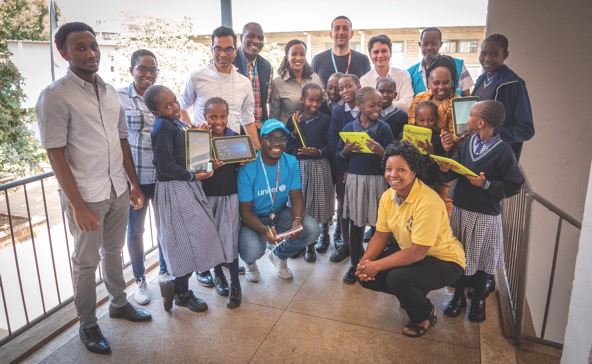 UNICEF staff, students, and teachers gather for a group photo in Gatuanyaga, Kenya, in 2023. (Photo courtesy of Giga/UNICEF-ITU)
Giga’s experience in Kenya offers four lessons for organizations and governments seeking to scale complex social impact initiatives:
1. A shared agenda does not require a shared value proposition. Cross-sector initiatives often seek to align participating organizations around a common purpose. Kenya’s experience suggests that collective action does not require actors to value an intervention for the same reasons. School connectivity mattered to education authorities, because it expanded access to digital learning; to ICT institutions, because it extended digital infrastructure; to regulators, because it supported digital inclusion; and to development partners, because it advanced broader development objectives. Collective action did not require convergence around a single rationale, but recognition that the same intervention could advance different but compatible objectives. Complex challenges may therefore become more actionable when multiple value propositions are accommodated rather than collapsed into a single shared purpose.
2. Pilots provide useful insights into the limits of scaling. Pilots are commonly expected to demonstrate whether an intervention works before it is replicated at greater scale. In Kenya, connecting schools exposed substantial differences in geography, proximity to existing infrastructure, deployment costs, bandwidth requirements, provider incentives, and maintenance needs. What initially appeared as a relatively standardized intervention—connecting a school—therefore became an increasingly complex implementation. The pilots generated value not simply by demonstrating that connectivity was possible, but by revealing where assumptions broke down and where different configurations would be required. For complex interventions, piloting may therefore be less about identifying a model to replicate than about discovering where and why the model must vary in order to scale.
3. Evidence increases in value when it becomes transportable and actionable. Implementation generated substantial information about school connectivity, but evidence alone did not produce scale. Its value increased when it could be translated into forms that actors controlling different resources could use: unit costs for government planning, investment scenarios showing how many schools different funding levels could reach, and implementation parameters that providers and public agencies could act upon. This allowed evidence generated through relatively small-scale implementation to enter budgeting, policy, and investment decisions and support much larger resource commitments. The challenge in scaling is therefore not only to produce more evidence, but also to translate it into forms that can travel across institutional boundaries and become actionable within the decision processes of those whose resources are needed for the next stage of scale.
4. Scaling reveals new forms of value that reinforce scaling. Taken together, these lessons suggest a different way of thinking about the value propositions and scaling complex social impact initiatives. Scaling is not simply the replication of a proven solution. It is a process through which the value of an intervention is progressively revealed, translated, and expanded. In Kenya, educational value provided an initial reason to act, implementation exposed the infrastructure requirements of scale, evidence translated those requirements into propositions that could mobilize investment, and expansion revealed broader socioeconomic value around connected schools. This created a potentially reinforcing dynamic: Scaling revealed new forms of value, those forms of value gave additional actors reasons to contribute resources, and those resources created opportunities for further scaling. The challenge for Giga—and for other organizations tackling complex development problems—is therefore not only to scale an intervention, but also to recognize and mobilize the additional value that becomes visible only along the way.
Looking Ahead: The Future of Giga
The expanding value of connectivity also points toward what might come next. In Kenya, government ambitions increasingly extend beyond providing digital access to developing the capabilities needed to make use of it. The nation’s ambition, Washington Okoth says, is to “train close to two million citizens on digital skills, with teachers potentially serving as important multipliers within their communities.” The possibilities are also beginning to extend to artificial intelligence. “The more we train them on digital and AI skills, the more they come up with the use cases that touch on public service,” he says.
Against this backdrop, Fabian sees a broader question about the capabilities Giga has developed. By 2026, Giga had established an approach that has been tested across different countries with varied contexts. The next challenge is no longer just to apply that approach country by country, but to enable others to use it.
One direction is to scale the approach Giga developed for school connectivity through UNICEF itself. Representatives working directly with governments could use the same combination of evidence, advocacy, and cross-government engagement in conversations with ministries of education, ICT, and finance. Fabian envisions this becoming fundamental to UNICEF’s mission in the way that advocacy around vaccination, early-childhood development, and other priorities became embedded across the organization.
A second possibility is to apply the underlying capabilities to other digital-inclusion challenges. Fabian points to health and emergency response as potential applications, as well as the emerging challenge of equitable access to AI and computing capacity. UNICEF recently launched “Universal Basic Compute,” an initiative exploring how people can gain more equitable access to the computing power needed to use AI. Rwanda is already experimenting with distributing AI applications, including for health, more widely across its population.
These developments make the challenge of connectivity increasingly consequential. When Giga was launched, being disconnected limited access to digital education, services, and economic opportunities. As AI becomes embedded in education, healthcare, public services, and economic activity, “the digital divide risks evolving into an AI divide, in which unequal access to connectivity and computing infrastructure determines who can benefit from the next generation of digital technologies,” Fabian says. The experience of Kenya therefore points beyond the challenge of connecting schools. It suggests that the capabilities developed through Giga may become increasingly essential as new forms of digital inequality emerge.
Read more stories by Lisa F. Canova, Nina Zachlod & Tina C. Ambos.