


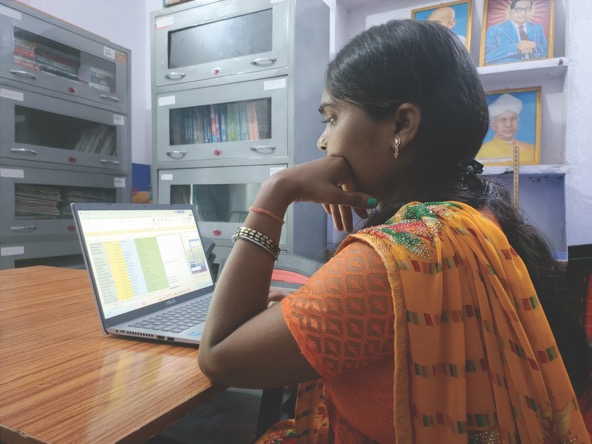
 Rina Kumari works on a laptop at the Didi ki Library in Kulharia village in Bihar’s Bhojpur district. (Photos by Anuja)
Rina Kumari, 31, was married just days after her 10th-grade exam results were announced. She wanted to keep studying, but her father’s failing health and the “burden” of marrying off five daughters, as her father and others called it, left her little choice but to accept the match. It saddened but did not surprise her. Growing up in a village in India’s eastern state of Bihar, she had often seen other girls leave school early.
Nearly 15 years later, her past has become her purpose.
After a long break, and with her husband’s encouragement, Kumari completed her studies and earned a bachelor’s degree. She also worked odd jobs to fund her three children’s schooling. In 2016, she joined a local self-help group (SHG), which eventually led to a job in 2023 running a Didi ki Library (library of sisters) in Kulharia village in Bihar’s Bhojpur district.
“I decided early on in life that if I ever found myself in a position where I could afford to teach children for free, I would,” says Kumari, draped in an orange sari as she types on her laptop in the library. “Students who come here now call me Vidya Didi [knowledge sister], and it makes me very proud.”
The Didi ki Library initiative is part of Bihar government’s Community Library and Career Development Centre (CLCDC) program. The first library opened in February 2023, and there are now 117 libraries across 33 districts.
On the ground, the CLCDC program is implemented by Jeevika, a World Bank-supported rural-livelihoods project that federates and runs over a million SHGs in Bihar. Women in those SHGs, locally known as Jeevika Didis, conceived, designed, and run the libraries.
Bihar, one of India’s least developed states, trails on most socioeconomic indicators, with low literacy rates and the country’s highest multidimensional poverty. Literacy has improved in recent years, but the gender gap in education, especially in villages, remains wide.
In rural Bihar, where nearly 84 percent of the state’s population lives, male literacy stands at 81.5 percent and female literacy at 65 percent. Deep caste stratification in the state further disadvantages students from poorer and rural backgrounds.
The Didi ki Library initiative places women at the center of transforming a sector where they have historically been left behind. These free libraries offer a safe learning space, blended physical and digital knowledge access, and career guidance through webinars and interactions with experts.
The Libraries
At the edge of a quiet Kulharia neighborhood sits a single-story pink building with blue windows, one of Bihar’s many Didi ki Libraries. These libraries are typically set up in unused government buildings. The Kulharia branch repurposes a two-room space, now upgraded with furniture, a laptop, a printer, internet access, and power backup.
The first room has rows of study tables and chairs, with notice boards displaying the latest exam announcements. The second room holds more than 800 books, daily newspapers, and magazines stacked in cupboards.
At a Didi ki Library in Amhara village, librarian Archana Kumari, 34, proudly points to a projector in the reading room. Its proximity to Patna, the state capital, and an Indian Institute of Technology (IIT) campus draws many competitive exam aspirants.
Archana speaks fluently about entrance exams, job recruitment, and scholarships. She receives this information through Jeevika’s centralized system and shares with students at the library or via WhatsApp groups she has created. She pays special attention to schemes for women returning to education after a gap and for students from disadvantaged backgrounds.
According to Jeevika, 174 learners have gained admission to higher education and 146 have been selected for jobs.
“These are all existing government schemes, and students can fill forms on their own,” Archana says. “However, for first-generation learners who have no one to help at home, having a point person like me makes all the difference.”
Both Archana and Rina, who are in charge of running such libraries and have worked there since 2023, earn a monthly honorarium of around $70.
Each state government-funded library costs around $6,700 to set up; the first 100 were partly financed by the World Bank through Jeevika. Annual operating costs of $1,350 per library are typically covered by a separate community-managed fund.
Himanshu Sharma, Jeevika’s CEO and a senior civil servant, says the libraries’ real impact lies in combining physical learning space with digital-information access. Most rural students, he says, lack mentors, and despite their will to study, they often don’t know which career path to pursue.
“If students get good mentors and guidance, then decision-making becomes easier and their risk-taking ability also increases,” he says. “This I consider is the biggest change that these libraries have brought. Students, especially girls from rural areas, are aspiring big and getting confident of doing well.”
The Learners
According to Jeevika data from October 2025, the libraries have over 123,000 registered members, 61 percent of them female, with daily traffic of 5,000-7,000 learners. More than 15,000 learners have received career guidance.
Several female students at Kulharia and Amhara said their families “allow” them to study at the Didi ki Library because it is close to home, free, and run by women, making it a “safe space” in their eyes.
Lakshmi Kumari, a 12th grader, shares a three-bedroom home with 16 family members. “My house is always noisy. It does not matter where I sit and study, it is noisy even on the terrace,” says Lakshmi, who first heard about the library from a school teacher. “When you see everyone else studying here, you have no other option but to study.”
Her classmate Urmila Kumari says her mother runs a small cosmetic shop from their backyard. “Whenever I study at home, my mother draws me in to help her at the shop. It is impossible to focus and so I come here often,” she says. A self-described “below average” student, Urmila says her results have improved markedly since she started using the library. Both attend the library run by Rina in Kulharia.
“This initiative tackles two fundamental constraints in education: the absence of a strong peer network and the lack of a safe space,” says Nishith Prakash, a professor of public policy and economics at Northeastern University in Boston. “I see this as a beginning. Students now have a place to study alongside motivated peers, and my hope is that this shared aspiration will carry many of them to college. If sustained, we should see clear effects on human capital in the years to come.”
Prakash, who is from Bihar, visited a Didi ki Library last year and was “pleasantly surprised” by what he found.
Impact and Scaling Up
The broader goal of the CLCDC program is to use education to break the cycle of generational poverty in SHG households. To that end, the libraries offer webinars, career workshops, spoken-English training, and entrance-exam support for jobs and higher education.
Three years in, the results are beginning to show. According to Jeevika, 174 learners have gained admission to prominent higher-education institutions, including Delhi University, and 146 have been selected for jobs, including positions in the state police force.
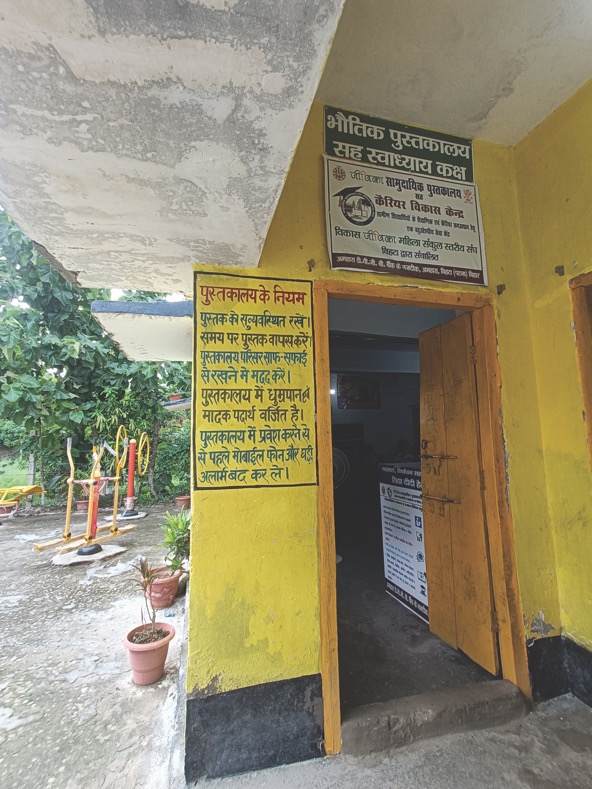 The entrance of the Didi ki Library in Amhara village in Bihar’s Patna district. (Photos by Anuja)
Prakash noted that the initiative’s “missing piece” is more regular access to experts and researchers who understand local labor- market realities and can offer formal career counseling.
“Scaling up with additional career and educational counselors will be challenging, largely because of financial constraints,” he says. “Much of this, however, can be addressed through the strategic use of technology—and they have already begun doing so.”
Bihar has nearly 8,000 gram panchayats, or village councils, and Sharma says the goal is to eventually have at least one Didi ki Library in each one.
“Our biggest limitation is we only have 117 right now. Our financial resources, among other constraints, are a key challenge. Providing high-quality resources for education is in itself a very big challenge,” he says. Sharma adds that plans are underway to expand digital resources, hold regular expert webinars, and secure more funding.
The libraries also advance the education of women in SHGs, partnering with open- and distance-learning institutions to help dropouts and other sidelined learners, mostly women, reenter mainstream education.
For instance, Neelam Devi, 41, visited the library at Amhara to learn about a state government scheme that could help her complete her matriculation, nearly 24 years after she dropped out.
“I left studies because I got married. Now my children are going to college; should I sit alongside them and fill forms? I want to complete my studies, but I am not very confident,” Devi said, looking expectantly at Archana.
“You do not have to worry; we are here to help you at every stage. Matriculation is an important milestone. You must cross it to see what life looks like on the other side,” Archana said with a smile, guiding her toward a laptop to fill out a form.
Read more stories by Anuja.