


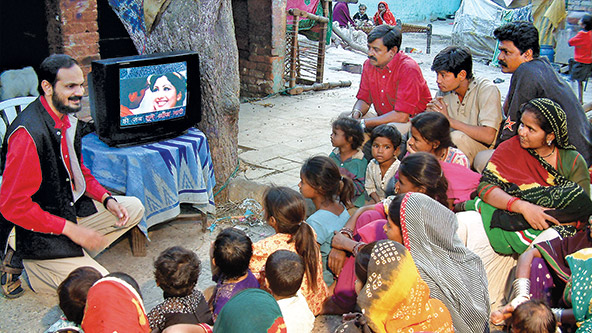
 Coauthor Brij Kothari speaks to a group of children and their parents in the Gulbai
Tekra section of Ahmedabad, India. (Photo by Jaydeep Bhatt)
Coauthor Brij Kothari speaks to a group of children and their parents in the Gulbai
Tekra section of Ahmedabad, India. (Photo by Jaydeep Bhatt)

Pedro Almodóvar could not have imagined that his zany film Women on the Verge of a Nervous Breakdown would have anything to do with a billion people reading in India. But in 1996, when four graduate students watched his Oscar-nominated Spanish film huddled in a small apartment in Ithaca, New York, one of them (coauthor Brij Kothari) commented that he wished the English subtitles were actually in Spanish—not a translation, but a transliteration of the audio. That would have enabled them to follow the original dialogue better while remaining immersed in a language they were learning. Then he extended the idea in jest: If they subtitled Bollywood films in Hindi, maybe India would become literate.
“You might be onto something,” a friend chimed in. It was just the intuitive affirmation Kothari needed. Over the next couple of weeks, he conducted an extensive literature search on subtitles. He found many papers on the benefits of translation subtitles for language learning and of closed-captioning (CC) for media access among the deaf and hard of hearing. But he also encountered a baffling dearth of research on subtitles for reading skills.
The idle joke about Hindi subtitles on Hindi films began morphing into a possible research topic. The idea of subtitles in the same language as the audio went (and still goes) by monikers like “bimodal subtitling.” To focus on the need for audio and subtitles to be in the same language, for reading literacy, Kothari coined the term “Same Language Subtitling.” The same year, he transitioned to a faculty position at the Indian Institute of Management, Ahmedabad (IIM-A), and initiated the SLS project, purely as academic research.
Twenty-three years later, on September 11, 2019, India’s union minister of information and broadcasting announced a set of Accessibility Standards that require all major TV channels—India has more than 900—to caption at least one program per week in 2019 and ramp up captioning to 50 percent of all TV programming by 2025. The language of captioning, according to the standards, “shall be the language of the content,” or what we called SLS back in 1996.
This is the story of how a simple idea born of student banter became national policy. In a country where one billion people, in 200 million TV households, watch on average nearly four hours of TV every day and will do so throughout their lives, SLS promises to have far-reaching consequences for raising reading literacy skills in India and worldwide.
The Promise of SLS
Seventy-six percent of the global illiterate population lives in southern Asia (49 percent) and sub-Saharan Africa (27 percent). These people need solutions if the global community is going to achieve the Sustainable Development Goals (SDGs)—the plan that all member states of the United Nations adopted in 2015 to end poverty, improve health and education, and preserve the environment by 2030. Specifically, SDG 4 calls for inclusive and equitable education and lifelong learning opportunities for all. This objective depends on the world’s population having foundational reading skills. Based on our work in India, we believe that SLS offers a powerful solution for ensuring reading literacy worldwide, because of its pedagogical effectiveness, scalability, and low cost.
India’s literacy rate has improved dramatically over the past 73 years, from 18.3 percent at the time of the country’s independence (1947) to 74 percent in its last census (2011). It is expected to surpass 80 percent by census 2021, which will supposedly mark the ability of 8 out of 10 Indians to read newspaper headlines at least.
But these statistics hide disabilities. Five out of eight officially “literate” people in Hindi states cannot read functionally and are weak readers of text, according to our research.1 They may be able to decode some letters and words but lack the basic fluency for comprehension of simple texts. Consistent with this finding, Annual Status of Education Reports (ASER) for the past 15 years have highlighted an alarmingly steady figure: 50 percent of rural Indian children in grade five cannot read a grade-two-level text.
In actuality, India has an estimated 400 million functional literates (32 percent), 600 million weak literates (48 percent), and 250 million nonliterates (20 percent). The number of people who have yet to achieve quality reading literacy—the number of non- and weak readers who need to transition to functional reading skills or better—is a staggering 850 million.
Fortunately, SLS offers a cost-effective and proven solution to switch on daily and inescapable reading practice for all of India’s one billion TV viewers. SLS is the idea of subtitling audio-visual content in the same language as the audio. Word for word, what you hear is what you read. India has the world’s most prolific film and television industries. Around 1,500 movies are produced every year in 20 Indian languages, and almost every production has at least five songs. After an initial run in cinema halls, films and film-song programs have a strong presence on TV. Indian’s passion for movies permeates every cultural aspect of life.
India is the first country to pilot SLS on mainstream TV entertainment for the purpose of achieving mass reading literacy. The United States was the first country to mandate CC in 1990, for media access among the deaf and hard of hearing, and several countries in the Global North have followed suit. European TV predominantly uses subtitles for translation, supporting the continent’s linguistic diversity. In general, countries worldwide have used CC and subtitles on TV for language acquisition, rather than reading literacy.2 It is surprising, then, that countries in the Global South and the global education community at large have overlooked the transformative potential of subtitles for reading literacy, especially in low-income, low-literacy, and linguistically diverse countries.
Large-scale pilots of SLS for existing film songs on TV in eight major languages have found two things: First, weak readers exposed to content with SLS cannot but try to read along automatically,3 and, second, regular SLS exposure results in significant improvement of reading skills.4 After three to five years of regular exposure to SLS, most weak readers advance to functional, and many to fluent, reading ability.5 The earlier a child is exposed to SLS at home, concurrent with primary schooling when letters are introduced, the stronger the child’s reading skills become. While the reading skills of schoolchildren in grades one to three improve most effectively from SLS, youth (11 to 20 years) and adults (20 and older) benefit, too, but less efficiently with age.
The pedagogical effectiveness of SLS in film songs stems from multiple factors. First, SLS works by strengthening text-sound associations; as the adage goes, neurons that fire together wire together. Second, it is seamless: Watchers read unthinkingly, without any additional effort or time. Third, it transforms the learning experience from one marked by cognitive exertion and failure to one of enjoyment and success, because the answer to the reading task is present in the audio. In the early phase of reading development, one of the biggest challenges the budding reader faces is staying motivated for an activity that is difficult and offers no immediate reward. Fourth, it builds on viewers’ prior knowledge of lyrics and melody, enabling them to forge text-sound associations in a positive state of mind. Fifth, it allows viewers to read without social judgment or embarrassment. These powerful factors join with a billion people’s boundless passion for popular entertainment to make daily and lifelong reading sustainable for the masses.
Scale is basic to SLS. The four billion person-hours that the nation spends collectively in front of the TV every day present an unparalleled opportunity to translate screen time into achieving three major goals: lifelong reading practice among one billion TV viewers, including 600 million weak readers; media access among 65 million viewers who are deaf and hard of hearing; and Indian-language learning among one billion viewers.
The cost for a billion people to get about two hours of daily reading practice for life, via SLS, is one cent per person. That may sound incredible, but the underlying logic is straightforward. The film industry has so far produced around 50,000 films, of which only about 20,000 are likely to ever be shown on TV. Now that government policy requires SLS in all new films, the cost of mainstreaming SLS in all existing films on TV is effectively fixed at $10 million.
Collecting the Evidence
However, as everyone who has tried to push policy changes knows, evidence of effectiveness is necessary but not sufficient to move policy. So how did we translate SLS as an idea into successful government policy?
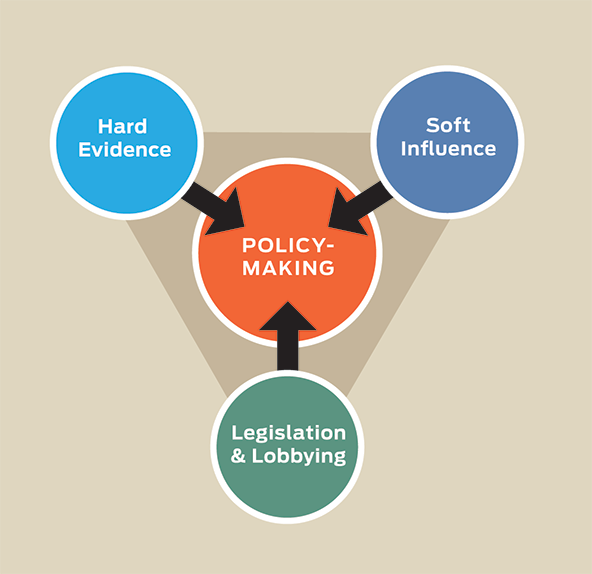
We built our approach on evidence-based policymaking (EBPM). We combined scientific research with repeated attempts to persuade decision makers and a dogged patience to wait until factors beyond our control, such as who was in charge of what channel or ministry and what policy priorities they had, shifted in our favor. We pursued both hard evidence and soft influence and received a major boost from disability groups who demanded changes in the law that helped our cause.
Our marshaling of evidence for SLS went through six distinct phases. We began by researching two basic questions: Did viewers even like SLS in song-based content, and did it improve their reading skills? We found that viewers did enjoy the content,6 and an experimental study in a municipal school netted encouraging results about reading. Children in the treatment group who watched 30 minutes of film songs with SLS three times per week over a three-month period ended up as slightly better readers than the control group, who saw the same content without SLS.7 The evidence supported our confidence in SLS, but state and private TV channels were not interested in a research article from a classroom study.
In the second research phase, we sought to allay the concerns of the TV channels and see if what worked in a controlled setting would also work on TV. We struggled to secure the first implementation of SLS on TV, though, because the channel executives we met presumed that viewers would reject SLS, despite the video evidence to the contrary. But the appointment of a new director at Gujarat state TV gave us an opportunity: He agreed to try out SLS on four episodes of a popular Gujarati film-song program. The viewer feedback was positive, so the director permitted SLS to continue on the program for a year. This decision, in turn, enabled us to complete our first impact study of SLS on TV.8 About 90 percent of viewers preferred SLS in film songs. In addition, literates and weak literates saw “karaoke value” in SLS, because it enhanced the entertainment of song-based content. Even a majority of illiterate viewers esteemed SLS—not for themselves, but for their children.
We drew three lessons from our early partnership with a state channel. First, evidence, however strong, is necessary but insufficient to secure a policy outcome. Second, government positions change regularly, so waiting out opponents is a viable first-line strategy. Third, the earlier into a decision maker’s tenure you can make your case, the greater their openness to engage—perhaps because they want to cement a legacy—and the longer the potential period to create institutional memory.
After our success with Gujarat state TV, we moved to national broadcast policy. We began by sharing the findings of the Gujarat state TV pilot with Doordarshan, India’s national TV network, headquartered in New Delhi. We thought that a demonstration of the operational viability of implementing SLS on a state channel, combined with positive feedback from viewers and evidence of improved reading skill among TV viewers and schoolchildren from two separate studies, would sway policy makers, but a deputy director general at Doordarshan summarily rejected SLS.
That rebuff could have been the final answer, if not for our having won a globally competitive innovation grant of $250,000 from the World Bank’s Development Marketplace in 2002. Armed with this award, we went to Doordarshan’s director general, Dr. S. Y. Quraishi, accompanied by our own director, Dr. Jahar Saha, to add institutional heft. Quraishi overrode vehement objections from within the organization to permit SLS for one year on Rangoli, one of India’s most popular and longest-running Hindi film-song programs, telecast for an hour every Sunday morning on national TV.
Few longitudinal studies on the impact of subtitles existed. So, in the third research phase, we sought to strengthen the evidence base by implementing SLS on Rangoli over one year, an undertaking for which funding was available, and hoped additional funding could secure more time. The pilot, originally planned for one year, got extended through a fortuitous alignment of donors—Sir Ratan Tata Trust ($200,000), Google Foundation ($350,000), and the government’s Ministry of Human Resource Development (MHRD) ($100,000)—that each chipped in with one to two years of funding at the right time. Doordarshan kept granting annual permission for SLS on Rangoli because its ratings improved by about 10 percent after it added SLS.
Policy makers are typically too busy to digest research publications, but studies supporting an idea help mitigate the risk of advancing it in policy.
The resulting study, which no single donor would likely have funded, offered the strongest affirmation of SLS’s impact on reading skills.9 Among nondecoding schoolchildren (those who could not read a single letter in Hindi at the beginning), 70 percent in the high-SLS viewing group became functional readers (able to read at least grade-two-level text) five years later, compared with 34 percent in the low-SLS group. In the 15-and-older age group, 14 percent in the high-SLS group went from nondecoding to functional reading. By contrast, only 5 percent in the low-SLS group made the transition. As we expected, schoolchildren benefited substantially more from SLS than adults did.
In the fourth phase, we expanded our collaboration from a single national TV channel to wider acceptance by the national government. We persuaded the Department of Adult Education (DAE) under the MHRD to survey the popularity of SLS among adult learners in the ministry’s continuing-education centers—the bare-bones village libraries that serve the needs of adult weak literates. The ministry found that 85 percent of its adult learners preferred SLS in song-based TV programming.
Although we were pleased with our success, we were not satisfied. We wanted to convince the Indian government to require SLS on all the film songs shown on TV, in every language. In the fifth research phase, we built a stronger case for national expansion of SLS. We won $300,000 in the All Children Reading (ACR) grand challenge competition, conducted by USAID and World Vision. For two years, SLS was scaled up in Maharashtra state (population: 122 million) and used in 20 Marathi films per week, shown on two of the state’s leading private TV channels, Zee Talkies and Zee Marathi. Neighboring Gujarat served as a control state. At the beginning of the study, the Gujarat and Maharashtra sample populations were comparable in reading skill. But after two years, 68 percent of students in grade three in Maharashtra could read at grade one level or better, compared with 43 percent of Gujarati grade-three children. While children in every primary grade benefited from SLS, the impact was strongest in grades two and three. The independently conducted Annual Status of Education Report (ASER) also marked the benefits of SLS. Over the same two-year period as our pilot, Maharashtra schoolchildren’s reading skills improved more than in any other state nationally.
Policy makers are typically too busy to digest research publications, but studies supporting an idea help mitigate the risk of advancing it in policy. A strong scientific foundation from a variety of credible sources can provide the necessary defense against any questions that future bureaucrats might raise. In the sixth research phase, currently in progress, we are seeking to help policy makers better grasp the effectiveness of SLS by using portable eye trackers to follow the viewing patterns of weak readers in villages as they watch entertainment content with and without SLS. We conducted an eye-tracking study of 127 weak-reading schoolchildren, youth, and adults in Rajasthan. They saw film dialogue and song clips, with and without SLS. We found that 87 percent of viewers automatically tried to read the SLS but the remaining 13 percent ignored it.
Studies of SLS’s effect on reading skill and eye tracking form the bedrock of our efforts to advance SLS in education and broadcast policy. Evidence alone likely could not have convinced policy makers to accept SLS, but it proved instrumental in overcoming their resistance. In 2010, the board of Prasar Bharati, the national policymaking body for TV and radio, heard our presentation on SLS and approved the idea in principle. It tasked the director general of Doordarshan to work out a detailed implementation proposal. We wrote the proposal for him, but it fell on deaf ears. What seemed like a fait accompli in 2010 would have to wait another nine years. We needed something besides strong evidence.
Exerting Influence
We could not have secured any changes to public policy without also exerting soft influence. Soft influence is similar to Joseph Nye’s concept of soft power, or “the ability to obtain preferred outcomes by attraction and persuasion, rather than coercion and payment.” 10 In all of our interactions with government officials, they made us aware that we never had any power over any of them, no matter where they fell in the hierarchy and no matter how compelling our evidence. But we had soft influence to complement our evidence-based case.
We owe much of our success in influencing policy makers to the institution where the SLS project was based: IIM-A, one of the country’s top-ranked business schools. IIM-A’s brand alone helped us to land meetings with some of India’s most senior policy makers. Over the course of the SLS project, we were able to meet almost everyone we wanted to: government officials, including union ministers, secretaries, and joint secretaries across several ministries; officers at the Prime Minister’s Office (PMO); CEOs at top institutions like the National Institution for Transforming India (NITI Aayog), the federal government’s most influential policy think tank; and Prasar Bharati. In short, we got most (but not all) of the face time we sought.
But landing myriad meetings is only as good as the positive institutional and relational connections they seed. Government officials occupying senior positions are there for stints lasting only a couple of years. By the time you’ve established a relationship, they move on. Translating rapport into institutional memory is therefore essential. Extending influence beyond the current incumbent on any policy matter depends on the file of all written correspondence, which government offices meticulously maintain; the impressions of officials lower in the hierarchy who have longer terms in any ministry than senior officers; the views of previous incumbents and other senior colleagues; and the media.
Specifically, we took four lessons from our efforts at soft influence. First, pushing for policy change through the bureaucracy of career civil servants is better than doing so through elected ministers, unless they see a clear political benefit from the change. A couple of times, we did not think through this idea and faced hard rejections by ministers from two different governments. We found that evidence had little influence on ministers’ considerations; they rejected appeals from the gut as an exercise in raw power.
On one occasion, a cabinet minister and senior bureaucrats at MHRD invited several researchers in education to present their findings. As soon as coauthor Brij Kothari started his presentation and the minister heard words like “television,” “films,” and “subtitling,” he declared, “This has nothing to do with literacy.” He shut down our idea and work so publicly that in one instant, he set us back several years. We became pariahs at the ministry and were told that further interaction was impossible until we “neutralized” the minister’s views. It did not matter that several months later, the same minister found himself giving away an award certificate to Kothari for SLS. “Keep up the good work,” he said.
Two other interactions with cabinet ministers did not result in much, but they also did not hurt us as badly. The second minister considered neither the evidence nor the rationale and said simply that she did not think SLS would do anything for literacy. Fortunately, a third minister saw SLS’s potential. (Years later, we found out that a young industrialist from her state, Vaibhav Kothari [no relation to coauthor], whom she knew well and who happens to be deaf, had written to her in support of SLS.) Following an in-depth discussion, she created a period of openness to SLS at the ministry that then led to conversations with senior bureaucrats and a national expansion proposal. But she did not push for it in any sustained way, and the proposal faded from consideration. The bureaucracy claimed no ownership of the proposal, because we had taken the ministerial route. Most ministers do not have the bandwidth or the time in office to see social innovations through to their formulation in policy.
SLS ping-ponged between two ministries. Each side insisted that it was the other ministry's responsibility to implement the policy.
Second, institutional memory, like evidence, is a necessary piece of the policy-change puzzle. As Madhav Chavan, cofounder of Pratham, said about partnering with the government, “It became clear to us that the way the government functions in India today, officers go through revolving doors and partnerships fall apart with every transfer. There is no institutional memory and no policy continuity for change.” The revolving door presents a problem, but institutional memory can and should be created to counteract it.
Our approach eventually succeeded. We requested a meeting early in the tenures of senior officials, established a positive relationship, and shared research articles. When senior officials appeared receptive, we submitted a project proposal. Every such proposal goes through a process of consideration up and down the government hierarchy, receives jottings by officers at every rung, and lands a permanent place in a physical file. That file represents the institutional memory that will outlive any officer and provide continuity for future discussion. The SLS project composed robust files at a number of key ministries and policy institutions, including, most notably, at the PMO. In regular correspondence—to seek meetings, for example—we shared documents that reflected policy support from one state institution to influence others. We call this policy “contagion.”
Third, try to capture statements from influential figures on video. For example, we gave a presentation on SLS in 2013 in Gandhinagar at a conference that included then-Chief Minister of Gujarat Narendra Modi in the audience. SLS had resonated with him; in his closing keynote, he made a fleeting reference to our work when talking generally about innovations. The next year, he became India’s 14th prime minister. The clip of Modi’s comments likely influenced policy makers. Other videos, of former US President Bill Clinton and UK Prime Minister Gordon Brown commenting on SLS, have also helped raise its credibility.
Fourth, ministries like to work in silos, but policy innovations tend to happen across ministries and departments. We aimed for cross-ministry communication, which seems relatively easy through email but is hard to achieve face-to-face around the same table. SLS straddles the broadcast and education ministries. For the longest time, we could not get policy makers from both sides in the same room. Instead SLS ping-ponged between the two ministries for at least a decade. Each side accepted the concept but insisted that it was the other ministry’s responsibility to advance the policy and implement it.
A young officer on special duty (OSD) responsible for innovation at the PMO broke the logjam. After reading the published research, he referred the matter to NITI Aayog.11 To our astonishment, the government think tank convened two high-level meetings led by Dr. V. K. Saraswat, one of three “members” directly within earshot of the chairman, the prime minister. The single agenda item for both meetings: SLS. They invited secretary-level officers from education and broadcast, and representatives of private TV channels. The meeting signaled that policy makers at the highest levels were taking SLS seriously. We presented the evidence. Most attendees affirmed SLS on principle, but the private TV channel representatives said that because the implementation would be costly and cumbersome, the government needed to allocate funds. But no ministry was willing to carve out money for SLS from its existing budget.
We had seemingly struck another policy impasse—until a Doordarshan representative pointed out that the Rights of Persons with Disabilities Act (RPwD Act) of 2016 mentioned TV subtitles for the deaf.
Applying a New Law to an Old Problem
“Despite the number of groups that will present themselves as the decisive force behind any legislative accomplishment, no successful advocacy effort is the result of any one organization or initiative,” political scientist Steven Teles and policy researcher Mark Schmitt wrote about advocacy work.12 Their claim applies to the story of how SLS became policy in India.
Since the beginning of the SLS project in 1996, policy interest in literacy has been waning. The cause enjoyed its strongest policy and resource support from 1988, when the National Literacy Mission was established to “eradicate adult illiteracy,” through the 1990s. Officially, 127 million adults became “literate,” according to the 2001 census, but we know that did not mean that they could read or write simple texts. In the new millennium, funding for literacy fell off a cliff as policy makers shifted their attention to childhood education. They reasoned that if all children completed primary schooling, 100 percent functional literacy would simply follow. In 2009, India passed the Right to Education Act to ensure free and compulsory education for all children between the ages of 6 and 14. Now that India has achieved nearly 100 percent school enrollment for those ages, policy makers have finally turned to quality of education. Annual surveys have shown for more than a decade that half of schoolchildren are not acquiring foundational reading ability.
But in 2015, the legislative winds shifted in our favor. Under pressure from the National Centre for Promotion of Employment for Disabled People (NCPEDP) and other civil society groups, the government launched the Accessible India Campaign at the Ministry of Social Justice and Empowerment (MSJE). The initiative sought to achieve universal accessibility for persons with disabilities, including built environments, the transportation system, and information and communications systems. We then wrote to Javed Abidi, director at NCPEDP, to build a broader coalition around SLS: “Although literacy has been the primary driver of our work, we know that [SLS] on TV also contributes to media accessibility among the deaf and hearing impaired.”
NCPEDP and its partners deserve all the credit for their advocacy, inputs, and passage of the RPwD Act. The law mentions differently abled people’s right to a cultural life and recreational activities, including “ensuring that persons with hearing impairment can have access to television programmes with sign language interpretation or sub-titles.” We credit the indomitable Abidi with the seemingly minor inclusion of two words—“television” and “subtitles”—in an otherwise extensive and detailed law on a large number of issues pertaining to disability. The RPwD Act gave us a powerful legal basis from which to push for SLS on TV for media access, reading literacy, and language learning for all citizens, including the differently abled. We also began advocating for SLS through the Department of Disabilities at MSJE, which in turn asked the Ministry of Information and Broadcasting (MIB) to frame the rules for the law’s implementation in electronic media.
MIB then entered into discussions with disability rights groups and state and private TV networks. We advocated for a seat at the table. The director general of Doordarshan proposed a timeline for the implementation of captioning and sign language on all TV channels. She emphasized that captioning under the RPwD Act was a right—not merely a recommendation. The powerful TV industry united to object that the suggested interventions were too costly and not relevant for the overwhelming majority of (hearing) viewers. Here, the SLS project offered a counterpoint: Captioning and SLS were as much for the hearing as for the deaf. In fact, for more than a decade, the industry had, on its own, added SLS to all English-language programs on TV to expand their viewership. Ironically, it was to make American, British, and other English accents more accessible to the Indian ear.
We thus find ourselves within striking distance of a billion readers for life. SLS is now national broadcast policy but needs consolidation. The policy itself will come up for governmental review every two years, beginning in 2021. As long as the entertainment industry sees SLS as an imposition, the policy may not be implemented properly unless strong regulatory oversight and consequences for low-quality or no implementation are in place. We now urgently need to implement a model for SLS quality that all stakeholders—the government, entertainment industry, researchers, and civil society—formulate and approve. Its design should further the three core goals: media access, reading literacy, and language learning. Failure to do so would allow only two powerful stakeholders, the government and industry, to determine whether the model is implementable, based upon a less-than-ideal prototype. Civil-society organizations and researchers who succeeded in making SLS policy must still catalyze its proper implementation from the beginning and help institute a quality benchmark for years to come.
The EBPM Experience
Looking back on our experience, we find that simply sustaining our evidence-based policymaking (EBPM) efforts remained our greatest task. EBPM seeks transformational outcomes and system change whose outputs are not easily measurable. Our fight to make SLS required on TV, via a national broadcast policy mandate, began in 2002 and didn’t succeed until late 2019—and our efforts could easily have failed. What outputs from 2002 to 2019 could we have showcased to a donor’s satisfaction, so that funding could have continued for that long or have been attractive to other donors? We had small policy wins all along, captured in numbers of meetings and official minutes when available. But the real movement all along, we hoped, was taking place in the minds of an ever-changing and opaque bureaucracy.
When outputs are not easily defined or measurable, evaluating the progress of policy work happens only through trust in those pushing for reform and their ability to drive policy change. Was our SLS research sound? Were we relentless and adept enough in our policy advocacy? What were the institutional memories we were creating? Judgment requires a critical lens formed of patient and liberal skepticism and an acceptance of the high risk-to-reward ratio of EBPM as a path to system change. Venturing down the EBPM path is difficult without support and a shared understanding that small victories and failures are integral to the process.
The status of the SLS project often depended on who specifically occupied the top positions in the relevant ministries and state institutions. We have already mentioned the director of state TV in Gujarat and the director general of Doordarshan in New Delhi, who made important policy breakthroughs. In addition, the CEO of Prasar Bharati agreed to let Kothari accompany him in his car through Mumbai’s gridlocked traffic—treacherous but, in this case, helpfully slow—to make a presentation. He decided to support our wide collaboration with eight state channels.
Several years later, the chairperson of Prasar Bharati’s board allowed us to deliver a presentation on SLS to the full board. In another instance, an old college classmate of Doordarshan’s director general turned out to be one of our colleagues at IIM-A. SLS made remarkable progress in policy during the director general’s tenure because he opened a direct line of communication with us and backed SLS by writing, for example, to the vice chair of the planning commission, a cabinet-level post reporting directly to the prime minister.
Nothing, of course, tops a presentation on SLS at a conference where the most important member in the audience, Chief Minister Narendra Modi, takes a liking to our ideas and goes on to become prime minister.
As long as the TV is operational at home, the constancy of reading practice and improvement with SLS will always be there for all.
To be sure, we were fortunate in raising funds for a number of pilot implementations, each lasting one to two years, and the research and impact evaluations to go along with them. But these short-term relationships reflected the growth-oriented logic dominant in social-change projects. Funders asked questions such as: How many programs are you subtitling now? What is your budget? How many employees do you have? These inquiries apply more readily to an organization delivering a service or a product than to one seeking policy change. Proper funding mechanisms exist for activities that have short-term, tangible outcomes, but are too rare—if they even exist—for policy change making that by nature happens over a long time frame and incurs high risk. In short, we found support for evidence-based work but not for effecting actual policy.
We had to handle the arduous policymaking aspect of SLS work creatively and frugally: the many meetings we got, those we tried but failed to get, and others that were canceled at the last minute. We tacked on policy meetings to other paid trips and found reasons to route travel through New Delhi whenever possible. These hacks actually worked most of the time, because even though senior officers tend to prefer advance written requests for meetings, they like to grant them on very short notice, after they know you are already in town.
More than 150 trips to New Delhi in the SLS project cannot be readily managed without a proper budget for policy work. We did not have that, but we had the backing of an anonymous donor who, for seven years (2010-2016), sent PlanetRead an unrestricted grant of $50,000 annually. We do not know why they contributed. All we know is that it made the difference between SLS becoming policy and it remaining trapped in academic research and pilot projects. And, like so many social entrepreneurs, we also depended on the generosity and flexibility of family and friends.
Better Democracy
By 2025, 50 percent of all Indian TV programming will have SLS, according to government policy. At stake is daily reading practice for one billion TV viewers and media access for millions more. The amount of print engagement in a person’s life span, thanks to SLS on TV, would be hard to match in any other system. Not even schools come close: The mean number of years Indian children spend in school is 6.4 (8.2 for boys and 4.8 for girls).
SLS has direct implications for India’s and the world’s ability to meet SDG 4 on quality education by 2030. Our studies indicate that it takes two to three years of regular and frequent SLS exposure on TV for a weak reader to become a functional reader. SLS can boost two specific indicators for meeting SDG 4: the percentage of girls and boys who master a broad range of foundational reading literacy by the end of the primary school cycle, and the proportion of youth (ages 15-24) and of adults (age 25 years and older) who can at least read and understand a newspaper headline in their language.
Indian women not only spend less time in school, but they also watch more general entertainment content on TV than men. The combination of these two factors suggests that SLS could be especially effective for enhancing the reading skills of female household members, compensating for their fewer years in school and exploiting their greater screen time at home. In conflict regions, too, girls’ and women’s access to schools and learning is more compromised. But as long as the TV is operational at home, the constancy of reading practice and improvement with SLS will always be there for all, and especially for female viewers.
We also expect the national expansion of SLS in all languages in India to contribute significantly to print-matter consumption and circulation, chiefly newspapers. The Indian Readership Survey (IRS), which annually surveys the ownership and usage of media products such as newspapers and magazines, would provide an independent assessment of the impact of SLS on the reading of print matter nationwide.
For one billion viewers, even a small improvement in the reading skills of an individual would add up to massive national boosts in education and information access. SLS could contribute to transparency, people’s empowerment, governance, the economy, and a better-functioning democracy. Once India fully implements SLS, it is likely to spread to other low-literacy countries in South Asia and sub-Saharan Africa. If SLS works for a billion people in India, it should work for the world.
Read more stories by Brij Kothari & Tathagata Bandyopadhyay.