


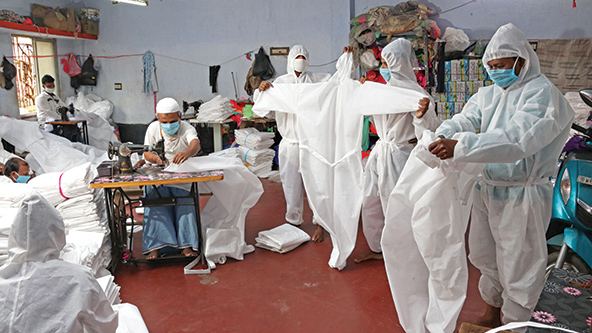
 On April 5, 2020, workers near Kolkata, India, prepare personal protective equipment to be distributed to medical staff during the country's nationwide lockdown. (Photo by Debajyoti Chakraborty/NurPhoto via Getty Images)
In March 24, 2020, India ordered one of the world’s strictest national lockdowns on its 1.3 billion citizens to combat the COVID-19 pandemic. The national government imposed a three-week ban on all domestic and international air and rail travel and shut down all offices, factories, educational institutions, malls, and shops catering to “nonessential” services. Each Indian state, in turn, halted all public and private transportation, including interstate transport, which impeded the shipping of essential commodities. The entire nation and its economy effectively came to a halt. The government extended the 21-day lockdown to 68 days.
In a country as vast and densely populated as India, with very limited spending in the public health-care system, there was perhaps little hope for another option. Studies estimated that the number of infected could range from 125 million to 240 million people at the peak of the pandemic and that as many as 1 million might require ventilators. But the country had only 57,000 ventilators at the start of the pandemic.
In this moment of public crisis, Anand Mahindra, chairman of one of India’s largest private business conglomerates, stepped forward to help. He didn’t offer just money and assistance. Instead, he committed his company’s automobile production plants and capabilities. Mahindra became one of the many for-profit firms that focused on developing and producing low-cost ventilators that suited India’s needs. In the three months of lockdown, India climbed from a significant shortage of ventilators to excess production capacity. In addition, Mahindra offered its extensive footprint and personnel across India to give the government temporary care facilities.
In a world fraught with uncertainty, unforeseen crises have the power to bring entire economies to a standstill. During such times, public attention focuses on the NGOs that typically lead relief and recovery efforts. Governments coordinate, while NGOs, thanks to their work in local communities, ensure that relief reaches every last person. But governments and NGOs cannot meet the needs of the hour, unless the products and services necessary to address the crisis are readily available or can be mobilized quickly. More often than not, this contingency depends on the procurement, production, and distribution capabilities of for-profit firms and the ability of managers to mobilize them—though their role often goes unnoticed.
Recent management research argues that for-profit firms are more effective than other types of organizations to solve certain social problems, since they are better at undertaking innovation and producing and distributing goods and services.1 We propose that handling a large-scale crisis requires a new ecosystem of networking and collaboration among multiple organizational forms—for-profit firms, government agencies, and NGOs—that combines their strengths and exploits their synergies.
In particular, we insist that companies’ resources and capabilities must form the backbone of any effective relief and recovery effort. Consequently, governmental organizations and NGOs leading a crisis response must collaborate effectively with for-profit firms to succeed. In what follows, we offer a framework for how NGOs and public administrators must address large-scale crises such as pandemics and natural disasters. We also enumerate the resources and capabilities of for-profit firms that they should access and, if necessary, retool to meet the needs of such crises.
Four Essential Capabilities
If for-profit firms and their management are central to emergency response in society, why has their role in crisis management gone underappreciated? Over the past few decades, no disaster was large enough to disrupt the entire global economy. In the smaller-scale crises that did occur, governments and NGOs—which work in the public spotlight—could continue to be effective while relying upon the resources, capabilities, and supply chains of for-profit firms as a backstop.
But the COVID-19 pandemic marked a break. As governments around the world enacted national lockdowns to contain the spread of the novel coronavirus, the global economy ground to a halt, leaving many businesses idle. This cessation made providing relief and recovery to affected people exceptionally difficult and exposed the dependence of governments and NGOs on private industry.
The challenges have been especially pronounced for developing countries like India, whose governments have more limited state capacity than more affluent countries do. Many countries lack state machinery to distribute aid to all of their regions and localities during a massive crisis. For-profit firms and NGOs, on the other hand, have a pervasive footprint because of the inherent nature of their businesses and can muster local resources quickly to address local needs. Consequently, as the pandemic demonstrated, the effective management of such a crisis requires collaboration among government agencies, businesses, and nonprofits.
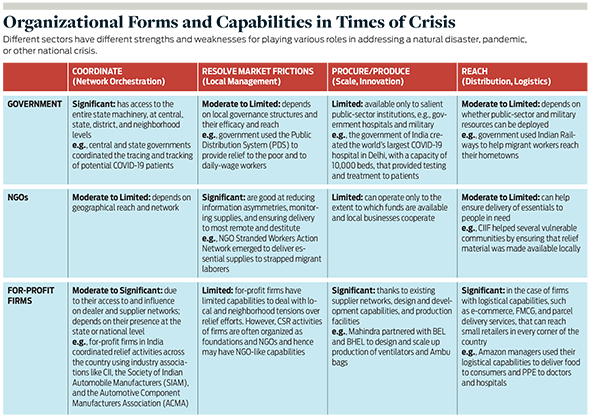
Different aspects of relief and recovery during a crisis are better managed by different organizational forms. We have carefully analyzed large-scale crisis situations that have hit multiple geographies in the world during the past two decades, such as the COVID-19 pandemic and the 2004 Indian Ocean tsunami triggered by Indonesia’s Sumatra-Andaman earthquake. We focused on the responses of various actors and stakeholders, and the strengths and weaknesses they demonstrated. Our analysis found that four capabilities are essential for managing such large-scale crises. While governments and NGOs do command some of these capabilities, they must depend on other sectors to secure all of them to their fullest extent.
Network Coordination | Crisis management requires effective coordination among many different parties to ensure that relief is delivered quickly and efficiently. Among other things, crisis coordination requires the procurement and delivery of different types of goods and services on a large scale. Governments are well positioned to coordinate, because they have authority over the entire state machinery—at the central, state, district, municipal, and neighborhood/village levels.
By contrast, individual firms are unlikely to possess the requisite authority. For-profit firms may together be able to orchestrate their networks through trade groups or partnerships in a moderate to limited fashion, depending upon the size and reach (through dealer and supplier networks) of their firms and their presence at national or regional levels. Similarly, NGOs—some with a broad presence across multiple states, others with a local presence within specific regions—have only moderate to limited coordination capabilities.
Local Management | While government centralizes coordination and leadership during a crisis, NGOs can connect relief efforts to individuals on the ground who are in need. Consequently, they can serve as fiduciary liaisons between those affected by the crisis and the broader economy and state. During a crisis, nonprofits and community organizations take on the role of local management. They resolve information asymmetries between government authorities and local needs, and monitor relief material and services on the ground. NGOs tend to be very good at these activities. Without such oversight, bottlenecks and hoarding by corrupt government officials may prevent relief funds and material from getting to those who need them. NGOs are more agile at raising funds, material, and volunteers from local communities to address the needs of these communities during a crisis.
For-profit firms are less capable of tracking and typically have less incentive to track information asymmetries on the ground, or to verify that all those in need have received their due. For-profits tend to focus on their own customer base, not all segments of society. But the corporate social responsibility (CSR) arms of firms are often effectively organized as NGOs, and they can contribute during a crisis the way other NGOs do.
Governments, by contrast, though well positioned to eliminate information asymmetry, are prone to allowing bureaucracy and corruption to impede getting the job done. In addition, some countries lack the state capacity to serve all constituents in every region and village. They instead rely on NGOs to reach all who need assistance.
Production and Procurement | We consider production and procurement capabilities together, since most organizations that engage in the production of goods and services also engage in procurement. For-profit firms are incentivized to produce goods and services efficiently. The need for raw materials and other resources makes them part of extensive supply chain networks, which give firms access to a variety of resources and actors. Such capabilities are important in crises that trigger sudden demand for products and services. For instance, during the COVID-19 pandemic, several firms in the automobile industry came together to address the shortage of ventilators and collaborated with medical-device manufacturers to ramp up ventilator production.
National governments also possess production and procurement capabilities, but they are typically restricted to areas such as defense and health care and are limited in extent. NGOs are least likely to possess these capabilities, since they are focused mostly on coordinating last-mile delivery of services and goods to the needy.
Distribution and Logistics | For-profit firms that specialize in the distribution of goods (such as e-commerce, courier, and parcel-delivery firms) command by nature significant capabilities in distribution and logistics. Such firms can help transport material and people quickly and efficiently to wherever they are needed. For instance, during the COVID-19 lockdown of Wuhan, China, from January 23 to April 8, 2020, Chinese e-commerce giants Alibaba and JD.com managed to deliver essential food and medicines to city residents safely and securely.
Governments do possess moderate logistics capabilities, typically through the military, and have access to mobile telephony/digital networks. Some governments, including India’s, also have access to public distribution systems (PDSs), railways, and public buses through which they can ensure the supply of essential items to the affected areas. NGOs, on the other hand, are least likely to possess significant distribution and logistics capabilities.
Analyzing India’s COVID-19 Crisis
To get a better sense of these four essential capabilities in action during a crisis, let us return to India’s management of the COVID-19 pandemic. The country’s lockdown was one of the world’s strictest, according to the Oxford COVID-19 Government Response Tracker. Meeting the needs of all of India’s citizens required vast coordination among all sectors.
To get a broader view of how for-profit firms responded to the lockdown, we analyzed the business communication on Twitter of the major Indian corporations listed in India’s National Stock Exchange (NSE), which tracks the stock performance of 50 of the NSE’s most capitalized companies. We found that after lockdown, companies began to focus on distributing food and other supplies, and private health-care organizations came forward to support the government in providing health-care facilities, such as hospital beds and ICU units for treatment of COVID patients. We expanded our analysis further by collecting and reviewing articles from the business press and academic literature. We found that India confronted a major challenge in producing and delivering to its 1.3 billion residents, because of the severity of the lockdown, the poor pre-existing state capacity, and the country’s inadequate social-safety net.
A deeper examination of the international business press, including the Wall Street Journal, The New York Times, The Guardian, Financial Times, and Forbes, and of the Indian business press, including The Economic Times, Mint, and The Hindu BusinessLine, revealed that firms played a central role in addressing the COVID-19 crisis and actively coordinated with other organizations.
In what follows, we describe how various organizational forms used their respective strengths in these four capabilities and came together to address India’s challenges during its COVID-19 lockdown. We especially highlight how the executives of for-profit firms played a central role in helping the government and NGOs overcome the crisis.
Producing and Delivering Essentials
While the government allowed production of essential items, such as processed foods, agricultural goods, cement, and steel, during the lockdown, firms struggled to retain the work force needed to operate their production facilities, because of popular fear of contracting the virus and lack of public transport. Several companies responded by establishing extra safety precautions, such as fumigation after every shift, use of masks and hand sanitizers, temperature checks, and social-distancing policies. Some companies even provided their own transportation and/or lodging facilities to workers to continue production, albeit at a lower capacity.
Firms also confronted the task of distributing the essential goods they managed to produce across a country under strict lockdown. India’s retail sector, which sells the majority of essential items, is largely unorganized—dominated by nearly 13 million kirana shops (traditional mom-and-pop stores). These shops are typically supplied by an intricate web of wholesalers, distributors, and manufacturers spread far and wide. To ensure the distribution of essential goods, firms had to coordinate with central and state government agencies and administrators overseeing the nationwide lockdown. Companies such as Britannia, Parle, PepsiCo, Hindustan Unilever (HUL), Dabur, Coca-Cola, ITC, Nestlé, and Mondelez wrote to the government through three separate industry associations, seeking immediate exemption from movement restrictions for delivery of essential items, on the very first day of the lockdown. The central government granted the exemption and coordinated with the respective state governments to transport essential goods across states.
To ensure delivery of goods to consumers, e-commerce companies such as Amazon, Flipkart, and Grofers ramped up their essential product lines, including food and grocery items, and transformed most of their storage, distribution, and delivery capacity to meet lockdown guidelines. As distributors of several fast-moving consumer-goods companies struggled because of a shortage of drivers, Amazon India’s logistics came to the rescue and began supplying local kirana stores through next-day deliveries. This step not only ensured supply to kirana stores but also reduced their in-bound delivery lead times from four days to one day. In addition, these stores, which could not get shipments from their traditional suppliers during the lockdown, could place a single order with Amazon for most of their bulk purchases. This arrangement led to improved efficiencies, such as lower costs and less managerial and labor time. Amazon proactively entered into arrangements with food delivery companies such as Swiggy and Zomato, which had swaths of unused capacity because of a ban on cooked-meal deliveries.
Reliance Jio, a large mobile network operator that caters to more than 50 percent of India’s internet users, entered online retail with Reliance JioMart just before COVID-19 hit the country. JioMart focused on delivering grocery and daily essentials, linking small mom-and-pop stores to local customers—a need that became urgent during the COVID-19 lockdown. To help meet the increased demand for online groceries, Reliance JioMart contracted with local kirana stores across 200 Indian cities to offer them merchant point-of-sale devices to help manage inventory and working capital, maintain digital records, accept digital payments, and file returns.
Managers of e-commerce companies and fast-moving consumer goods (FMCG) distributors also worked with government-owned Indian Railways to ramp up their inbound and outbound logistical capacities. Several NGOs and civil society organizations pleaded with local and central government officials—in some cases even reaching out to courts through public-interest litigations—to ensure that the lockdown would not disrupt India’s food and agriculture industry. They pushed to allow essential workers to travel for harvesting and to help with the storage and processing of food.
Health-Care Delivery
India’s daunting challenge of producing and distributing essential goods during the lockdown was surpassed only by the urgency of providing health care to the nation’s sick. The unprecedented scale of the pandemic and India’s history of poor investment in public health meant that the national government simply did not have adequate means to ramp up health-care capacity to meet demand. Companies and civil society organizations stepped into the gap to ensure adequate supply of ICU beds, personal protective equipment (PPE), hand sanitizer, face masks, and ventilators.
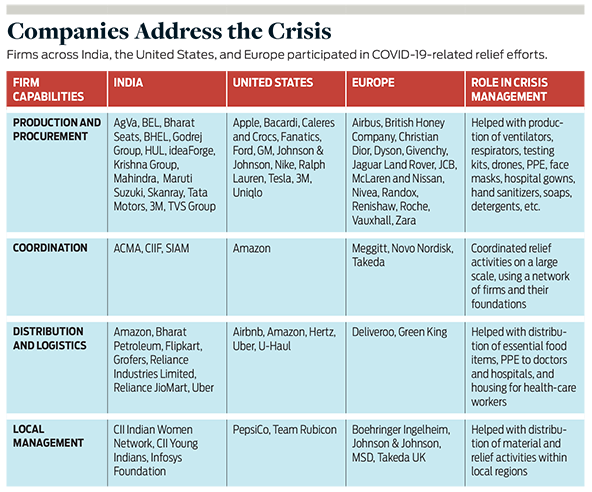
Three of India’s top automakers—Maruti Suzuki, Mahindra, and Tata Motors—committed on April 1 to manufacturing 50,000 ventilators by May 2020, through partnerships with medical device manufacturers such as Skanray and AgVa Healthcare. Mahindra also collaborated with public-sector entities, such as defense manufacturer Bharat Electronics Limited (BEL) and engineering firm Bharat Heavy Electricals Limited (BHEL), to reduce the manufacturing cost of ventilators and automated Ambu bags, through design simplifications and production scale-ups. Mahindra also sourced a design for face shields from its partner Ford Motor Company and began making them in its auto plants in Mumbai. In addition, auto-components manufacturer Krishna Group volunteered to make components for ventilators and face masks, while vehicle-seat manufacturer Bharat Seats helped produce PPE.
Indian automakers and their suppliers were not unique in taking these steps. US and European companies also devoted their production and procurement capabilities to making ventilators and PPE for frontline medical workers. In the United States, for instance, companies as diverse as Tesla, Crocs, Bacardi, and 3M helped to produce PPE and sanitizers. India also needed help to distribute the stream of health-care production. E-commerce companies chipped in to bridge delivery gaps. For instance, Amazon India delivered PPE, soaps, sanitizers, and detergents to hospitals and doctors, free of cost.
During the second phase of the lockdown, from April 15 to May 3, when several private labs and hospitals offered testing and treatment of patients, the Indian government contracted a few companies for RT-PCR test-kit production to increase testing capacity. Apollo Hospitals—the largest private hospital chain in India, with 10,000 beds—added 500 ICU beds and planned to expand to 5,000 more, if necessary. Apollo also activated the supplier networks of its 3,500 pharmacies to procure the necessary items to manage the COVID-19 pandemic, such as face masks, PPE, medicines, and ventilators. In addition, Apollo ramped up its telemedicine services by networking more doctors from its offline hospitals onto online service platforms, to reduce the patients’ need to visit hospitals.
Several large, medium, and small companies from the Indian corporate sector coordinated their pandemic relief efforts through the Confederation of Indian Industry (CII), an industry association, and its initiatives, such as the CII Foundation (CIIF) and Young Indians (YI). CIIF is a charitable trust CII set up in 2011 to support social and development initiatives across India, while YI is a nonprofit established in 2002 to promote the country’s youth leadership and economic development. CIIF, through CII’s presence across many local districts in 28 states of India, provides a bridge between marginalized communities and corporate-sector donors. YI, on the other hand, includes young (21-45 years old), progressive Indians, including entrepreneurs, white-collar professionals, and achievers from different walks of life. Companies felt comfortable contributing money and material toward COVID-19 relief through these two organizations, because they typically had members and officers in one or both, and because the organizations possess office branches, chapters, and/or affiliate NGOs across many regions of India.
Immediately after the government announced the lockdown, CIIF and YI got to work. In collaboration with CII regional and state offices, CII Indian Women Network, India Business and Disability Network, and other CII-affiliated associations, they partnered with government officials in each district and township (taluka), to create awareness about the best hygiene practices, including the importance of handwashing and social distancing. They also distributed hygiene kits, rations, and other daily essentials. Through this coordinated effort, Indian corporations managed to provide dry rations and cooked meals across 28 states and food for more than seven million people. They also distributed relief through community kitchens across 23 different cities and supplied more than 1,700 metric tons of food grains to those in need. In addition, they donated soap, hand sanitizer, face masks, face shields, and PPE to vulnerable populations and frontline workers in police, district administration, and health-care departments. With the support of industry, CIIF also set up tele-ICU centers across nine government hospitals in Maharashtra and Haryana to offer 24-hour remote ICU patient monitoring, as a stopgap for the growing physician and nurse shortage. All of these relief activities helped some of India’s most vulnerable communities, such as the disabled, nomadic tribes, lepers, farm laborers, widows, and migrant workers.
To help Maharashtra and other states severely affected by the pandemic, ideaForge, an unmanned-aerial-systems company, deployed drones to help police forces impose security surveillance and monitor social distancing within communities. From civil society, volunteer groups like Coronathon.in, which called itself “India’s COVID-19 Online Hackathon,” sprang up overnight to enlist thousands of technology developers from India’s tech businesses and health-care industry to build dashboards, platforms, apps, and other tools to help reduce the pandemic’s impact on India. Among other things, they developed a COVID-19 dashboard for state chief ministers; created platforms that connected PPE donors, recipients, and suppliers to bridge the gap between supply and demand; and designed an app to help hospitals better manage the influx of COVID-19 patients.
The Need for Greater Collaboration
India’s COVID-19 experience demonstrates how various for-profit organizations filled in gaps opened by the country’s lockdown—gaps that NGOs and the government could not hope to fill on their own. But as welcome as they were, business-led interventions were quite ad hoc in nature and at times arrived too late.
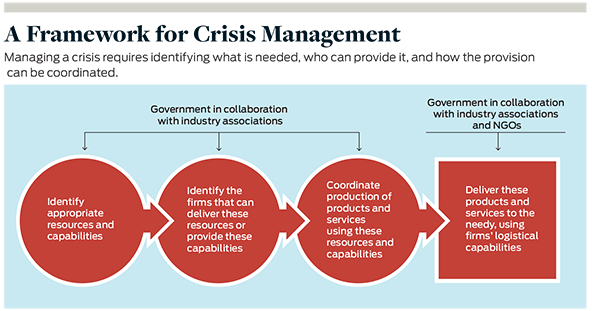
Our investigation of India’s pandemic management demonstrates the need for greater collaboration between various organizational forms and across sectors. To systematize such reforms, we propose a generic framework to help stakeholders collaborate to meet the immediate needs of a crisis more quickly and efficiently.
According to our framework, when a crisis hits a country, the government must work with industry associations to identify the resources and capabilities necessary to address the urgent needs of the affected parties. Instead of focusing simply on their immediate departments and niches, policy makers, NGOs, and business leaders must take stock of the core resources and capabilities they jointly command and figure out how they can best retool these capabilities to meet the needs of the crisis.
Next, government institutions must coordinate with firms and NGOs to help them redesign and scale up, because their existing internal capabilities alone are unlikely to suffice in meeting the needs of a large-scale crisis.
Third, for-profit firms must take the lead in procuring and producing the goods and services deemed necessary through these collaborative efforts.
Finally, the coordinating agency (usually the government ministry in charge of crisis management) must ensure that these products and services are delivered swiftly to the affected population, using the distribution and logistics capabilities of enlisted organizations. Our research showed that NGOs and charitable foundations possess good local management capabilities and should therefore be responsible for ensuring delivery of essentials to all, including the most remote and needy.
The relief efforts after the 2004 tsunami are a good example of how enhanced collaboration among multiple organizational forms can be very effective in managing a large-scale crisis. Nagapattinam, in the southern state of Tamil Nadu, was one of India’s worst affected districts: More than 7,000 hectares of agricultural lands flooded there. Initial estimates suggested that it would take at least two to three years to desalinate the land and resume farming activities in that area.
In response, Nagapattinam’s district administration quickly put together an NGO Coordination Resource Centre (NCRC), starting with 23 NGOs that volunteered to work together toward the land-reclamation effort. Nearly 400 NGOs came together to help out with the relief activities in about 80 villages severely affected by the tsunami. NCRC, in collaboration with relevant government departments, local communities, and farm-equipment manufacturing companies (which provided necessary tools and machinery), worked tirelessly to reclaim the tsunami-affected lands and made them cultivable in less than a year.
The NCRC later also focused on rehabilitating the affected population through more coordinated interaction among district administration, NGOs, and funding organizations. For instance, several fishing villages in Nagapattinam lost their homes and livelihoods and required damage assessments, compensation, housing, and alternative livelihood opportunities. NCRC created village information centers to facilitate communications between affected villagers and funding organizations, so that appropriate relief could be mobilized and made accessible to the needy. It also established village facilitation units and a clearinghouse that collected information, identified needs, and ensured that adequate support was provided to priority areas and communities. The NCRC’s success underscores the vital importance of coordination in catastrophe response.
Who Benefits?
As the world struggles to recover in COVID-19’s wake, economic revitalization will require governments, NGOs, and for-profit firms to work together. But what will motivate the respective parties to invest their time and energy? What’s in it for firms? Why should for-profit companies venture into crisis management? What will NGOs and the government get out of it?
In addition to fulfilling CSR responsibilities and generating goodwill, firms can spark new business opportunities through participation. Given the uncertainty that the COVID-19 pandemic has created for businesses, participating firms will likely have a better understanding of the market and be better prepared to face the future than rivals who do not partake in crisis-management efforts.
NGOs will likely open new avenues to increase their reach and sources of funding through collaborations with for-profit firms and their foundations and associations. This opportunity especially holds in countries like India, where for-profit firms are required to spend 2 percent of their profits on CSR activities. Collaborations with government and for-profit firms during crises can enable NGOs to better demonstrate their causes and needs, build credibility, and strengthen their future calls for funding. NGOs will also get the chance to work with public servants and build networks with government agencies; doing so will likely help them to better navigate regulatory hurdles and manage future dealings with government agencies.
Finally, the government gains greater capacity from these collaborations. Government agencies can more easily access and draw upon NGOs and for-profit businesses to address future crises. The intense collaborative efforts between for-profit, government, and NGOs, such as the NCRC, can also provide blueprints for long-term, community-related development work to address local problems. In such undertakings, for-profit firms can provide the necessary resources and CSR funding, NGOs can act as coordinators and volunteers for implementation, and government can fill the remaining gaps by putting in place appropriate regulatory structures and incentive mechanisms.
When countries face disasters, no one organization has the resources and capabilities to deal with it, so resources across different organizations need to be pooled. Therefore, intense collaborations and networking among multiple organizations is necessary to bring together the unique strengths of governments, NGOs, and firms. As India’s 2020 pandemic response showcased, when such collaborative efforts get deployed, even the deadliest of disasters can be managed effectively.
Read more stories by Haritha Saranga & Prateek Raj.