


 (Illustration by Yarek Waszul)
As the boundaries between business and charity become increasingly blurred, many nonprofits are considering how to pursue their mission through revenue-generating activities rather than relying on philanthropic contributions alone.1 This trend toward commercialization was sparked by dwindling governmental and donor support in the 1980s and ’90s, which created mounting pressure on nonprofits to diversify their funding sources.2 More recently, starting in the early 2000s, new types of resource providers emerged seeking to support nonprofits that generate financial—not just social—returns. By the early 2010s, even traditional charitable foundations began pursuing impact-investment strategies.3 Encouraged by these opportunities, nonprofit leaders increasingly see commercialization not as a necessary evil, but as a promising way to enhance and expand their social mission.
Integrating revenue-generating activities within a nonprofit’s existing organizational model is not simple. To be effective in the long term, any shift toward commercialization must be consistent with the organization’s social mission and use its core capabilities. Yet nonprofits often struggle to find new approaches that enhance—rather than distract from—the social mission. Moreover, commercialization initiatives stretch already limited resources and often require new skills and expertise beyond the capacity of the current team. How, then, can nonprofit leaders identify a viable commercialization strategy?
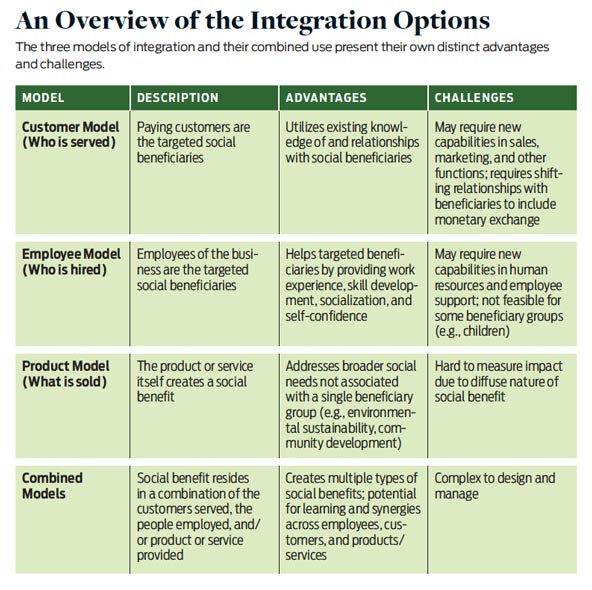
Based on more than a decade of research on nonprofit organizations and social-business hybrids, including 1,200 that filed applications with Enterprising Nonprofits (ENP), a major Canadian grantmaking body, we have identified three approaches for integrating revenue generation within an organization’s social mission.4 They are the customer model, in which integration occurs through who is served; the employee model, in which integration occurs through who is hired; and the product model, in which integration occurs through what is sold. To inform the decision making of nonprofit leaders considering their first—or next—move toward commercialization, we developed a framework outlining these alternatives and an associated set of decision criteria. The core premise of our framework is that there are multiple ways in which a nonprofit can integrate revenue-generating activities with its social mission, and leaders should choose the approach, or combination of approaches, that best fits their organization’s mission, resources, and capabilities.
Separation Versus Integration
Nonprofits often begin their approach to revenue generation with a mistake: They envision commercial activities separately from their social programs. For example, museums often operate a gift shop or café; numerous nonprofits generate income by selling merchandise or apparel bearing their logo. This separation between business and mission can enable organizations to create additional revenue streams not tied to particular funder mandates.
But this approach fails to capitalize on potential synergies and complementarities between revenue-generation activities and social mission. For example, a nonprofit with a mission of increasing food security for low-income populations could put on an annual tag sale of used clothing or donated goods to generate funds and create awareness, but this activity would neither utilize its expertise in food issues nor would it directly contribute to the core mission. In addition, organizing the event might siphon off resources and managerial attention that could otherwise be devoted to more mission-critical activities.
In contrast to the separation approach, new models being developed by the most innovative nonprofits seek to leverage commercialization for social good by integrating revenue-generating activities with the social mission. For example, a nonprofit focused on child and family welfare might initiate a fee-based intervention program for autistic children to provide families with social and emotional support and expert advice. While complex to design and manage, an integration approach has the advantage of enabling nonprofit leaders to pursue a single set of activities that both advance the social mission and generate revenues. In fact, the most effective integration approaches combine social and commercial activities in ways that generate synergies among them. To return to our previous example, the nonprofit that provides fee-based programs to families of autistic children can use its existing client relationships to generate additional revenues at a relatively low cost, while also offering more substantial support to families in need. In this way, both social impact and revenue generation are greater than either would be on its own.
Although our research suggests three distinct models for nonprofits to integrate revenue-generation with their social mission, they are not mutually exclusive. In fact, it is increasingly common for nonprofits to combine multiple models. Organizations should choose an approach that fits their social mission and existing resources and capabilities. Let us consider the models in turn.
The Customer Model: Who Is Served
Traditional charities provide beneficiary groups with products or services free of charge. By contrast, the customer model involves selling a product or service to the target population—therefore treating them not just as beneficiaries but also as customers whom the nonprofit serves through a business. In this way, the customer model integrates revenue generation with social mission by focusing on who is served by the organization. Social impact comes not primarily from the product or service provided but from the population you target as customers of the product or service.
Consider World Education Services (WES), a New York City-based nonprofit that serves recent immigrants seeking to gain employment in North America. This population struggles to gain recognition in the United States and Canada for the educational degrees that they earned in their home countries. To address this issue, WES offers credential-evaluation services for a modest fee. In return, immigrants receive a credential-evaluation report that is endorsed by national accreditation bodies in both countries and accepted by more than 2,500 employing organizations. By combining their beneficiaries and customers into a single group to be served, WES has found a way to generate revenues while meeting the needs of its target community.
The customer model affords the advantage of familiarity with the beneficiary group. In the case of the Tseshaht First Nation on Vancouver Island, for example, leaders’ knowledge of community norms and the local transportation infrastructure helped them identify a challenge facing indigenous youth—the lack of a driver’s license. Not having a license significantly limits employment prospects for youth in the community, because public transportation systems are weak. Leaders also understood that aboriginal youth had few incentives to get a license, because their families often had no car and their relatives tended not to have licenses themselves. Recognizing that the driver’s license problem was becoming an intergenerational social issue, Tseshaht
First Nation partnered with a local driving school and an aboriginal training organization to launch a driver training and testing service focused on aboriginal youth.5
A nonprofit that wishes to adopt the customer model may face several challenges that need to be addressed. First, nonprofits may not initially have the capabilities to create and sell the kinds of products or services that would meet their beneficiaries’ needs. Many development organizations faced this challenge when they first launched microfinance activities. Deeply knowledgeable about health, education, and economic hardships in the impoverished communities they served, leaders in this sector understood that access to small loans could help community members, especially women, gain economic independence and break the cycle of poverty. Yet their organizations did not necessarily possess the skills and capabilities to offer financial services, and it was not easy to find new hires with a background in both finance and social work. Nonprofits such as Banco Solidario in Bolivia, a spin-off of the larger NGO Banco Prodem, suffered significant internal conflict and turnover as they sought to hire and train the right mix of individuals to staff their nascent microfinance business.6
Second, the customer model requires a significant cultural shift for nonprofits and their beneficiaries, because it adds a monetary component to relationships that were previously based on noncommercial exchange. How can beneficiaries be convinced to pay for the new product or service? The greater the differentiation between what was provided in the past and the new products or services offered, the easier it may be to overcome this challenge. At the same time, if the product is too removed from existing services, it may not present many opportunities for synergies with the nonprofit’s ongoing activities, even if it targets the same population.
Third, the customer model may simply not be feasible for some social missions. Organizations that serve children, for example, are unlikely to be able to adopt this model, unless they shift to think about parents and caregivers as customers. Likewise, organizations that address broad social issues such as environmental sustainability do not have a specific population of individuals they seek to serve.
Finally, there are important relational and financial factors to keep in mind when considering the customer model. Both funders and beneficiaries themselves may be concerned about mission drift—the risk that commercial exchange will lead the organization to lose focus on the beneficiaries’ most important unmet needs.7 Organizations adopting the customer model may therefore need to be particularly diligent about selecting activities not just because they can be monetized, but also and indeed primarily because they fulfill a critical social need for the existing beneficiary population. Otherwise they risk losing financial support from traditional funders and damaging trust and goodwill with beneficiaries. Nonprofits pursuing this model might also benefit from securing new sources of funds, such as social impact bonds or impact investments, which not only encourage but often require financial as well as social returns.
The Employee Model: Who Is Hired
In the employee model, revenue generation is integrated with social mission through who is hired by the nonprofit: The beneficiary is the employee who produces the good or service being sold to customers. Nonprofits adopting this model are often referred to as “work-integration social enterprises” (WISEs), because they facilitate beneficiaries’ integration in the labor market through work experience, skill development, training, and socialization. The employee model is especially appropriate for serving populations that traditional employers are not well-equipped to hire due to beneficiaries’ particular needs or perceived challenges.
Digital Divide Data (DDD), for example, was founded in 2001 with a mission of helping impoverished people in Southeast Asia break the cycle of poverty and move on to better economic futures. Recognizing that these individuals struggled to find well-paying jobs due to their low education and skill levels, DDD launched a nonprofit IT outsourcing business that offers entry-level jobs and provides extensive training as well as scholarships and loans to support further education. Those who finish the entry-level program move up to higher paying jobs either within DDD or with other organizations. Today, DDD graduates earn approximately eight times more than their peers employed elsewhere, with additional gains in self-confidence and other skills critical to their well-being and economic independence.8
The employee model can significantly enhance a nonprofit’s social impact. As DDD’s experience indicates, beneficiaries in a work-
integration model not only win income from employment, but they also boost their future employability and earnings, as well as their self-confidence and self-efficacy. Moreover, many of these gains also benefit their families and communities. This model can also enhance a nonprofit’s internal capacity to fulfill its mission. Employees from the target population may possess a deeper understanding of beneficiaries’ needs as well as strong relationships with this group, helping the organization to better reach and serve them. Finally, integrating beneficiaries into the organization’s workforce can enhance motivation and meaningfulness among existing employees.
Northwest Center (NWC), a US nonprofit that serves people with developmental disabilities, illustrates these benefits. NWC had long funded its services in part by operating various manufacturing and service businesses. In an effort to more fully realize its mission of social and economic inclusion for people of all abilities, NWC significantly increased its hiring of people with disabilities to work in the business units. This shift not only provided substantial benefits in income and socioeconomic well-being to the individuals now employed, it also transformed their coworkers, who developed a much broader understanding of ability and found their jobs more meaningful. Moreover, quality and productivity improved significantly, as supervisors redesigned work processes to utilize the unique abilities of employees who were differently abled.
Like other integration approaches, the employee model also has its challenges. First, for nonprofits that have traditionally relied on the provision of services to beneficiaries, integrating beneficiaries into the workforce may require a shift in roles and outlooks. Instead of treating beneficiaries only as individuals to be helped, leaders must also see them as valuable contributors who have something to offer the organization. The employee model also requires a substantial investment in training and socialization, and it may increase attrition and turnover in the short term as the organization gains experience with integrating the target population into the workforce. DDD initially faced these challenges with some of its target populations in Cambodia, particularly women rescued from sex trafficking who required not just English-language and computer-skills training but also extensive social and emotional support.
Nonprofit leaders considering the employee model must understand the needs of the target beneficiary population and design training and support programs that take these needs into account. To further these efforts, many national governments worldwide provide subsidies to organizations that include a work-integration component in their activities. In Germany, for example, three-quarters of WISEs receive substantial public support; half of all WISEs in Ireland receive at least 75 percent of their funds from the government at multiple levels; and in Japan, WISEs that employ and train people with disabilities receive more than half of their funds from the state.9
The Product Model: What Is Sold
The third model focuses on integrating revenue generation and social impact through monetizing a product or service. In this approach, the social benefit resides primarily in the product or service sold, rather than in the customers or beneficiaries buying it or the employee providing it. For example, in projects aimed at selling organic seedlings for farmers, or increasing re-use and recycling of housing materials, the primary social benefit resides in the product itself. Similarly, for regional food hubs that aggregate, distribute, and market local foods grown using sustainable farming practices, the social benefit comes from the service being offered, which supports environmental sustainability, healthy eating, and regional economic development. Our research suggests that the product model is becoming increasingly common among nonprofits seeking to initiate commercial activities. In fact, among nonprofits applying to ENP that proposed any one of the three models, the product model was the most common by the end of the 13-year time period in our study.
A primary advantage of the product model is that the social impact realized is not limited to just one particular beneficiary group. The product model is therefore a natural fit for nonprofits that target broader social needs such as environmental sustainability or community development. For example, an organization working on environmental sustainability and community development launched a waste-reduction and composting service, aimed at both residential and commercial customers. By centralizing the retrieval of organic waste, as well as the processing and sale of organic compost, this nonprofit created a commercial service that provides the social benefit of reducing waste volume and increasing the availability of compost. The program also offers a broader educational benefit by informing other local organizations and residents about organic farming and sustainability.
Yet despite its growing popularity and seeming simplicity, the product model presents several challenges tied to the difficulty of identifying a specific beneficiary group and measuring social impact. In the case of food hubs, for example, social impact comes partly from enabling local farmers to sustain and grow their operations, and partly from helping underserved consumer segments gain access to fresh produce. But the service provided by hubs can also yield more diffuse environmental and public health benefits that individual organizations rarely have the resources to measure. The diffuse nature of the social benefit also means that funders with a mandate to help a specific target population might be less inclined to support nonprofits adopting the product model. Organizations may therefore have to work with a variety of different funders, including those that support broad social issues as well as those that focus on specific populations that may especially benefit from the product or service, such as low-income urban communities and youth in public school systems in the case of food hubs.
Combining Integration Models
While many nonprofits choose to integrate revenue generation with their social mission through only one of the three models, some adopt more than one. In fact, our research suggests that combining models is increasingly common. Consider Furniture Bank, a Toronto-based social enterprise that provides furniture free of charge to populations in need, including newcomers to Canada, women coming out of abusive domestic situations, and the formerly homeless. By charging nominal fees for the pick-up of unwanted furniture items, Furniture Bank was able to monetize a service to the broader population and to give new life to furniture items that would otherwise have ended up in landfills (product model). By hiring former beneficiaries of the charity to perform the pick-up service and refurbish collected items (employee model), Furniture Bank was able to further extend its social impact.10
Other organizations combine all three models. For example, Aki Energy Inc., an indigenous-owned and operated business, installs renewable energy systems and energy efficiency upgrades for individual homes and institutions of First Nations communities in Manitoba, Canada. By hiring and training indigenous workers on state-of-the-art technology, Aki Energy provides employment opportunities for its target beneficiary group (employee model) while also selling sustainable solutions (product model) that expand the scope of services available to its target beneficiary group (customer model).
Combining more than one approach to integration can yield synergies between different areas of activity. Employing individuals from a given beneficiary group, for example, may help an organization learn about that population, ultimately making it easier to sell products or services to them. Selling a product or service with intrinsic social benefits may help reach new customer groups and expand the population benefiting from the nonprofit’s activities. In this way, combining models can help ensure that revenue generation and social benefits are mutually reinforcing. Yet, this approach also requires a higher degree of managerial sophistication, because multiple dimensions of change in the organizational model need to be juggled at the same time.
Choosing the Right Model
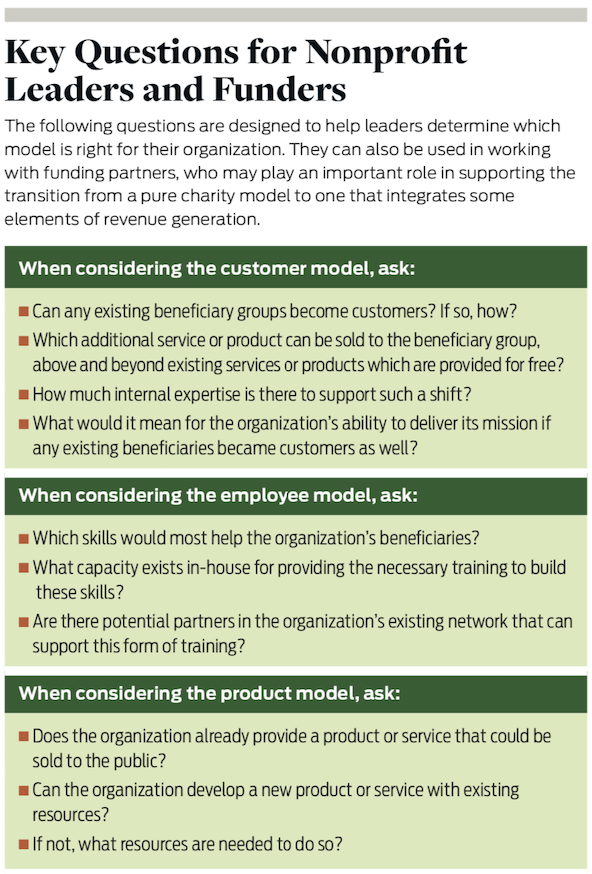
The decision to switch from a purely nonprofit model to one that includes commercial activities is neither simple nor straightforward. It often requires a significant cultural shift and may increase costs in the short term. Yet initiating commercial activities need not require a complete organizational overhaul, and in the long term it can enhance both social impact and financial viability. To choose the best path forward, nonprofit leaders should weigh the advantages and challenges of the integration models and assess how well each one fits their organization’s mission, resources, and capabilities.
One critical concern is whether shifting to an earned-income model might compromise existing sources of revenue such as individual donations, foundation and government grants, and even corporate funding. There is also the issue of legal structure, since many countries have extensive regulations governing the kinds of commercial activities in which a nonprofit can engage. In Canada, for example, the Canadian Revenue Agency (CRA) stipulates that nonprofit organizations intending to begin a revenue-generation activity can only do so if it is a “related business.” Furniture Bank’s pick-up service fits this criterion because the organization was already running a furniture donation and distribution service. However, launching a more distant revenue-generating activity, such as a catering service, would jeopardize the organization’s nonprofit status. To address these issues and preserve vital revenue streams from existing funders, some organizations may need to create a contract hybrid, with a for-profit legal entity managing the earned-income activities and the existing nonprofit entity handling charitable activities.11 Other organizations may choose to shift to a new integrated legal structure such as the benefit corporation in the United States or the community interest corporation in the United Kingdom, both of which involve for-profit organizational forms with a legally binding commitment to a particular social mission. In many cases, however, nonprofits can incorporate revenue-generating activities within their existing legal structure by serving beneficiaries as customers, hiring beneficiaries as employees, or producing a socially beneficial product.
Another consideration, which applies to any commercial endeavour, is whether the revenues generated can offset the additional costs incurred. Providing the service or product, or employing beneficiaries, might in some circumstances be so costly as to obviate any financial benefit. Leaders will need to assess what organizational resources and capabilities are required to make the shift to an earned income model. In some cases it may be necessary to purchase or lease physical assets, and organizations pursuing the employee model may need to hire new training staff to help integrate beneficiaries into the workforce.
Finally, it is important to consider whether the organization has the required leadership capabilities to support a smooth transition toward revenue generation. Leaders must be open to seeing the organization’s beneficiaries—and its existing products and services—in new ways. Yet to be effective in the long term, leaders must introduce commercial activities without alienating employees, volunteers, and supporters who are deeply attached to the social mission.
Given the substantial challenges involved in such a cultural shift, it may work best in some contexts to hire external leaders to ease the transition. The advantage of this approach is that leaders without a history in the organization tend to be less attached to the existing culture and can bring a fresh perspective. On the other hand, new leaders must gain the trust and respect of staff while they challenge the existing approaches to which these individuals may be deeply committed.
For nonprofits willing to take the commercialization plunge, developing activities to earn income offers the potential to diversify revenue sources while at the same time enhancing social impact. Nonprofits can reap the benefits of increased income and financial stability, while also finding novel ways to achieve their primary goal of providing maximum social impact to the communities they serve. And by embedding their social mission within revenue-generation initiatives rather than keeping those activities separate, nonprofits can further benefit from potential synergies between the two.
This article appeared in the Fall 2019 issue of the magazine with the headline: "The Many Roads to Revenue Generation"
Read more stories by Marya Besharov, Jean-Baptiste Litrico & Susanna Kislenko.