


 (Illustration by Jasmin Pamukcu)
In early 2026, US Rep. Lauren Underwood and her colleagues reintroduced a package of 14 bills that they hoped would finally be enacted by Congress to address maternal mortality and related health inequities. Previous versions of the legislative package had been introduced as the Black Maternal Health Momnibus Act. This time, however, when the bills were introduced for consideration, sponsors had changed the name: It was now, simply, the Momnibus Act.
The removal of the word Black from the proposed legislation’s title and largely from its contents was intentional. Underwood’s office described the change as a strategic way to move the legislation forward in a political environment that’s been openly hostile to any policy that addresses racial inequities, while still attempting to direct resources toward women who need them. However, advocates who have dedicated their careers to this issue see the change as an effort to erase the very people the legislation was created to protect. The case for providing resources through the Momnibus Act rests on data that revealed unjust racial disparities in maternal health outcomes. The data showed that Black women have among the highest pregnancy-related death rates in the nation. Deleting the word Black or failing to collect the data doesn’t make the racial inequity disappear—just the evidence that proves it. Erasure doesn’t just happen when a federal agency deletes a dataset. It also occurs when a political climate is so oppressive that it makes the mere act of naming racial injustice a liability. You can’t fix an inequity you’re not permitted to name. You can’t allocate resources to address a problem that you’re not allowed to measure.

As the Trump administration has taken down or altered hundreds of federal datasets that don’t align with their political or ideological priorities, it has become clear that the old order of our federal data system has effectively collapsed. The data systems that state and local government agencies, researchers, and community organizations once considered trusted, fixed features of the landscape are no longer reliable, have been weaponized against communities, and in some cases no longer exist.
The ongoing federal data collapse now threatens one of the nation’s most essential data sources—the US Census. Conducted every 10 years, census data is used to allocate federal funding to communities, determine political representation in Congress, and inform programs related to housing, transportation, emergency preparedness, and more. But in September 2026, the Trump administration proposed unprecedented changes to the US Census, including a prohibition on collecting data related to race, ethnicity, and sexual orientation, as well as the exclusion of many noncitizen residents. These changes, if adopted, would infuse discrimination, exclusion, and inaccuracy into a critical national data source. Excluding noncitizens would also likely violate the 14th Amendment’s requirement that census results include “the whole number of persons in each State.”
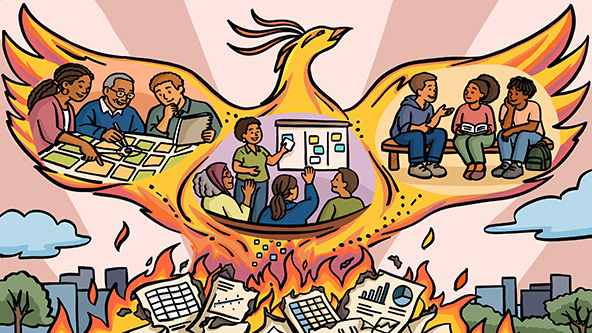
While the destruction of so many federal data sources must be grieved, it also reveals a moment ripe for reimagination. We are living in a Phoenix moment: a volatile, high-potential period for transformation where we can create new and better approaches to federal data. This moment offers us an opportunity to change, and ultimately improve, how our country produces, protects, and uses civic data—information a society gathers about itself to influence governance and determine where resources should flow. Like the mythical bird of the same name, we must first contend with the burning ashes of the old data order and assess the cost of its limitations and its loss. Only then can we rise anew from the ashes with better approaches to federal data—approaches that are more inclusive, more insightful, and more actionable for communities across the nation.
The Federal Data Collapse and What It’s Cost Us
The disappearance of federal data did not happen in isolation. It occurred in parallel with the dismantling of federal institutions responsible for its collection, interpretation, and use. And nowhere is the cost of this data disappearance clearer than the impact it’s had on public health. In March 2025, just two months into the second Trump administration, the US Department of Health and Human Services (HHS) announced roughly 10,000 layoffs. At the Centers for Disease Control and Prevention (CDC), numerous grants were cancelled or revoked and thousands of staff were cut, putting public health programs, data collection efforts, and protections in jeopardy across the country. In July 2025, the CDC suddenly made the surveillance of the microscopic parasite cyclospora optional after nearly three decades in which reporting had been mandatory. The decision was part of a broader retreat that also stopped federal efforts to routinely track six other foodborne pathogens. Fast forward just a year later: An outbreak of the intestinal disease cyclosporiasis quickly spreads across the country, with confirmed cases in the thousands, as investigators—now lacking essential public health data—struggle to trace the source.
Also, in early 2025, the Trump administration began dismantling USAID and withdrew from the World Health Organization (WHO). By May 2026, an Ebola epidemic broke out in the Democratic Republic of the Congo and spread to Uganda. The specific strain that caused the outbreak had no approved vaccine or treatment and the international response to the outbreak was dangerously delayed, causing “needless suffering and death.” Public health experts have described the dismantling of USAID, the WHO withdrawal, and the CDC cuts as a combined blow that made rapid response impossible. USAID once ran the systems that transported patient samples from remote areas to laboratories for testing. With those systems gone, samples were moved at the wrong temperature during the outbreak, delaying even the confirmation that Ebola was what they were facing.
These are just a few of the consequences of a civic data collapse, which will inevitably ripple outward for years to come. Some of what we are losing may not even be counted because even the capacity to count it has been cut. With surveillance systems being deleted and altered—or simply switched off when mass layoffs left no one to run them—the result is a society that’s in danger of erroneously assessing its problems, misunderstanding what it sees, and failing to act while there’s still time.
The Old System Was Already Flawed
Although the collapse of our old federal data system is lamentable, the harder truth is that many federal data systems were already failing the people they were purported to serve in two key ways.
The first flaw in the old system: It often failed to count what mattered. Consider what it took for the United States to start counting maternal deaths on a national scale. To catch maternal deaths that were being missed across the United States, the National Center for Health Statistics (NCHS) added a pregnancy checkbox to the US standard death certificate in 2003. And while states often model their own death certificates after the standard one created by NCHS, no federal law requires them to adopt it. As a result, the adoption of the pregnancy checkbox wasn’t quickly utilized by states. Uptake slowly crept along as states ultimately recognized its value or as state laws required its use, with the final state adopting the checkbox in 2017, 14 years after the NCHS instituted it. During that same timeframe, NCHS had stopped publishing an official national maternal mortality rate because data from states with and without the checkbox couldn’t be properly compared. When reporting finally resumed in 2020—after a silence of more than a decade—the data revealed that Black mothers were dying at two and a half times the rate of white mothers. This racial inequity didn’t magically appear while no one was looking. No one suppressed the data. It simply went unmeasured. It was a flaw in the system created by delays and neglect. And now, that old flaw has opened the door for more deliberate data harm.
In July 2026, the Equal Employment Opportunity Commission (EEOC) proposed eliminating six decades of annual demographic reporting by employers, including EEO-1 reports that allow the agency to examine patterns of workforce discrimination by race and sex. Civil rights constitutional protections remain, but what may disappear is the routine evidence needed to see whether they are working. A federal system that was once allowed to stop counting what mattered due to bureaucratic delays now gives rise to one that stops counting on purpose.
The second flaw in the old system: Federal data systems were more often built to monitor problems rather than solve them. Take the National Highway Traffic Safety Administration’s Fatality Analysis Reporting System (FARS), a federal data system that has been keeping count of every death in a traffic crash on American roads since 1975. It is meticulous and comprehensive, but it was built to track fatalities, not to directly prevent them. Nothing in its design requires responsible government agencies to take specific, timely actions. Like many other data systems, FARS operates from a well-meaning yet faulty assumption: Once the numbers exist, the right action will be obvious, someone will take it, and the problem will be solved. But that’s not how it’s worked in over 50 years. In 2024, nearly 40,000 people died in crashes on US roads—a number that’s only about 5,000 fewer than the number of road fatalities that occurred in1975, the year FARS began. The data continues to accumulate, and so do the deaths.
Old Flaws and New Efforts to Weaponize Them
Now both flaws are being exploited. Data systems that were presumably built for public benefit are being turned into harmful instruments of surveillance or being rendered useless at a time they are needed most.
The US State Department runs the Smart Traveler Enrollment Program (STEP), through which Americans abroad register their whereabouts so the US government can reach them in a crisis. Its entire premise is that collecting the data will produce protection. In March 2026, as the US war with Iran closed airspace across the region, the State Department told Americans in more than a dozen countries to depart immediately. But those who called a State Department hotline heard a recording: Do not rely on the US government for assisted departure or evacuation, there are currently no US evacuation points.
STEP failed people by going silent when they needed it. Other systems have done worse, turning the data people shared in good faith against them.
Section 6103 of the US tax code makes taxpayer information confidential. For decades, this assured undocumented workers that filing would not expose them to immigration authorities. Many undocumented workers filed their taxes, not because they trusted the government, but because the promise of confidentiality made participation possible. But that promise was broken on April 7, 2025, when the IRS signed a memorandum of understanding with US Immigration and Customs Enforcement (ICE) permitting the agency to confirm names, addresses, and tax data for people facing deportation orders. In May 2025, ICE began arresting people at their mandatory immigration court hearings, using the court system’s own scheduling data to do it. By June 2025, ICE had requested 1.28 million taxpayer records, and by the time a federal judge blocked further sharing the following November, tens of thousands of records, including home addresses, had already been ceded to the agency.
The tax code had not changed, but the method of weaponizing it had.
And if the IRS wrongfully shared people’s data, and ICE weaponized it, then the Social Security Administration (SSA) took things even further by outright falsifying it. In April 2025, at the direction of the Department of Government Efficiency (DOGE), a temporary Trump administration initiative that sought unfettered access to federal databases, roughly 6,100 living immigrants—ranging from children to people in their 80s—were falsely entered into the SSA’s Death Master File and marked as deceased. Being recorded as dead freezes a person’s bank accounts, ends their benefits, and makes legal work impossible. Banks and credit bureaus rely on the file because it has long been trusted as accurate. But entering false deaths corrupted the instrument itself. And no controls were built into the system to prevent it.
The older federal civic data system had two defining flaws: It often failed to count what mattered, and it too often failed to act on what it knew. The current moment now reveals a third flaw: Data systems that may have once been built to serve the public are now increasingly being repurposed to surveil, punish, and deceive them. The question is no longer whether our data systems work. It’s now: Whom do our data systems work against, and who benefits from the harm?
What Rises From the Ashes
So, what do we build in the open crater that the federal data implosion has created? What can rise from the ashes? By affirming this as a period of transformation, we are freed from simply recreating what’s been lost. We can imagine something new, something better. We can rebuild in ways that are values-driven, community-centered, and action-oriented, and we have historical proof it can be done.
During the AIDS crisis, four years passed between the first reported cases and the first time a sitting president publicly addressed the epidemic, and in the midst of that painful silence, communities did the work themselves. In March 1983, Larry Kramer published the article, “1,112 and Counting” in a newspaper that served the LGBTQ+ community. The title made it clear that someone outside of government was keeping count because no one inside it would. The Gay Men’s Health Crisis in New York and other organizations founded at the time documented needs the state refused to acknowledge and provided services the state failed to fund. And the work didn’t stop at counting. ACT UP’s science wing was called the Treatment and Data Committee: People with no formal training dedicated themselves to studying FDA procedures, analyzing trial protocols, and pushing the agency toward reforms that changed how drugs reached dying patients. One member designed the clinical trial that brought a breakthrough therapy to approval and helped change the course of an epidemic.
The Black Panther Party’s free breakfast program offers an even earlier example of communities turning federal data into action long before federal agencies themselves. In 1970, witnesses at Senate hearings testified that federally supported school meal programs were missing millions of eligible children. Two years later, the federal breakfast program, which provides low-cost or free morning meals to students in schools and residential childcare institutions, still reached less than a quarter of the nearly 5 million low-income children who qualified. Government action was clearly needed, but the Panthers didn’t wait for it to act. By the end of 1969, their free breakfast programs were feeding more than 20,000 children across the country, far more than the federal government was serving at the time. Alongside anti-hunger advocates, the Black Panthers helped create a model for what was possible, and in 1975, Congress finally expanded the School Breakfast Program and made it permanent. Research has since found that expanding access to school breakfast improves children’s diets and their math and reading scores.
These are two of many examples in which communities recognized the failure of government to act on their own evidence and used government data and their own ingenuity to meet the need themselves, well before government interventions caught up. And even today—as we work to reimagine, redesign, and rebuild our federal data system—we can learn a lot from communities across the country that are already working to improve civic data. Their work is converging along three principles. First, respect and defer to community authority: Data must benefit and be governed by the people it describes. Second, value words as much as numbers: Quantitative data isn’t absolute. People’s lived experiences, conveyed through stories, art, and music, are invaluable and essential civic infrastructure. And third, create an intentional pathway from evidence to action: Design data systems around the decisions they are meant to inform. Data that ends in a dashboard—but hasn’t influenced a decision that benefits a community—has not fulfilled its potential.
These three principles are being actualized right now in communities across the country. In Baltimore City, Maryland, the Baltimore City Youth Data Hub centers young people’s own accounts of what success looks like and uses their perspectives to move public and private resources toward improving educational attainment and economic mobility for youth. In Portland, Oregon, the Collective Environmental Datahub for Action and Resilience (CEDAR), managed by the Coalition of Communities of Color, tracks the events that traditional climate metrics ignore, including which neighborhoods flood and which families have no cooling in a heat wave. In Tucson, Arizona, the Tucson Indian Center’s Promoting Indigenous Models of Assessment (PIMA) data ecosystem builds on traditional knowledge systems to shape employment opportunities and workforce decisions for urban American Indian communities. And in Pittsburgh, Pennsylvania, residents of the Larimer neighborhood are generating their own traffic safety data, counting near misses and unsafe crossings and uplifting them so that city engineers can take action to make roads safer.
These principles are grounded in ideals that practitioners have been articulating for years: data equity, justice, and sovereignty; consent, transparency, reciprocity, accountability, and trustworthiness; and the recognition that community data is powerful and trusted evidence for decision-making. Together, these fundamental ideals safeguard information by centering communities in ways that drive effective data collection, interpretation, governance, and action.
As the stable coordinating role long played by federal institutions has been upended, communities, states, and localities have new incentives to build relationships across jurisdictions. Smaller and less powerful places can pool capacity into networks no single jurisdiction could sustain alone. The objective is not to replace federal capacity, but to build systems that can survive in its absence. Then, when a functioning federal partner returns, it can strengthen and scale what already works at the local and state level rather than rebuilding it from scratch.
But all of this depends on closing the chasm between the professionals and agencies who hold the data and the organizers, advocates, and residents doing the work of change on the ground. The knowledge that makes data actionable already exists in communities. What has been missing is the intentional work of piping that knowledge into information systems that powerful partners will use to guide action.
There is yet another argument for community governance that this moment has made impossible to ignore: The community-based organizations leading this transformative data work are facing unpredictable funding, shrinking capacity, and strained partnerships. But what they have not had to worry about is the federal government reaching into their data. Because community data is housed by trusted community-based organizations and governed by the residents and community members it describes, it has remained beyond the reach of the apparatus that repurposed tax records and falsified death records. Community governance was long justified on grounds of ethics and accuracy. It has also proven to be an act of resistance and a form of resilience.
A Blueprint for Something Better
There is a strange gift buried in the ashes of the old system’s failures. Each way the old order failed us provides a hint for how we can build a better one. Because the erasure of federal data often negated the specificity necessary for an equity-centered response, our new systems must name who is harmed, plainly and without apology. Because federal agencies collected mountains of information but too rarely connected it to action, what we build next must be designed with change in mind. And because federal data has been weaponized against the very people it was meant to serve, our new data systems must be governed by the communities they describe so that they cannot easily be turned against them. The flaws are not just losses. They can become the blueprint for a better way: Civic data systems that center equity and specificity, treat the people they count with dignity and care, and measure success by the lives they materially improve.
In this Phoenix moment—as the ashes of old systems continue to burn and smolder and new approaches are yet to emerge—what remains are our choices. We can choose to repeat the flaws that failed us, or we can build new and better federal data systems that are worthy of the people they describe. Either way, the responsibility belongs to all of us to forge a new path forward and make the most of this rare period of transformation.
Read more stories by Jamila M. Porter & Yewande O. Addie.