


 (Illustration by Valero Doval)
The conversation about how women can be included more productively in the economy has been amplifying exponentially over the past few years. “Invest in women” is now a common rallying cry for corporations, multilateral organizations, NGOs, and banks. Goldman Sachs, for example, has its “10,000 Women” initiative to provide support for female entrepreneurs, and Dell created a “Women’s Entrepreneur Network” connecting women entrepreneurs around the globe.
To make the case for these initiatives, proponents claim that women are “good investments” because they are risk averse. Women, they say, are more likely than men to invest money into their communities and families, to pay back loans, and to make “risk aware” decisions in business. Portraying women as more risk averse than men has, in this way, helped garner financial and logistical support for female entrepreneurs and executives.
At the same time, women’s supposed risk aversion has been used to explain why the gender gap exists. The argument is that risk aversion can be a barrier to women’s economic inclusion: Women are seen to hold themselves back from going into riskier, but potentially more profitable, male-dominated business sectors, or from seeking credit or investment, thus limiting their opportunities for business expansion.
The Boston Consulting Group’s 2010 report, for example, Leveling the Playing Field: Upgrading the Wealth Management Experience for Women, found that investment advisors often assumed that women had low risk tolerance and therefore provided them with only a narrow range of investment opportunities. Similarly, surveys of impact investors, as reported in Value for Women’s 2013 report Beyond the Threshold: Investing in Women-Led Small and Growing Businesses, portrayed female entrepreneurs as more “risk averse” and “less self-confident.”
It is this association—that female risk aversion stems from a lack of confidence, instead of, say, intelligence—that makes it a backhanded compliment and a limiting stereotype. As Harvard University professor Rosabeth Moss Kanter has noted, “good stereotypes of women can be just as confining and inaccurate as bad stereotypes.”1 Taking these arguments together, we see that the image of women as risk averse is a double-edged sword.
To explore society’s views on women and risk aversion, we examined 112 reports—such as those mentioned above—from corporations, NGOs, and multilateral organizations, all aimed at making the case for women’s economic inclusion.2 We also reviewed scholarly research on female risk aversion. The survey of reports found a near-universal assumption that women are more risk averse than men. Scholarly research, on the other hand, has demonstrated that the differences between men and women are much smaller than popularly assumed.
These conflicting results suggest that if we are going to bring women into the global economy effectively, we need to understand the propensity for risk that women and men have, under what conditions these behaviors express themselves, and what effect that ultimately has on women’s and men’s roles and status in society. This article is our effort to answer these important questions.
The Rhetoric of Female Risk Aversion
Much of the interest in investing in women came from some early successes that microfinance institutions (MFIs) had lending to groups of women in Bangladesh and from the publicity that came when Muhammad Yunus and Grameen Bank were awarded the 2006 Nobel Peace Prize for their work in microfinance. Recent scholarly research has raised questions about whether microfinance actually improves women’s empowerment in developing economies,3 but the rhetoric remains. Many reports we studied use these early successes to suggest, for example, that directing microfinance to women leads to lower-risk portfolios because risk-averse women will pay back loans reliably.
Women’s World Banking’s 2013 report Gender Performance Indicators: How Well Are We Serving Women? looked at the work of Fundación de la Mujer (a Colombian MFI). The authors say, “Women tend to have lower incomes and assets, yet loan sizes represent a higher proportion of their asset bases than men. At the same time, women had consistently lower PAR (portfolio at risk) levels, suggesting that they are better money managers and substantiating the notion that women are better repayers.” The report further states, “Part of the reason women make less risky customers is because they themselves are more risk-averse and thus more likely to engage in low-risk (albeit low-return) enterprises.”
This rhetoric has been picked up by organizations seeking to promote investment in women-owned businesses more broadly, as in Veris Wealth Partners’ 2013 report, Women, Wealth and Impact: Investing With a Gender Lens, which states, “Microfinance institutions that have more women clients have lower write-offs and lower credit-loss provisions, confirming the common belief that women in general are a better credit risk for MFIs.” They use the argument about microfinance to suggest that women-led businesses in the United States and elsewhere should be good bets as well.
In a similar vein, some reports argue that women-led start-ups and small businesses in developed countries tend to be more capital efficient because of female risk aversion. As Silicon Valley venture capital firm Illuminate Ventures reported in 2010 in High Performance Entrepreneurs: Women in High-Tech, “Today, as we recover from another unprecedented economic downturn, limited partner investors and direct high-tech investors alike are seeking new ways of doing business. With a return to smaller funds, the bywords are capital-efficiency and risk mitigation—already characteristics of many women-led high-tech businesses. … More and more women have co-founded and successfully built capital-efficient high-tech companies that deliver venture-level returns. And they are doing so with less funding and fewer failures than the norm.”
This logic about female risk aversion has carried over to conversations about women on corporate boards and in executive leadership. Reports argue that companies with higher female representation at these levels have lower failure rates and higher returns because of better risk assessment. This point was made in reference to the 2008 financial crisis in the quip by then-French Finance Minister Christine Lagarde, who asked: “What would have happened if Lehman Brothers had been Lehman Sisters?”4 In her amplification of these ideas at the 2012 Women in the World Summit, she continued, “The degree of risk-taking on the part of women is significantly lower and more cautious than that of men.”5
This idea is reinforced in the World Economic Forum’s 2013 Global Gender Gap Report, which states, “There is evidence to show that companies benefit by successfully integrating the female half of the available talent pool across their internal leadership structures, that women may have a propensity for making more inclusive, informed decisions and for engaging in less risky behavior and that gender-equal teams may be more successful.”
Many reports also claim that, because women are risk averse, they are more prudent investors. According to the National Council for Research on Women’s 2009 report Women in Fund Management: A Road Map for Achieving Critical Mass—and Why It Matters, female investment portfolio managers tend to “take less risk and to follow less extreme investment styles (which are more stable over time), while male managers had a more active style, with higher turnover ratios than female managers.” Female investors, the argument goes, are more deliberative, consider a broader range of data, and are sensitive to risks in ways that male investors are not.
Paradoxically, the association between women and risk aversion has also been mobilized to highlight barriers that prevent women from being “good investments” or “good investors.” Reports claim that women are held back in the workplace because they are more risk averse than men. As a 2012 McKinsey & Company report, Women Matter: Making the Breakthrough, claims, “Young women, just like young men, start out with high ambitions. But while they never lose belief in their own abilities, they do frequently turn down advancement opportunities because of commitments outside work, risk aversion to positions that demand new skills, or a desire to stay in roles that they feel provide personal meaning.” Similarly, as leaders of businesses, “Women effectively hold themselves from going into riskier, but more profitable, male dominated business sectors because they avoid seeking out credit,” according to Goldman Sachs’s 2014 report Giving Credit Where It Is Due: How Closing the Credit Gap for Women-Owned SMEs Can Drive Global Growth.
Some even argue that women have less enthusiasm for investing than do men. “Women feel like they know less than the average investor, but men feel they know more than the average investor. Men lean into the investment conversation and women may tend to lean out of the conversation,” wrote Michael Liersch, head of behavioral finance at Merrill Lynch in the company’s 2013 report Women and Investing: A Behavioral Finance Perspective. Similarly, a Dell-funded 2014 report, Forget the Glass Ceiling: Build Your Business Without One, states that 78 percent of women do not want to be actively involved in the investment process.
When risk aversion is positioned as a barrier to economic inclusion, the reports laud the exceptional women who do take risks. The Kauffman Foundation’s 2006 report Women and Angel Investing: An Untapped Pool of Equity for Entrepreneurs highlights that the few female angel investors in the United States see themselves as “risk takers” and regard other potential female investors as more cautious than their male counterparts. The International Center for Research on Women’s 2012 report Catalyzing Growth in the Women- Run Small and Medium Enterprises Sector (SMEs): Evaluating Goldman Sachs’ 10,000 Women Initiative highlights successes such as that of “Diksha,” who after going through Goldman Sachs’s training program, said, “I am more willing to take a risk, … I don’t feel scared now.”
The Reality of Female Risk Aversion
Whether risk aversion is seen as helpful or hurtful, there is a general consensus in these reports that women are more risk averse than men. And this consensus is fully consistent with stereotypes about women held more generally in society and among scholars: women, by virtue of their sex, are fundamentally different from men in their preferences for risk.
But is there actually something essential about being female that leads to risk aversion? If we examine carefully the research on female risk aversion, the picture is much more nuanced. Julie Nelson, a professor at the University of Massachusetts, Boston, recently conducted a meta-analysis of the topic. This statistical analysis, which summarizes a wide range of other results from experiments and surveys in finance, decision sciences, economics, and psychology, concluded that women are not more risk averse, or only marginally so, and only in certain contexts.6 Where there are differences between men and women, they are not large. That is, if we were to look at the distributions of risk preferences of men and women, we would see that men vary quite a bit, women vary quite a bit, and the distributions largely overlap. There are more differences within men, or within women, than across genders.
If risk aversion is not intrinsic to being female, why might we still observe behaviors by women that appear to be risk averse? Nelson suggests that other factors that tend to be associated with the different genders, such as pressures to conform to gender expectations or status in a particular social context, may actually explain the differences. In other words, rather than risk aversion being an essential part of women’s “nature,” it may be attributed to “nurture,” where the nurturing factors are social roles and social norms.
Several studies support this insight.7 One analysis finds that female students educated in single-sex schools in the United Kingdom were not different from male students in risk preference, but those educated in co-ed schools were. In another study, women at various US universities and corporations were put in a stereotypethreat situation—that is, they were asked to indicate their gender before playing a typical lottery game used to assess risk aversion and were told that the game would be used to test mathematical skills. This stratagem might cause the female study participants to worry about reinforcing a “women aren’t good at math” stereotype. Indeed, these women demonstrated much more risk aversion than men in the same experiment, whereas without the stereotype threat condition, women were no different from men.
Another study found some gender differences in risk taking, but only among whites and not within other ethnic groups. Yet another study found that when Maasai people in Tanzania and Khasi people in India play similar lottery games, there are no gender differences in risk taking. A series of other studies have shown that the preference for risk taking can be manipulated by the context in which people find themselves. For example, when men are primed to think about masculinity, they demonstrate a higher propensity to take risks than they do otherwise (and than women demonstrate).
Our analysis of these findings is that context can change an individual’s calculation of the payoffs for taking a risk. For women in the stereotype-threat condition, the cost of failure is higher than just the monetary amount proposed in the lottery, so she will choose the certain option rather than risk a loss that is both financial and social. For a man under a stereotype threat, there will be costs to choosing the certain option because he risks his masculine status. As a result, he chooses the “riskier” bet because it is in fact less risky once all of the costs—not just monetary—are factored in.
Some of the reports we analyzed did acknowledge that context may shape women’s risk-taking behavior. For example, The Gender Global Entrepreneurship and Development Index (GEDI) 2013 report indicates that “Social norms impact female entrepreneurship in a number of ways. For one thing, they impact the general societal support for women as entrepreneurs, which can affect an individual woman’s decision to take the risk to become an entrepreneur.” And Goldman Sachs, in its 2014 report Giving Credit Where Credit Is Due, suggests that lenders might be able to create alternative financial vehicles—for example, “contractual savings” that would help women business owners accumulate capital and create a buffer in case of unexpected family expenses, or new insurance products to provide protection against downside risks for women-owned businesses—that address the contextual stressors on women. But most of the reports didn’t take context into account.
It is these contextual cues that may explain why in many cases women appear to be more risk averse than men even if intrinsic differences between men and women are small. When we talk about investing by women, we place women in the realm of money and finance, which is seen as a traditionally masculinized domain, and therefore it is more likely that cultural norms about female risk aversion would be triggered in women’s behavior.
We might also imagine that women and men actually face different risks, even in exactly the same situation. If we find that women demonstrate a “confidence gap” where “women don’t ask,” it might be because they are treated differently from men if they do ask.8 This difference in the way men and women are treated ties quite closely to the well-established research showing that women can be seen as competent or nice but not both, that women are penalized for success in “male” tasks, and that “uppity” (meaning strong or powerful) women can often be subject to sexual harassment to put them in their place.9 In certain cultural contexts, women’s behavior seems more risk averse (or men seem more risk seeking), not because of essential differences, but because the risks that each gender faces are different—even in the same “objective” condition—because context matters.
The Dangers of the Rhetoric of Female Risk Aversion
The problem with the rhetoric of female risk aversion is that it can hide, or even enhance, the effects of discrimination or discriminatory beliefs in markets. It becomes a rationale for accepting unequal distributions of wealth, pay, or investment for men and for women. Three dangers in particular arise when we use risk aversion to explain female behavior.
First, the language of risk aversion is seen as connected to women’s roles as wives and mothers. Time and again the reports we examined refer to women’s positive role in the economy as being based on the fact that—as stated in Value for Women’s 2013 report The Other 1 in 10: Underinvestment in Women-Led Enterprise and What You Can Do About It—“Women generate improved family well-being by investing in their living conditions and their children’s education.”
Attributing risk aversion to a woman’s family responsibilities reinforces gender roles, which can have pernicious effects. As the UN General Assembly 2012 report Women’s Rights and the Right to Food suggests, this rhetoric may “reinforce gender stereotyped roles as women are prioritized as ‘mothers’ and ‘caregivers,’ rather than empowered as equal to men. Women are relied upon to ensure that the household invests in children,” which leads them to sideline their own needs. If women are seen as people who will invest back in their families, they will be less likely to invest back in their businesses. And if business growth requires capital investment, women will be less likely to succeed. When simultaneously encouraging women to become entrepreneurs or seek work outside the home, this expectation can lead to time poverty, as women are then expected to participate in the formal economy as well as in the “care economy.”
In the worst case, women who cannot repay their loans feel that they are failing their families. Their guilt feelings have led, for example, to a suicide epidemic among borrowers in some rural Indian communities, many of them female.10 Focusing on women as the caregivers of the family implicitly frees men from those responsibilities, thus potentially leading to even riskier behavior by men and more risk-averse behavior by women. As the Women’s World Banking 2013 report Gender Performance Indicators notes, “If women are in fact better repayers, is this necessarily cause for celebration, or could it be because women might choose to work in lower-risk economic activities?”
This view is consistent with research on “benevolent sexism” pioneered by scholars Peter Glick and Susan Fiske.11 We can v iew some stereotypically female characteristics as positive (for example, nurturing behavior), yet those views can still be considered sexist and may lead to discriminatory outcomes. Positioning women as more risk averse and more caring potentially makes it harder for women to start a business or to take on leadership responsibilities at work. This chain leads to women in the corporate world being tracked into more prescriptively feminine roles, such as human resources management. Research also suggests that benevolent sexism, although making some women feel better about themselves, can discourage both women and men from changing discriminatory structures, such as maternity leave policies.12
Second, if risk aversion is seen as an essential characteristic of women, then the focus is on how women as individuals can improve themselves to fit the current culture, rather than on how we can change the culture to become more open to women. Facebook COO Sheryl Sandberg’s “Lean In” narrative fits here. If women, she writes, “hold ourselves back in ways both big and small, by lacking self-confidence, by not raising our hands, and by pulling back when we should be leaning in,” then the solution is to speak up, ask for a promotion, start a new business, seek funding, and the like.13
Many of the reports, such as the 2009 Survey of Greater Philadelphia Women Entrepreneurs or Dell’s 2014 Forget the Glass Ceiling, simply recommend that women should “embrace risk culture” or “go for it!” as entrepreneurs. These recommendations, however, ignore the fact that women cannot individually change the systems in which they operate. Surveys of top business school graduates show that women are already “going for it,” often rating opportunities for career growth and development as higher in importance than do men.14 But it is hard for women to succeed in these efforts unless they can operate in a system that is not biased against them or unsupportive of their actions. Women often risk backlash for acting in ways that disconfirm stereotypes such as those about risk aversion. These penalties change the risk calculation for women.15
Interestingly, the 2013 report by GSMA mWomen Global Development Alliance, Unlocking the Potential: Women and Mobile Financial Services in Emerging Markets, suggests that bank sales agents should be equipped to “reduce potential customers’ anxiety and overcome women’s risk aversion to try new tools. And if MFS [mobile financial service] providers invest in these opportunities for women, the data suggests than many potential male customers’ fears also may be addressed.” The implication is that men are potentially as risk averse as women, but people find it difficult to attribute such a characteristic to them. One insight is that if we think about changing the contexts that might contribute to risk-averse reactions rather than focusing on how individual women can change themselves, the benefits will accrue to everyone.
Third, research suggests that attribution of risk aversion to women can lead to cycles that reinforce unequal outcomes. To the extent that social norms inhibit women’s risk taking, the net effect is that men are likely to encounter failure more often than women and girls, and that women and girls are less likely to experience success. If confidence comes from perseverance after failure, then lack of failure can become a reinforcing cycle.16
The belief that women are more risk averse may also put women in situations where they are actually subject to more downside risk. For example, among top corporate executives, men are more likely to get a higher proportion of their compensation as incentive pay. The result is that women get substantially less of the upside and substantially more of the downside risk related to firm performance.17
What Can Be Done?
Organizations that seek to improve the lives of women and girls—be they corporate foundations, multilateral organizations, NGOs, philanthropists, government agencies, or development banks—are increasingly being pushed to make the business case, rather than the social justice case, for action. As economic development initiatives are increasingly financialized, they have found that it is not enough to justify action based on the argument that women have the human right to be included in the economy fairly. Instead, organizations of all kinds, even governments and NGOs, are being required by their stakeholders to make the economic case for bringing women and girls into the economy as equals to men.
Hand in hand with this trend has come the rhetoric of female risk aversion. Assumptions about risk aversion make calculations about economic value possible: If we invest in women and the women invest in their families, the economy will grow; if women overcome their risk aversion, they can achieve more in growing their businesses and careers. But such rhetoric can potentially do more damage than good, trapping women in the care economy or preventing them from gaining access to opportunities. And if their risk aversion is seen as tied to their responsibilities to their families and communities, this rhetoric simply puts more burdens on the shoulders of women.
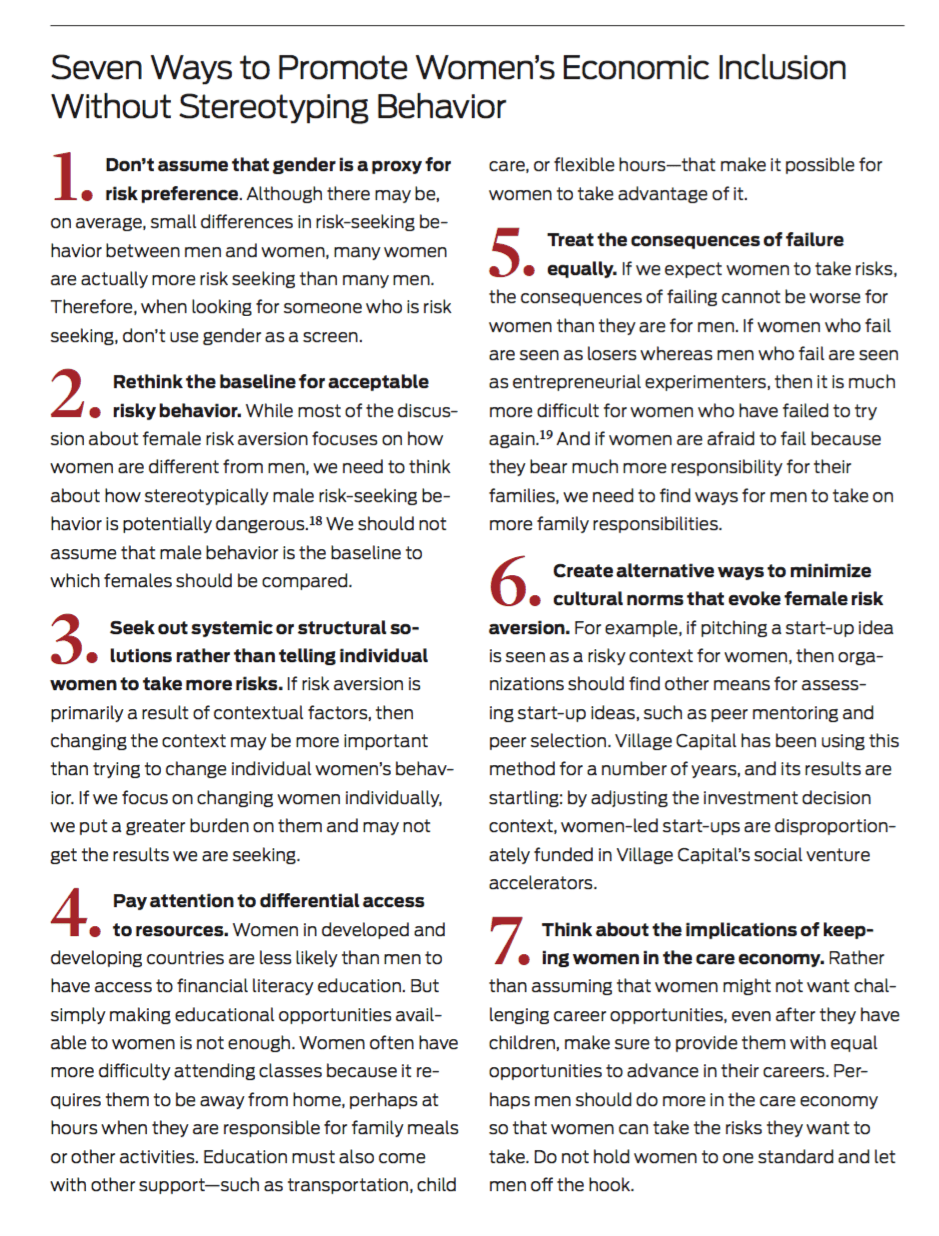
With the accelerating interest in women’s economic and financial inclusion in both developing and developed economies, we must take care in how the case for action is crafted by organizations that want to help. Relying on the rhetoric of female risk aversion as either a justification for action or an explanation for the gaps in opportunities may paradoxically hinder progress. Understanding the underlying social and structural sources of the apparently risk-averse behavior of women and risk-seeking behavior of men may help organizations take more productive actions to make change.
Read more stories by Natassia Walley & Sarah Kaplan.