

 (Illustration by Brian Stauffer)
We should start by saying that this is not just an article about education. It’s about something far more powerful.
Through her work as a journalist, Myra has travelled the world and learned from people tackling some of humanity’s most pressing challenges. She’s met changemakers working on vastly different problems in highly specific contexts, from visiting what’s said to be the world’s first 3D-printed classroom in Malawi to discovering a night school for child laborers in Pakistan.
And, as a communications specialist, Jessica has spoken to and amplified the stories of changemakers, including one who built a growth mindset among Native students as the first PhD graduate from her tribe in the Tulalip Indian Reservation in the United States, another who taught children at traffic lights as a chemistry teacher in Mexico, and many more voices featured later in this article.
Across cultures and diverse settings, we’ve seen one common thread running through all these efforts: hope.
Not a passive or idealistic hope, but a transformative one that changes lives, even in the toughest circumstances.
It can mean ensuring that children continue to learn in regions affected by conflict, or creating opportunities for children in refugee camps across Asia and Africa to learn through play. These interventions may look different from one context to another, but they share a belief in what is possible, even under the most difficult conditions.
But why should we pay attention?
Education in times of crisis does not always receive the same attention as food aid, emergency shelter, or medical care. And when it does, the conversation is often dominated by deficits: trauma, disrupted schooling, language barriers, and chronic shortages of resources. These challenges are real and deserve our attention. But they have also helped shape a narrative of low expectations that too often sees people affected by crisis as beneficiaries in need of help, rather than as individuals with agency, ambition, and the capacity to shape their own futures.
The tide is slowly turning, however. Around the world, people are rethinking what education can and should look like. Even more exciting is the growing recognition that some of the most innovative approaches developed for children in crisis can have relevance far beyond emergency settings. They have the potential to transform how we think about learning everywhere.
In recent conversations with children and teachers across the Middle East, Africa, and Asia, Myra explored new perspectives on what the future of learning might look like. That left us wondering: What could happen if we chose to innovate differently and embraced bolder approaches to teaching?
Two organizations led by Yidan Prize laureates—Can’t Wait to Learn, hosted by War Child Alliance, and BRAC—offer powerful examples. Their work shows what becomes possible when we start from a different premise: that crisis-affected learners bring not only needs, but also capacity, cultural richness, and resilience.
Conversations in a Lebanese Learning Center
Shahed, age 13: Finding confidence through game-based learning | When Myra asked Shahed what she wanted to be when she grew up, she didn’t hesitate. “A teacher,” she said.
Not just any teacher, though. She wants to teach Arabic, mathematics, and religion.
When Shahed first joined the program, she could only read “a little.” Today, she reads with growing confidence, progressing through a learning approach that combines familiar games with new ways of building literacy.
She especially enjoys flashcards, where each letter becomes a starting point for fun activities and images, eventually leading to sentences. Step by step, she builds her skills. Shahed says it feels like being on the playground, only she’s in a classroom.
Just as important is the sense of belonging she has found there. Though it is a learning center, Shahed repeatedly calls it a school: a place where supportive teachers and classmates have helped her grow more confident. That confidence extends beyond the classroom. She can now introduce herself in both English and Arabic, and she helps her younger siblings with their own reading and writing.
In a way, Shahed is already becoming the teacher she hopes to be.
Khadijah, age 11: The joy of having a teacher | Before joining the program, Khadijah’s parents were her only educators. They gave her a foundation, but she also had a quiet longing for something more: classmates and a teacher of her own.
So when she first arrived at the learning center, meeting a teacher was thrilling. “She was very happy to see a teacher,” the interpreter told Myra. “She liked that the teacher explained things simply and listened to her.”
Khadijah was also surprised to discover she could use a tablet for the first time. In Syria, she had never encountered one. At the center, the device gives her access to instructional videos that guide her through lessons, including how to form sentences.
Her favorite part, though? Roses.
The digital games they play reward progress with virtual flowers. Each rose represents an achievement—a small, visible marker of the effort she has put in and the skills she has gained. For Khadijah, earning a rose was a moment of joy: proof that she is making progress, one step at a time.
The program also incorporates puppetry, sports, and dance, giving children who have been through difficult experiences space to simply be children. For Khadijah, it’s jumping rope that makes her happiest.
As we finished our conversation, she told Myra that she was proud that she could read. She wants to be a dentist, and at 11, she already understands that reading is the first step toward the future she imagines for herself.
Mahdi, age 11: Education as a future | There’s a reason 11-year-old Mahdi speaks about education with such a strong sense of purpose. He wants to be a lawyer and is motivated by a desire to help others.
His educational journey has been interrupted more than once. In Syria, he attended school until displacement brought his education to a halt. Then, for a period after arriving in Lebanon, learning was absent altogether.
So returning to education through Can’t Wait to Learn was deeply meaningful. When his mother first told him he would be joining the program, he could hardly believe it. He waited eagerly until later that day to confirm the news with his father. A lawyer in the making, perhaps!
Mahdi loves learning. He smiles as he describes his achievements, including scoring full marks on a dictation exercise. These small successes are helping him see what he is capable of. To Mahdi, education is the foundation for the future he imagines: supporting a family, pursuing a good career, and contributing to society.
He also has a surprisingly thoughtful understanding of “life skills,” which is a component of the wider holistic intervention that teaches children how to support others without causing harm.
For a future lawyer, it may be one of the most important lessons of all.
Khalil, age 11: Learning and aspiration | Khalil is ambitious. He wants to learn and dreams of becoming a soccer player. Like many children at the center, his education was disrupted after he left Syria. Before enrolling in the program, he had some exposure to Arabic but very little formal schooling.
Joining Can’t Wait to Learn brought Khalil an instant source of happiness, especially as he began working with his teacher, Miss Bushra. With her guidance, he has developed new skills, including basic English translation, which he now uses to read to his 7-year-old neighbor.
Khalil is one example of how educating one child can benefit others in the community. He draws inspiration from the people around him as well as from famous role models such as Cristiano Ronaldo, the soccer star. He is deeply rooted in his community, but education has given him something more: the confidence to imagine a future that reaches beyond it.
The Leader’s Perspective: Steering Through Unsettled Waters
Teachers and play leaders have the challenge of keeping learning on track, often against the pull of difficult realities outside the classroom. Enrolling children in the programs can take considerable effort, as parents understandably may be more concerned with meeting their families’ immediate needs.
Many of the children live in unstable conditions, sharing crowded spaces with extended family members and facing financial hardship. Some older children are pushed toward work instead of school. By the time they arrive at a learning center, stress and insecurity may already be shaping how they engage with learning.
At Can’t Wait to Learn, teachers work alongside caseworkers to identify children who may benefit from additional support beyond the learning program. At BRAC, play leaders have been trained to offer mental health support to children and parents.
In this context, introducing play-based, technology-supported learning can represent a significant departure from more traditional approaches to educating children affected by crisis. Some teachers embraced the change immediately. Natalie, who has taught Arabic and French for two decades, saw the play-based model as a natural extension of methods she had already begun exploring. Rather than skepticism, she felt curiosity and excitement. Her colleague Bushra shared her enthusiasm, describing the approach as a refreshing departure from traditional teaching and something she believes should be adopted more widely.
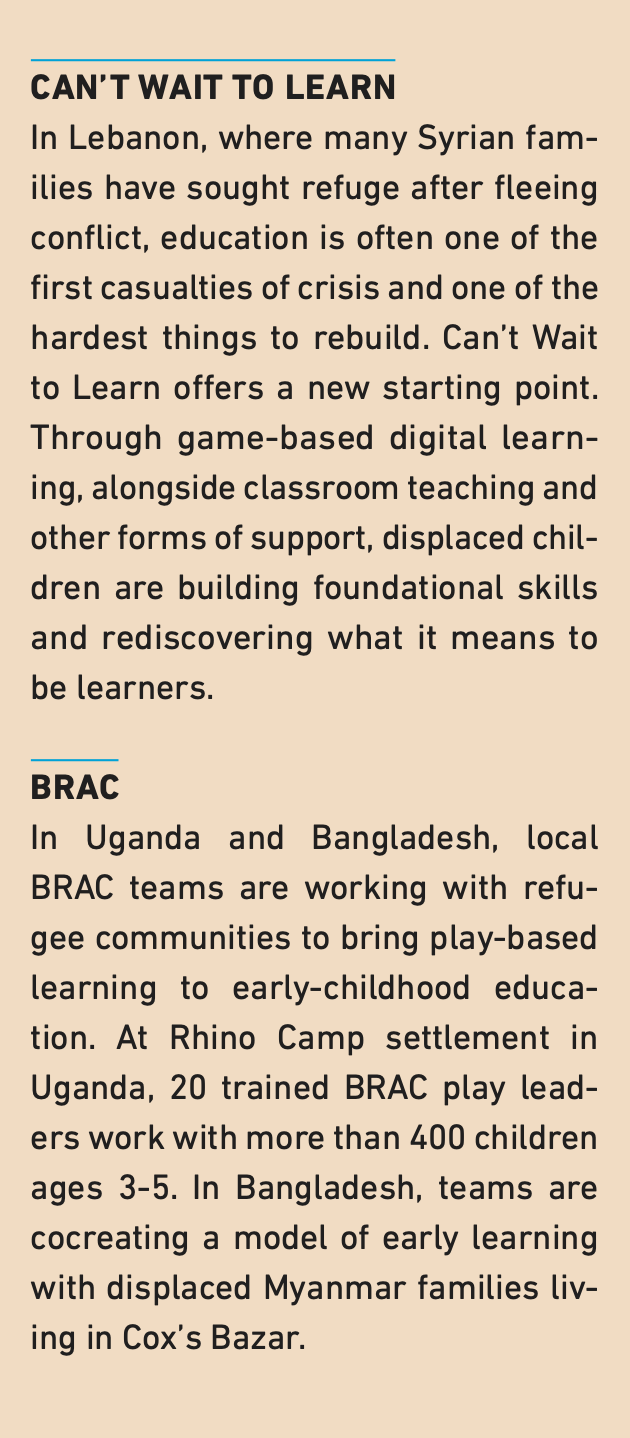
The BRAC team in Uganda initially encountered more skepticism. Staff member Milly worried that people would see the program as “just playing” and question whether it was having any real impact. Parents voiced similar concerns. They struggled to connect play with learning, and as Milly recalled, wondered, “Will our children be using their brains?”
Over time, seeing the children’s progress changed their minds. Milly watched parents become advocates for play-based learning, and the parents volunteered to help and engaged enthusiastically in parent training sessions. They saw their children growing more confident and finding their voices in a culture where young children are often expected to be seen, not heard.
In Lebanon, Natalie described the end-of-learning-cycle celebrations, when children present what they have learned through songs, dance, and spoken Arabic. She was especially proud to see children who had once been timid gain the confidence to stand before others and express themselves. For Bushra, the transformation that mattered most was more fundamental: watching children who arrived unable to read or write gradually acquire those skills.
The experience has changed the teachers, too. Bushra says she has become more adaptable, learning to respond to different personalities and strengthening her classroom practice. Natalie came away with a deeper realization: “Every child, regardless of circumstance, has unlimited potential and capacity to learn.”
Built With the Community, Not for the Community
A critical part of what makes these programs effective for learners and their families is that they are built with the community, not simply delivered to it.
Kuri Chisim, senior program specialist at BRAC Institute of Educational Development at BRAC University, describes this engagement in terms of ownership. Working with Rohingya families, she says, “When we recognize community and culture as the central strength of the project, people own it and feel proud of it.”
Codesign is also central to Can’t Wait to Learn, which works with local educators and artists to ensure that its programs align with national curricula and reflect the communities they serve. This matters not only for meaningful learning, but also for building connections with young learners and supporting their psychological well-being. According to both organizations, children and adults gain a sense of pride and self-esteem when they see their culture and identity reflected in the learning environment, especially after experiencing the painful loss of home.
At BRAC Uganda, this community-centered approach has produced an unexpected social benefit. Program overseer Charles describes how families divided by ethnic conflict were able to set aside their differences and come together for parenting sessions. In the process, they began finding new ways to coexist.
Education Must Continue in Emergencies, and the Models Are There to Adapt
Syeda Sazia Zaman, program head of BRAC Institute of Educational Development, emphasizes the importance of laying strong foundations from the earliest years. She makes the case that donors and policy makers should treat education as a priority on par with healthcare, especially in times of crisis.
She points to play as a powerful tool for both physical and mental health, as well as for developing social and emotional skills such as tolerance, patience, and respect. Kuri Chisim echoes this idea, emphasizing education as a foundation for self-expression.
Both believe these models can—and should—be adapted to different contexts. They encourage others to take what works and build on it in their own countries and communities. In Uganda, for example, the Play Lab model has received national endorsement, making it easier for partners to replicate and adapt.
Can’t Wait to Learn is already active in seven other countries beyond Lebanon: Chad, Jordan, South Sudan, Sudan, Syria, Uganda, and Ukraine. The team works with ministries of education, technology experts, research institutes, local and international NGOs, and UN agencies to expand its reach.
But the deepest sense of hope we encountered came from the people: the families, teachers, and play leaders who recognize potential in themselves and, most importantly, the children. It comes from their courage, resilience, hard work, and belief in a better future.
So we, too, remain hopeful. And when we think about what it will take to encourage more organizations and individuals to rethink education and embrace new approaches to teaching and learning, we keep coming back to the children’s aspirations.
If we challenge our assumptions and create space for new ways of learning, how many more happy, confident, curious, and ambitious children might we see?
It’s time to put more of these ideas into action.
Read more stories by Myra Anubi & Jessica Wong.