


Children in a village in Uganda run, dodge, and squeal with delight as they play a game of tag. There’s more afoot here than an ordinary childhood game. Two kids who are “it” buzz like mosquitoes. Other children, when they get tagged by one of that pair, pretend to suffer from the aches and fever of malaria. It doesn’t take long before the “mosquitoes” win. Then an adult on the sidelines introduces a new rule: When a mosquito approaches, children can put up their hands to mime the act of holding up a bed net. With a net in place, they can’t get tagged. This version of the game ends without any children getting “infected.” The leader now has a perfect opening to reinforce the message that, in real life, sleeping under a bed net provides an excellent defense against malaria.
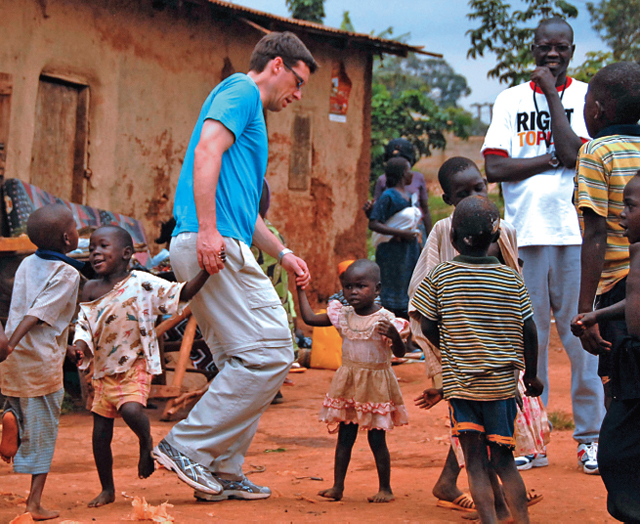 Johann Koss, Olympic athlete turned social innovator, shares a playful moment with children in Uganda. (Photo courtesy of Right to Play)
Malaria tag may seem like a simple game, but it is achieving profound results. Johann Koss, founder and CEO of an international organization called Right to Play, says that children carry the message of the game to their families. “When they go home, they’re captains of the malaria nets. They become very responsible, making sure their siblings and parents sleep under the nets,” he explains. Hard data back him up. In regions of Uganda where Right to Play programming has been introduced, 84 percent of children use malaria nets; nationwide, only 10 percent of them do so. Through play, Koss says, “children become change agents.”
Right to Play is tackling a wide array of global challenges through the medium of sport and play. Its carefully designed programming helps kids and young people recover from the devastating effects of war, extreme poverty, and tribal conflict. Each week, 1 million children in more than 20 countries take part in Right to Play activities that emphasize play and sport as essential ingredients of a healthy childhood.
The organization has honed a model that informs every move in its organizational playbook. “The core methodology is to create behavior change,” Koss explains. Facilitators can choose from 50 games and sports activities, and each activity addresses a specific challenge—from helping schoolchildren concentrate on their lessons to helping street youths avoid HIV and AIDS. “There’s no better way to learn,” Koss insists. “The motivation comes from the fun of the game itself.”
Josephine Mukakalisa, a Right to Play country manager for Tanzania, notes how children react whenever they spot the red soccer ball that has come to symbolize Right to Play. “When children see that it is time to play, they get very excited. After playing, they come together and discuss their lives and what they have learned in the games,” she says. Previously, Mukakalisa worked with Right to Play in Rwanda, her native country. She credits the organization with “helping to rebuild community cohesion” after the horrors of genocide.
Researchers in fields that range from neuroscience to psychology confirm that a play-centered approach holds real, enduring value. “The data are so clear,” says Stuart Brown, founder of the National Institute for Play and an early supporter of Koss’s efforts. “Our capacity to form social groups is built on a foundation of healthy play behavior.”
Koss and his organization are taking a lead in the emerging field of sport for development. “Play is sometimes seen as frivolous, but we know that it is critical for child development,” Koss says. “Our work is as serious as you can get.”
Play is the Thing
The story of Right to Play and the story of its founder are inseparable. Back in 1993, Johann Koss—already an Olympic medalist in speed skating—was training for the Winter Games that his home country, Norway, would host in Lillehammer in 1994. But he took a short break from his training to participate in a goodwill trip to Eritrea as an ambassador for an initiative called Olympic Aid. In Eritrea, Koss spotted a cluster of boys kicking around what looked like a ball. In fact, it was a long-sleeved shirt that they had tied into a bundle. “They just wanted to play,” he recalls. Seeing how that ragtag game lifted the children’s spirits, Koss appreciated not only his own ready access to equipment and coaches, but also the profound benefits that sport and play can deliver.
Koss returned to Lillehammer, where he earned three gold medals. He then pledged his Olympic bonus money to Olympic Aid. “All of a sudden, I had a broader purpose,” he explains. “It doesn’t matter if I win or not. If I can inspire children to participate in sport, particularly in the worst places in the world, then I will make a significant change.”
In 1994, Koss made a return trip to Eritrea, and with him came 13 tons of sporting equipment donated by the children of Norway. One journalist criticized Koss for bringing soccer balls to starving children. Any second thoughts that Koss might have had evaporated when he presented his gift to Eritrean President Isaias Afewerki. “He thanked me and said, ‘We have the same dreams for our children as any parent. Our people need more than to be kept alive,’” Koss recalls.
Through the 1990s, Koss continued to work with the international aid community. Then, in 2000, he founded Right to Play. The organization is a successor to Olympic Aid, but it focuses more sharply on promoting the sport-for-development model. Today, Koss is approaching this work with the same discipline that helped him shatter records on the speed-skating oval.
To achieve scale, Right to Play uses a train-the-trainer model. “It’s massive leverage,” Koss says, and it enables each trainer to “activate” from 10 to 30 more people. In all, the organization has trained about 13,500 volunteer coaches to implement Right to Play programming. It also trains children as young as eight to take on the role of junior leader.
In-country partners, meanwhile, provide direct services in a way that allows Right to Play to stay lean. In Rwanda, primary school teachers learn Right to Play methods—an approach that has a huge multiplier effect. In Tanzania, the British Council uses Right to Play programs to help street youths reconnect with their families. In Pakistan, girls are taking part in sports for the first time through school-based Right to Play programs that give them the self-confidence that they need to stay in school.
In every country where it operates, Right to Play tracks results to make sure that it is continuously improving its programs. “We use rigorous evaluation to constantly ask, Can we do better?” Koss says. That way of thinking comes naturally to him after a lifetime in athletics. “This is a great skill you get from sport,” he says, “and it’s transferable.”
The Right to Play model is also highly transferable. The organization, which is based in Toronto, recently brought its programming to the United States. A pilot program in the Bronx is helping preschoolers get a jump on academics—through games, of course.
Athletes as Envoys
Summer Sanders, an Olympic swimmer, first traveled to Rwanda in the mid-1990s. It was not long after the genocide that ravaged the country in 1994. “I was hoping to make an impact,” she says, “but I didn’t know the extent of the impact those kids would make on me.” She’s one of roughly 300 top athletes who have joined Right to Play’s corps of athlete ambassadors. They include professional sports stars as well as Olympians, and they represent 50 sports and 48 countries.
Sanders remembers the eager face of one girl in a Rwandan refugee camp—an amputee who was getting set to take part in a relay race. “She had these huge, awesome, curious eyes,” Sanders says. “Her prosthetic was just a wooden stick that she used to balance herself. When she took the baton, she was just hauling! That moment was so beautiful. Her spirit was exactly what I wanted to be part of.” Just by showing up on a dusty field in a remote corner of the world, Sanders says, athletes can send a powerful message: “We care.”
Their star power also raises visibility for the sport-for-development movement globally. Eli Wolff, a Paralympian turned scholar (he competed in the 1996 and 2004 Paralympic Games), directs the Sport and Development Project at Brown University. The leaders of this emerging field are pushing to define sport “as having value that goes beyond entertainment,” he explains. “It’s about the intersection with human rights and development—sport and play as basic human rights.”
And Right to Play has become a prominent player on that front. “They’ve been able to put boots on the ground all over the world to launch this movement in a tangible way,” Wolff says. “They have managed to elevate the conversation and engage stakeholders who haven’t worked together before.” Wolff, for example, cites the role that Koss and his organization played in lobbying to establish the United Nations Office on Sports for Development and Peace. Recently, in fact, U.N. Secretary General Ban Ki-Moon called sport and play “outstanding tools to support peace and development.”
Despite their hard-won accomplishments, Koss and his colleagues at Right to Play aren’t ready to take a victory lap. Money spent on sport for development represents a tiny fraction of global aid, and it pales in comparison with the billions of dollars spent on professional athletics. The pace of progress is too slow for those, like Koss, who are determined to change the game. “We have millions of children still to reach,” he says, and he’s eager to reach them before they outgrow their chance at a healthy, playful childhood.
Read more stories by Suzie Boss.