


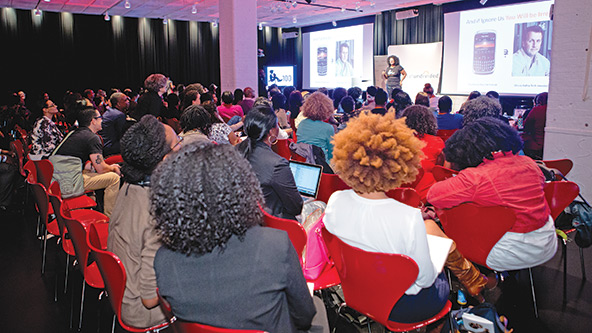
 Kathryn Finney, founder of digitalundivided, addresses a packed FOCUS 100 audience in 2013. (Photo courtesy of digitalundivided)
As a black female entrepreneur, Kathryn Finney knows firsthand how difficult raising venture capital can be. Her blog, The Budget Fashionista, which she started in 2003, quickly built a large audience and generated significant advertising revenue in the process. Finney then sought venture capital to leverage her audience to sell a subscription service that sells beauty products, similar to Birchbox specifically for women of color. But when she pitched her business proposal to venture capitalists, who were mostly white and all male, they showed no interest. They didn’t understand the market potential and concluded that she could not deliver a return on their investment.
Without the needed capital to scale her business on her own, she sold her company in 2012 and became editor-at-large at BlogHer, a community events and media company that received over $15.5 million in venture funding. There Finney learned about scaling venture-capital-funded businesses like The Budget Fashionista. But when she attended tech conferences for her job, she was the only black woman in the room. “Where are all the women who looked like me?” she recalls of her conference experiences.
Finney was determined to help other entrepreneurial women of color start and grow high-impact companies. In 2012, she launched FOCUS 100, a conference and training program to close the funding gap for black female tech entrepreneurs. It hosted an annual conference in New York City to connect black female founders to investors, and offered a virtual fellows program that provided remote training, mentorship, and resources to black female tech entrepreneurs.
In 2013, Finney formally incorporated FOCUS 100 as a for-profit LLC named digitalundivided (DID). The name signifies the organization’s mission to bridge the digital divide between black and Latinx communities and white communities. At the time of DID’s founding, there were no organizations focusing on catalyzing the economic potential of women of color tech entrepreneurs. This is exactly what DID aimed to do.
Proof in Numbers
Finney experienced limited success raising corporate sponsorship dollars for FOCUS 100. BlogHer and venture capital firm Andreessen Horowitz were the first funders of the 2012 conference. Global marketing conglomerate Ogilvy provided space and paid for the food for the first conference. To cover all the expenses, Finney contributed $30,000 of her own money.
“BlogHer’s philosophy was always to help like-minded organizations grow by supporting amazing people working within their communities,” says Elisa Camahort Page, cofounder and COO of BlogHer. “When Kathryn approached us with her vision for FOCUS 100, it was immediately clear that she and her event were going to have important impact, so we were all in!”
Andreessen Horowitz and Ogilvy were joined by Google and American Express in their support of the second year of the conference in 2013. In 2014, DID held its third and final FOCUS 100; American Express returned as a sponsor and was joined by Facebook, Mobile Future, and the Portland Development Commission.
After its incorporation, DID continued to have limited success raising sponsorship dollars. The problem, Finney believed, was the lack of knowledge. To help raise awareness of the role that the intersectionality of gender, race, ethnicity, and social class plays in women’s ability to successfully build tech companies, DID undertook a Kickstarter campaign to make #ReWriteTheCode, a documentary, to close the knowledge gap.
The 2015 documentary highlighted the many challenges faced by women of color in the sector. The DID team then sought data to expand the training component of the FOCUS 100 conference into an incubator for black and Latinx women founders and found that there was no data on women of color entrepreneurs in the startup space. Finney and her team decided to undertake their own research by conducting a demographic study of black female founders.
Published internally in February 2016, ProjectDiane—named after civil rights leader Diane Nash—reported that only 84 of the 2,200 female founders of tech startups in the United States were black. The study also reported that black female founders raised on average $36,000 for their startups, compared with $1.3 million raised by failed startups mostly led by white men.
The DID team soon realized that the data could have far-reaching impact. They published ProjectDiane on their website—and it went viral. “We estimate that all the articles mentioning ProjectDiane 2016 generated at least one billion impressions,” Finney notes.
The 2018 ProjectDiane report expanded to include Latinx women founders. The study found that only 4 percent of black female founders and 2 percent Latinx raised equity financing. This report also found that there were 2.5 times as many black-female-founded startups in the ProjectDiane 2018 database (227) than in the 2016 database (84). The amount of venture capital raised by black women also increased fivefold, from around $50 million in 2015 to approximately $250 million in 2017. However, the latter figure represents only .06 percent of the estimated $427 billion in venture capital invested since 2009.
What gets measured gets managed. ProjectDiane not only highlighted the lack of inclusion of black and Latinx women in the innovation economy but also quantified the problem. The ProjectDiane reports have become influential with the media, investors, and political campaigns that want to address the additional challenges black and Latinx women face when starting and growing companies. For example, BioSTL, a nonprofit that is building St. Louis’ entrepreneurial infrastructure in the plant and life sciences sector, relied on the 2016 report to understand how to finance businesses run by women of color. And Senator Elizabeth Warren’s presidential campaign has used ProjectDiane data to propose a $7 billion Small Business Equity Fund to provide grants to black, Latinx, Native American, and other minority entrepreneurs.
Building on Data
DID realized that to fund transformative change, they needed a different funding approach. The organization believed that innovative foundations would support the kind of sustained campaign that is necessary to build an ecosystem to support both high-potential black and Latinx women entrepreneurs, so they turned to philanthropy. In 2016, Finney and team formed Didtechnology, a 501(c)(3) nonprofit, and launched the BIG Incubator program in Atlanta, Georgia.
As an incubator/accelerator program, BIG targets black and Latinx women entrepreneurs who demonstrate high potential and aspire to grow large tech businesses—a mission that encompasses DID’s “go big or go home” philosophy. During its pre-incubator program, START, founders work through the Business Model Canvas—a strategic management tool used as part of the Lean Startup methodology, which is aimed at shortening product development cycles and rapidly discovering if a proposed business model is viable.
“We know that early stage founders will pivot their ideas as they progress through the program,” says Kelechi Anyadiegwu, DID program lead in Newark and 2014 FOCUS fellow. As an entrepreneur, Anyadiegwu knows that building a company is a marathon, not a sprint. In each applicant, she says, “we look for resilient women who can weather the ups and downs of entrepreneurship.”
Farah Allen, for example, participated in the second BIG cohort in 2017. Her company, The LABZ, is a collaborative workspace that uses blockchain to provide automated tracking, rights management, and protection of music files during and after production. “Facing not just sexism but racism can be paralyzing,” Allen observes. “Hearing how successful black female founders overcame these challenges was both motivational and practical.” In the incubator program Allen learned about the file-sharing technology platform she ultimately chose as the foundation for LABZ and raised angel investment.
In 2019, BIG welcomed its fifth cohort and, for the first time, expanded to Newark, New Jersey. Before taking this step, DID partnered with The Prudential Foundation on Startup Newark, a data project to map Newark’s startup ecosystem.
“We want to support initiatives that remove barriers and create opportunities for women of color, particularly those focused on high-growth entrepreneurship,” says Daryl Shore, director of inclusive communities at Prudential Financial. “Newark has the potential to be a high-growth entrepreneurial ecosystem, and we want to help DID leverage existing community assets as well as to identify holes and ways to fill them.”
Through data from ProjectDiane and the BIG incubator, DID is creating a body of knowledge for the entire entrepreneurial ecosystem. It can take as long as three years for women of color to raise the first $100,000 for their startups—a shocking disparity from the average of 12 to 18 months. Based on this insight, DID piloted an Entrepreneurs in Residence program, which provided a $25,000 stipend to each of the top two women from the incubator program in 2017 and 2018. The women selected to be in residence raised five times more than the average for women of color.
Black and Latinx families hold fewer business and financial assets because they have historically been less likely to start businesses. DID ultimately seeks to end this chicken-and-egg dilemma for black and Latinx women attempting to start high-growth companies when they and their friends and family have fewer assets to fund businesses. “We are looking at how we can become the friends and family for black and Latinx high-potential women entrepreneurs through a market-based approach,” says Finney.
Read more stories by Geri Stengel.