


 Member of the Coya indigenous community of Argentina's Puna region helps produce llama-wool clothing for Warmi. (Photos by Amaya Roman)
Enterprise success in low-income markets, where the majority of the world’s population lives and transacts, has remained elusive.1 This failure is remarkable, given that the World Bank estimates that the 4.5 billion people living and transacting in these markets—a socioeconomic segment that researchers often collectively refer to as the base of the pyramid (BoP)—have spending power of more than $5 trillion per year and the United Nations views the private sector as an important contributor to achieving its Sustainable Development Goals.
One reason for the lack of successful business launches in the BoP is that businesses see low-income markets, compared with markets further up the economic pyramid, as impoverished. Members of the BoP are defined as those with per capita annual income of less than $3,000.2 The market environment they live in appears underdeveloped: Physical infrastructure and formal institutions are often absent, electronic communication and information technologies are limited, and local talent rarely has the credentials and training that most employers desire. In response, many companies entering these low-income markets have emphasized fixing what is wrong by transferring assets that they and peer companies value in higher-income markets. Unfortunately, this approach has proved a mistake for most companies. Embedded therein is a misguided assumption about the assets that are valuable for building businesses in low-income markets.
Indeed, our research suggests that companies achieve greater success in low-income markets when they see them as rich in the assets needed to build awareness, demand, and distribution in their business models. Roberto Salas, CEO of Masisa, a Chilean table-board producer that purchases wood in low-income communities, describes his company’s approach: “Our biggest challenge is to be productive. To make the right decisions that support us in reaching that goal, we must explore what assets these markets provide in order to do business effectively.” Many companies like Masisa measure success in low-income markets the same way they do in all other markets: according to indicators such as productivity and financial returns. As Salas argues, the goal is not to redefine what long-term success means but to develop an approach that identifies the types of assets these markets offer for companies to be successful.
Our study of both multinational and in-country companies seeking to source or distribute products and services in low-income markets in Latin America revealed that successful companies use five types of assets that already exist in these markets: economic, knowledge, leadership, network, and innovation assets. Our results also suggest that identifying and using these assets requires a fundamental strategic shift. Companies seeking profitability in low-income markets focus on finding what is right, rather than fixing what is wrong.
For decades, enterprises—and many development programs—have used what we broadly call a “transfer approach” when working in low-income markets. Whether located in-country or headquartered abroad, these organizations seem to hold the same biases. To fill perceived gaps in low-income market environments, they transfer skills, competencies, and resources that have proven valuable in higher-income contexts. For example, Gerber, the Nestlé-owned baby-food producer, emphasized transferring its existing agricultural techniques and outreach approaches to producers of organic bananas in low-income markets in Costa Rica without first analyzing what other assets—beyond just the bananas—were potentially available there. In assuming that critical expertise and leadership were best sourced from higher-income markets, Gerber failed to recognize the presence of community leaders who could have proven instrumental in advising it on context-specific factors that influence productivity, as well as providing credibility in implementation. As a result, the company struggled to gain acceptance from more than a fraction of the producers it targeted in the first phase of its project. Only after changing its strategy to incorporate the expertise and status of community leaders did Gerber make substantial progress on its productivity goals.
In some respects, focusing on what is wrong and adopting the transfer approach seems to make sense. What is “missing” can seem daunting. The BoP segment is economically impoverished and its members have limited disposable income.3 Their material assets, such as land, farm animals, businesses, and homes, are generally hidden from view, because the owners often lack formally established legal titles.4 Literacy rates are low, and opportunities for mass communication and distribution may appear inadequate.5 In addition, formal laws or rules that can establish boundaries and offer protection in transactions may be missing or hard to enforce.6 Yet, as our research shows, the transfer approach—and an almost exclusive focus on fixing what is lacking at first glance—more often than not leads to failure when companies try to tap into the enormous promise of low-income markets.
In contrast with the unidirectional transfer approach, an alternative, more inclusive strategy has shown greater promise. By seeking what works in low-income markets, companies collaborate with BoP members to identify and leverage existing assets and “cocreate” novel solutions to business problems.7 We define cocreation in this context as a process based on transparency and mutual benefit in which companies and members from the BoP segment collaborate as respected colleagues to identify and use assets from low-income markets in hopes of building a successful business.
The microfinance industry popularized a familiar example of a cocreation approach.8 While potential borrowers in low-income markets may lack the physical collateral that a traditional banking model requires, they do have an abundance of social collateral. Resolving land disputes, mapping boundaries, and establishing a formal title process, in line with a transfer approach, is a costly, time-consuming, challenging effort. Instead, many microfinancing businesses use a group-lending model, recognizing existing social bonds between community members as an alternative source of collateral.
Although business leaders understand the specifics of why a lending model based on social collateral works, they have not translated this example into a broader strategic mind-set for low-income markets.9 The same holds true of the research community. In 2004, Ted London (a coauthor of this article) and Stuart Hart proposed that companies should cocreate with the BoP by focusing on understanding what is already working in these markets and avoiding unconsciously adopting a “Westernized” attempt to unilaterally define how these markets should work.10 However, they did not offer a more specific, strategic analysis of what assets are most useful in low-income markets. In 2011, FSG consultants John Kania and Mark Kramer published their thoughts on “collective impact” in this magazine and proposed conditions for successful collaborations with the BoP and partner organizations operating in low-income markets.11 These conditions, however, were process oriented; Kania and Kramer said little about the “content,” such as the assets in these markets that such collaborations should target.12 This research gap has continued until today.
In what follows, we extend “collective impact” and other cocreation models by arguing that successful enterprises should do three things: (1) recognize and respect members of the BoP segment as a valuable source of knowledge and skills; (2) perceive low-income markets not as a context full of problems that need fixing, but instead as an environment rich in assets; and (3) seek to identify and use the five assets that already exist in these markets and can facilitate the development of a robust business model.
Cocreation Breeds Success
For five years, we studied low-income markets in Latin America, and, after extensive research and interviews, we collected 43 case studies of companies that tried to do business in these markets.13 As we expected, some of the enterprises we studied were successful, while others were not. When analyzing those that struggled in their efforts to enter low-income markets, we found that they generally relied on the transfer approach and were blinded by their biases about both the capabilities of members of the BoP segment and the opportunities that assets available in low-income markets afforded. They sought to fix problems in low-income markets by using resources and expertise developed for high-income markets. Adopting this transfer approach meant that potential valuable assets remained invisible.
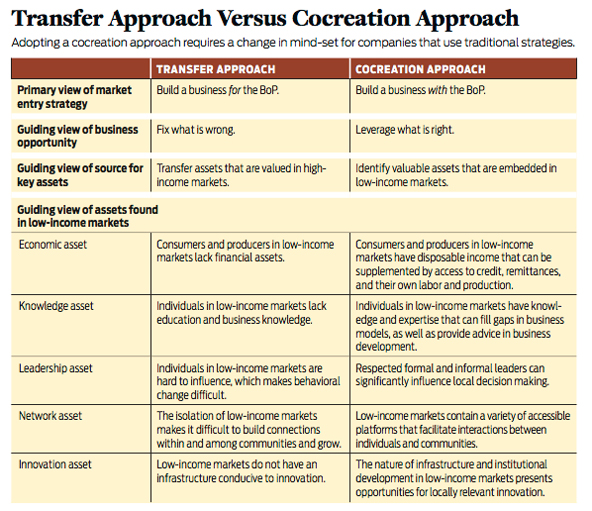
Among the companies that achieved greater success, we found that they had adopted a cocreation approach. Rather than seeing members of the BoP as needing their help, they perceived them as business partners and advisors in the companies’ development of a business model. Likewise, rather than treating low-income markets as impoverished, with few positive attributes, they emphasized identifying and using some or all of the five assets embedded in those markets. (See “Transfer Approach Versus Cocreation Approach” on this page.) We illustrate the cocreation approach through detailed examples of two Argentinian companies doing business in Jujuy Province. The first, uSound, was founded by local entrepreneurs and sells to low-income customers in different countries worldwide. The second, Warmi, buys from low-income producers and sells to international high-income markets.
uSound: Selling into Low-Income Markets
uSound is an Argentinian company that sells an innovative, low-cost hearing aid. It was founded in 2015 by Ezequiel Escobar and three fellow MBA students from Jujuy Province, one of Argentina’s northernmost, with a territory of 53,219 square kilometers (20,548 square miles) and approximately 673,000 inhabitants. It borders Bolivia to the north, Chile to the west, and Argentina’s Salta province to the east and south.
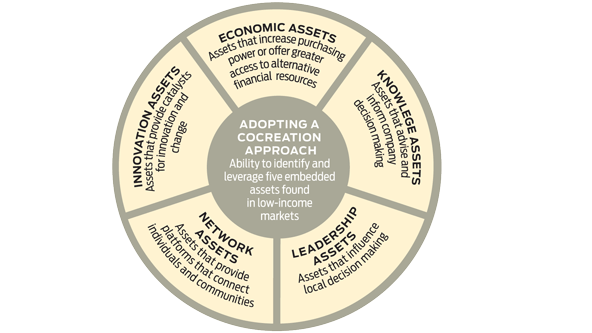 Enterprises can use five types of assets to build sustainable business in low-income markets.
Historically, northern Argentina has been the poorest region in the country, and Jujuy is no exception. With small, aging buildings, a large indigenous population, and a perpetual cycle of migrants, it demonstrates the stereotypical features of a developing Latin American region. While the area has slow, unreliable Internet service, many jujeños are able to connect with the rest of the world through basic smartphones and affordable service plans. This region also presents some specific contextual obstacles for businesses. Companies and profit making are socially demonized. Low incomes and cultural differences between indigenous people and the “white” population—as local press describe the ethnic divide—create social tensions. Given this complex situation, many companies avoid the region, thinking these problems are too difficult to overcome and failing to see useful assets there.
Escobar and his partners initially sought to support a fellow student who suffered from hearing loss. They created an app that helped him use his phone as a hearing aid. It worked, and—regardless of the perceived market obstacles in the local region—the four colleagues founded a company in Jujuy to bring their innovation to the market. uSound sold its devices online as an app-earphone package for less than 20 percent of the price of other hearing aids. By mid-2016, the app had been downloaded more than 250,000 times in 150 countries. We found that uSound’s success was grounded in the way it systematically identified and took advantage of the five assets from the local market.
Economic asset: Escobar and his colleagues learned that 5 percent of the world’s population suffers from hearing loss, and that the BoP segment represents much of the unserved market because its members cannot afford expensive hearing aids. Based on their own experiences in neighborhood slums, uSound staff learned that these low-income consumers can, however, pay small amounts for the products they value. To use this economic asset, uSound had to create both an affordable device and a payment mechanism that would enable these potential customers to purchase technological products.
Leadership asset: Escobar, who came from an indigenous and poor family, created uSound with two partners. Although the founders had the opportunity to relocate from the poorest region in Argentina to Boston—one of the wealthiest cities in the United States—the uSound team decided not to abandon the place where they had started. While facing pitfalls such as unreliable electricity and Internet access, they trusted the creativity they found within Jujuy to maximize the company’s strengths of innovation and competitiveness in the market.
Knowledge asset: Escobar began to attract more young people from the region, who, following in his footsteps, had demonstrated creativity and perseverance amid a modest upbringing. As uSound became more successful, Escobar and his growing team became local role models and were able to influence government institutions for the benefit of uSound and the broader business community.
Innovation asset: San Salvador de Jujuy, the provincial capital where uSound was located, has a university that offers programming courses. To create products and an associated business model appropriate for low-income markets, uSound hired young men and women with basic computer skills. Since most programming courses are available online, the new uSound employees began to self-train and, in turn, support uSound’s innovation efforts.
 Rosario Quispe, a Coya leader, is a founding partner of the venture. (Photo by Amaya Roman)
Network asset: uSound became popular among parties interested in supporting the development of low-income markets, such as provincial and national government institutions, international nongovernmental organizations (INGOs), local universities, investors from Buenos Aires, and young people from all over Argentina with different economic backgrounds. Escobar understood that uSound had the potential to connect groups that would otherwise remain separate. Through workshops that united various organizations and individuals, he used this network asset to explore new business ideas and ultimately created an entrepreneurship hub in Jujuy that attracts talented young professionals and fosters innovation for uSound and other local companies.
After its initial success, the relatively young company is now ready to explore how it can further expand its business with these local assets.
Warmi: Buying Products From Low-Income Markets
Warmi is an Argentinian partnership between a producer of llama-wool clothing and a cooperative run by indigenous people that coordinates the product’s supply chain in the Puna region, an area within Jujuy where most Argentinean Coya communities are located. By 2010, this tribe’s population was 42,541 inhabitants living in an area between 1,500 and 6,000 meters above sea level, with less than one inhabitant per square kilometer. As the majority of the Coya work in the informal sector, almost 95 percent of them are without government benefits and more than 50 percent live in extreme poverty. Nevertheless, the Puna is a unique natural environment and the Coya have strong cultural traditions working with llama fiber.
To view the full version in a new window, click here.
Many companies have avoided the region because of its remoteness and the strong differences between the Coya culture, which is based on First Nations roots, and the Argentinian culture, which is based on an immigrant history. Warmi is an exception. When Juan Collado, a successful Argentinian businessman, four other wealthy Argentinians, and Rosario Quispe, a prominent Coya leader, decided to invest jointly in Warmi, they used all five assets to build a successful business.
Economic asset: For many decades, the 40,000-plus indigenous people of the Puna had produced llama wool, a high-quality raw material, but they had not regularly exported their material and were often exploited by middlemen who took most of the profits. Warmi adopted a different approach to Puna’s economic asset: It sought to purchase raw material from the indigenous communities in a transparent and reliable manner. By controlling more of the value chain, the company could offer local producers a better price at lower cost and establish stable procurement.
Leadership asset: Rosario Quispe is a community leader who for decades protected the rights of her indigenous community against the “whites.” She also created an association for Puna women to support their economic advancement. Warmi’s mission fits this vision, and she became a founding partner. As Quispe was both locally respected and internationally renowned, Warmi benefited from her leadership in generating support for the company. Additionally, Juan Collado was friends with Jorge Gronda, a “white” gynecologist from Jujuy who had worked in the Puna for decades on a voluntary basis. Because of his work and his dedicated fight against cervical cancer in local communities, Gronda had achieved high status within the indigenous community. Introduced as a friend of Gronda’s, Collado gained some initial trust within the indigenous group.
Knowledge asset: Indigenous people in the Puna region have a long history of working with llamas, a profound relationship with nature, and strong community values. Warmi saw these traditions as an asset that might benefit its products and marketing. High-quality llama wool ponchos could be a unique product with an accompanying message that told the story of the cultural richness of Puna and its people. Warmi’s investors also recognized the opportunity to seek the advice of the indigenous people in clothing design, marketing, and production. Warmi brought together these local experts with production and marketing specialists who had experience in higher-end markets to tell a story of the Puna, along with promoting the product.
Innovation asset: Warmi’s leadership team was aware of Jujuy’s history as the seat of a prosperous spinning industry. Because of slow economic growth, most of the spinning companies had gone bankrupt, but the machines and production halls still stood. After some maintenance, this infrastructure was sufficient to begin production, close to the regional capital at first, and, since 2018, within the Coya community in Puna. Warmi is also nearly ready to display the spinning companies’ old machines in a museum created for visitors and tourists. Public appreciation of the instruments in action and the historical nature of the production process will increase awareness of Warmi and help build its unique message about a product with cultural richness and relevance.
Network asset: Building a relationship between the “whites” of Jujuy and the indigenous people of the Puna seemed a daunting task, as this divide had been present for more than 500 years. Racism still has a strong influence in local society, and tolerance among the predominantly “white” population of northern Argentina and the Puna was low. Yet many people on both sides sought to change this reality, and Warmi’s leadership saw an opportunity to broker better relations between the two groups. The procurement, production, and distribution of Puna llama wool would require a profound mutual understanding and purpose between the indigenous community and Jujuy’s wealthy. Coincidentally, President Mauricio Macri and his center-right PRO party (Propuesta Republicana) was looking for a business success story in 2015 to tell to the Argentine people in advance of that year’s national election. Warmi seized the chance to share its success in building a network between the indigenous and “white” communities. Thus, Warmi was able to use this network asset to gain government support.
Five Assets for Cocreation
The previous examples show that managers can build businesses based on cocreation in contexts where a transfer approach would likely fail. Companies like uSound and Warmi embrace cocreation by respecting, rather than criticizing or dismissing, members of the BoP segment and the markets in which they transact. An important component of their success was based on identifying and leveraging the five assets available in many low-income markets. (See “A Cocreation Approach” on page 42.) Let us examine them more closely.
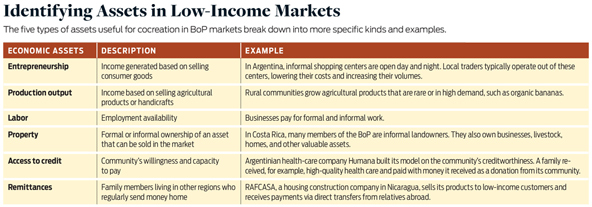
Economic assets refers to assets in low-income markets that may increase purchasing power or offer greater access to alternative financial resources. Our data show that this asset has several different forms. (See “Identifying Assets in Low-Income Markets” on page 45 for examples of economic and other assets.) They include assets that local consumers and producers currently have, assets they can access if necessary, and assets that they can provide as services.
For example, the aforementioned Jorge Gronda is a gynecologist who launched a private health-care system in low-income markets in Argentina. Many Argentine doctors were frustrated because very few of their patients could afford private insurance. Gronda took a different perspective: He recognized that while patients in low-income markets can afford only small amounts for health-care services, they pay immediately upon receiving the services. This is an important advantage in the context of the Argentinian health-care system, in which doctors must submit insurance claims, often wait months for reimbursement, and sometimes receive no payment at all. Another benefit is quantity. In the typical Argentinian health-care system, a doctor could see only a small number of privately insured patients each day. In Gronda’s private health-care system, doctors could see and help many more patients per day and earn more through higher-volume and faster-paying clientele.
“Entire families in Lima, Peru, make a living from collecting garbage. But they formed a powerful network that could clean up Lima’s streets.”
Knowledge assets refers to experience, skills, and expertise present in low-income markets that can advise and inform company decision making. This asset allows companies to effectively access information and advice valuable in building a successful enterprise—similar in some respects to working with traditional consultants in the developed world.
For instance, Corona, a Colombian home-goods manufacturer, was faced with an increasing number of competitors. In 2004, it decided to enter a new market: homeowners in low-income areas. To gain access to people with knowledge of the local scene, the company began to collaborate with nonprofits that had been working within these communities for many years. Their advice shaped Corona’s initial business development efforts. These relationships also allowed the company to build creditability with other potential partners. For example, Corona obtained government support in financing much of its startup cost.
Leadership assets enable improved decision making by taking advantage of formal and informal leaders’ status and influence in low-income markets inside and outside their communities. The German family business Hipp, which produces organic baby food, provides an example of using leadership assets. One of its products requires organic bananas, for which the company needs reliable suppliers. One quality source of organic bananas is the Bribri, an indigenous group from southern Costa Rica. The Bribri live inside a reserve where they maintain their traditional culture, including their own language and leadership structure. They rarely accept “white” people from the outside world, so even Costa Rican street vendors, let alone buyers like Hipp, have difficulty gaining steady access to a large quantity of organic bananas from this community. Hipp collaborated with and later hired a highly respected member of the Bribri community who lives in the reserve to manage the company’s supply chain. By incorporating a high-status person into its supply chain, Hipp has readier access to the organic bananas it needs than its competitors do.
Network assets are platforms that connect individuals and communities within low-income markets. In these markets, both formal or informal relationships and organizations provide platforms that bind an otherwise diverse set of people.
Entire families in Lima, Peru, survive on and make a living from collecting garbage. They recycle it for their own reuse and for their livelihood and have an intimate knowledge of where to find what they need. But these families individually have little power in the transactions they conduct and typically lack access to government benefits. Albina Ruiz, the founder of Ciudad Saludable (Healthy City), saw how these families formed a powerful network that could advance her vision of cleaning up Lima’s streets. To create a more robust market for these families, Ciudad Saludable started to professionalize these informal recyclers and strengthen their capabilities so that they could attain formal status. Furthermore, Ruiz created what she called a “table of trust,” a group that included government officials and other representatives of interested parties who worked together to draft a law that would formalize the recyclers in Peru and, later, in other Latin American countries. Formalizing the recyclers made it easier for them to sell their products, as they could now sell directly to formal buyers who eschewed dealing directly with informal recyclers.
Innovation assets focus on low-income market assets that can catalyze innovation and change. Andrés Valdivieso is a Chilean who used innovation assets to create the company Toth, which provides low-cost access to health services that relies on a technology platform. Targeting low-income markets, Toth offers a variety of services, including a home-care management platform for prescription drug control. To develop and oversee these technology platforms, Valdivieso hired young “professionals” from slums who were self-taught experts in programming. These professionals had built their skills using old computers they had found and restored. They then gained Internet access via restaurant Wi-Fi areas and took free online training. Valdivieso hired these professionals, rather than others with more traditional IT training, because they also had an intimate knowledge of informal markets and could adapt his products to local customers’ needs.
Are You Ready for Cocreation?
Our research shows that adopting a cocreation approach can boost business success in low-income markets. To use this approach effectively, company leaders must value members of the BoP segment for their knowledge and skills and embrace low-income markets for what they offer. Properly executed, a cocreation approach can unlock assets that are invisible to those relying on a transfer approach.
Managers familiar primarily with operating in high-income markets can assess their readiness for cocreation in low-income markets by answering the following questions about themselves and their teams:
- What role will the members of the BoP segment play in designing and executing the strategy?
- Is the strategy based primarily on fixing what is wrong or on employing what is right?
- When the company describes a low-income market, does it emphasize problems likely to occur or usable assets?
- Where will the company find the assets it needs to build a robust business model?
If the leadership is comfortable adopting a cocreation perspective, our findings indicate that it will further benefit from identifying specific assets available in low-income markets. These assets may not be obvious at first glance. The good news is that a cocreation approach means that the company’s leadership team will not have to work alone; they should seek advice from partners in low-income markets.
Still, a sharpened focus can help. To assess readiness and test creativity, the leadership team can reflect on the following questions:
- What economic assets do consumers and producers have that can increase purchasing power or offer greater access to alternative financial resources?
- What knowledge assets do local experts have that can advise or inform company decision making?
- What leadership assets does the community have that can influence the decisions of other members of the BoP segment?
- What network assets do low-income markets have that can create platforms to connect individuals and communities?
- What innovation assets do low-income markets have that can catalyze change?
Business opportunities exist in low-income markets, but company leaders have to perceive them first. Adopting a cocreation strategy can unlock new growth opportunities for companies and contribute to achieving the UN’s Sustainable Development Goals. An inclusive approach can also help to reverse existing power imbalances between companies and members of the BoP. Success in low-income markets is best achieved through mutual respect and a collaboration model that values and builds on what already exists.
Read more stories by Urs Jäger & Ted London.