


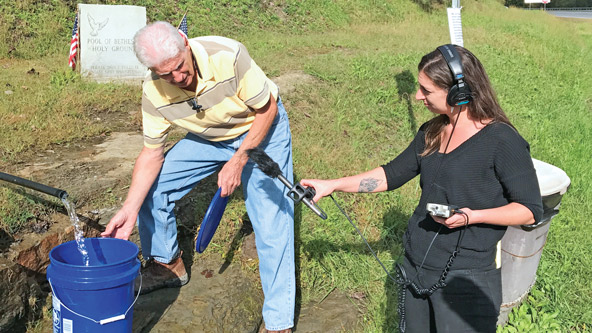
 Report for America 2018 Corps Member Molly Born interviews Jerry Rhea from Pikeville, Kentucky, for West Virginia Public Broadcasting. (Photo courtesy of the Groundtruth Project)
In 2011, veteran journalist Steven Waldman presented a provocative, landmark report to the Federal Communications Commission, warning that a nationwide collapse in local journalism was turning many pockets of the country into information deserts. “Ignoring the ailments of local media,” Waldman wrote, “will mean that serious harm may be done to our communities.”
Seven years later, Waldman partnered with colleague Charles Sennott and The GroundTruth Project to introduce a solution: Report for America, a first-of-its-kind journalism corps program. Modeled after other service corps like Teach For America and City Year, RFA pairs working journalists with resource-strapped local news organizations for a yearlong employment contract at an entry-level salary.
Having previously written a book about the founding of AmeriCorps, and even briefly having worked for the organization, Waldman thought the connection between service and journalism was obvious. But he knew it would take some education.
“People think of being a teacher or a fireman as a public service job, but they don’t think of journalists,” Waldman says. “At its best, local journalism is public service.”
With initial backing from the Ford Foundation and the Google News Initiative, RFA’s fellowship program formally launched in January 2018 with three journalists in Appalachian newsrooms. Ten more joined in June to form the first fellowship class, spanning the country from Chicago to Las Cruces, New Mexico, to Ridgeland, Mississippi.
RFA and its local news partners split the cost of the fellows’ salaries, with RFA’s own contribution capped at $20,000, and the nonprofit strongly encourages its partners to raise local funding. Newsrooms have the option to renew the fellow for a second year, with RFA reducing its contribution from a half to a third of their salary. RFA is picky about which newsrooms it works with, preferring nonprofits, family-owned enterprises, and public radio stations over corporate-owned newspapers.
One of the inaugural fellows, Obed Manuel, had been on the verge of leaving journalism altogether before he heard about RFA. A Dallas native and the son of a minister, Manuel had interned at local publications for several years without landing a long-term job prospect. RFA “was almost custom-made for me,” he says.
Manuel was placed with the Dallas Morning News, covering Latinx and immigration issues in his hometown. RFA fellows must also perform community service, so Manuel returned to his old high school to help its student newspaper launch their website. Now, as with 10 other RFA fellows in his class, his employer has renewed his fellowship for another year. But even during Manuel’s limited time at the paper, he’s seen firsthand the challenges facing the news industry: During his fellowship, the paper let go a longtime immigration reporter in an early-2019 round of layoffs.
One key difference between RFA and a program like Teach For America is that RFA offers no professional training. It wants applicants with prior journalism experience to hit the ground running, despite only being able to offer an entry-level salary. Just three of the initial 13 fellows joined straight out of college.
But outside observers want RFA to succeed. “If it does nothing but plug the hole in the dam for a couple of communities while we transition and see what else we need to do to alleviate the problem, then it’s worth supporting,” says Penelope Abernathy, Knight Chair of Journalism and Digital Media Economics at the University of North Carolina. In 2018, Abernathy published a report on news deserts across the United States, concluding that information needs were greatest in low-income communities that lacked the economic base to support newsgathering operations.
Abernathy’s biggest worry is that the newsrooms most in need of staff may not be able to afford the modest sum needed to cover part of an RFA fellow. “They’re losing money and punting and kicking the ball, hoping they can make it,” she says. Still, Abernathy supports RFA’s mission so much that she has helped lobby for the organization’s funding efforts.
And RFA is catching on with funders. In February, the Knight Foundation granted an additional $5 million to help grow the program, on top of existing support from sources such as Craigslist founder Craig Newmark, Google, and Facebook—tech giants often credited with destroying traditional journalism’s business model.
The money matches Waldman’s aggressive expansion plans. RFA has selected nearly 60 journalists for its second fellowship class, and Waldman hopes to dispatch an annual class of 1,000 reporters by 2023, cultivating corps members focused on specific regions and coverage areas like education and health care.
“If you look at the collapse of local news, we’ve lost thousands of accountability reporters,” he says. “We’re not going to solve this problem by putting dozens in the field. We have to put hundreds in the field. And ultimately thousands.”
This article appeared in the Fall 2019 issue of the magazine with the headline: "National Service Journalism"
Read more stories by Andrew Lapin.