


 (Illustration by Andrea D'Aquino)
Strategies for business-led “win-win” solutions to social and environmental problems—in which companies can promote social good and profit thereby—have gained wide appeal. Associated terms such as “shared value,” “circular economy,” “base of the pyramid,” and “reverse innovation” now pepper corporate reports and foundation websites. Corporate leaders, such as the members of the Business Roundtable, propose that they can simultaneously advance both profit and purpose. Famous academics contend that capitalism itself can be reinvented.
The coauthors of this article have a long association with several of these so-called win-win ideas. One, Andrew King, is an engineer turned academic who studies the economics of pollution prevention. The other, Ken Pucker, is the former chief operating officer of Timberland, who worked for 15 years to demonstrate the value of a business model committed to “commerce and justice.” Given our backgrounds, one would think that we would find the present popularity of win-win strategies heartening.
Instead, we are alarmed. We know that these strategies rely on improbable mechanisms, promise implausible outcomes, and boast effectiveness that outstrips available evidence. We believe that they also inflict harm because they distract the business world and society from making the difficult choices needed to address pressing social and environmental issues. Their shiny appeal distracts us from adopting more effective strategies whose costs require careful weighing.
From Heresy to Dogma
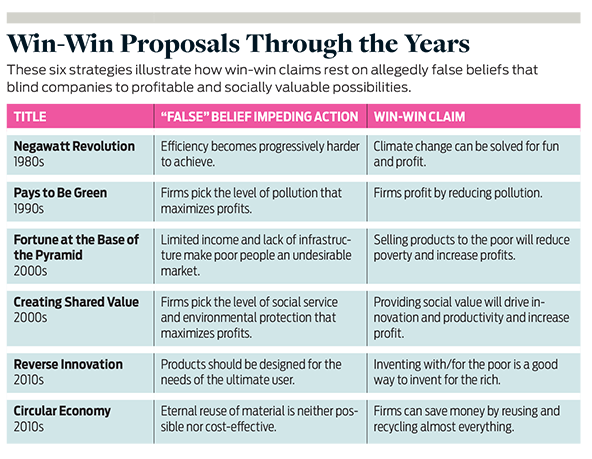
An exhaustive catalog of win-win strategies is beyond the scope of this essay. To give a sense of their breadth, ambition, and influence, we focus instead on six prominent examples.
The earliest idea of the group, the negawatt revolution, was proposed by Amory Lovins, a University of Oxford-trained physicist who in 1982 founded Rocky Mountain Institute, a US-based research organization dedicated to sustainability and energy efficiency. Lovins argued that companies were so inefficient that profits could be made by investing in energy-use reduction. As a result, firms could “solve climate change for fun and profit,” he promised.1
Not long after, Harvard Business School professor Michael Porter and researcher Claas van der Linde formulated the “pays to be green” approach. They held that firms were so profligate in their use of resources that simple operational changes could allow those companies to be both “green and competitive.” 2 Andrew King identified case examples that encouraged this contention.3
In the aughts, business professor C. K. Prahalad suggested the “fortune at the base of the pyramid” strategy.4 He claimed that firms had so neglected the world’s poorest people that they could make enormous profits from those at the “base of the pyramid” (BOP), while also lifting people out of poverty. Business professor Vijay Govindarajan extended this idea in the following decade by proposing the strategy of reverse innovation: He maintained that the innovative potential of BOP markets had been overlooked; if those markets were tapped, he contended, valuable innovations would flow from poor to rich nations, engendering both profitable products and green solutions.5
Michael Porter added another win-win proposal in the aughts, this time with consultant Mark Kramer, under the rubric of creating shared value. They argued that firms had neglected the profit potential of both social and environmental improvement. They also denied that conflicts between private and public objectives are common and encouraged managers to emphasize efforts that created “shared value”—i.e., value for both shareholders and stakeholders. Doing so, they claimed, would “drive the next wave of innovation and productivity growth in the global economy.”
Sixth, and finally, the Ellen MacArthur Foundation has synthesized several ideas for social and environmental betterment in recent years as the basis for a circular economy strategy. The foundation believes that firms can save money by reusing and recycling nearly everything.
The influence of these ideas is hard to overstate. They have reached the world’s biggest companies, informed White House strategy, shifted lobbying, and shaped international policy. Inspired by notions of profitable energy saving and poverty alleviation, Jeff Immelt, CEO of General Electric, created the “ecomagination” program in 2005. He designed it to engineer products and services that would save energy and lift people out of poverty—all while delivering superior returns to GE shareholders.6 In the following dozen years, Walmart, Nestlé, and Enel all announced that they were pursuing “shared value” initiatives.
In October 1993, President Bill Clinton unveiled his Climate Change Action Plan, which leaned on voluntary programs to help firms profitably reduce energy use and toxic emissions and design more efficient products.7 President Barack Obama’s November 2016 Climate Action Plan assumed that 20 percent of proposed CO2 reductions could be accomplished through “cost-effective energy efficiency.”
The International Finance Corporation has initiated several BOP projects in the past decade, and some policy advocacy groups have shifted their emphasis from promoting regulation to forming alliances with companies to promote win-win ideas.8 The idea that firms could profit by solving social and environmental problems went, as business and sustainability scholar Andrew Hoffman observed, “from heresy to dogma.” 9
Floating Above Analysis
A well-established principle of economics states that business competition should prevent the existence of a reliable “rule of riches”—a unique, surefire path to profits—because diminishing returns and the adaptation of competitors will dissipate the benefit of any new insight or strategy. To evade this principle, proponents of win-win strategies argue that false beliefs and narrow mindsets have precluded managers from identifying and harvesting available win-win opportunities. They trace these erroneous mental models to a mistaken acceptance of classic economic theory.
For example, in his speeches and writings, Amory Lovins repeats a parable about an economist and his granddaughter who see a $10,000 bill lying on the street. The child wants to pick it up, but the economist says “Don’t bother. If it were real, someone would have picked it up already.” 10 C. K. Prahalad tells the same story to explain why a presumed fortune remains untapped at the base of the economic pyramid. Porter and van der Linde use a similar narrative to defend their argument that firms can profit by reducing pollution. Likewise, Porter and Kramer blame economists for “legitimiz[ing] the idea that to provide societal benefits, companies must temper their economic success.” 11
Appeals to false beliefs and flawed mental models only partially explain why win-win strategies persist. To justify claims of widespread and accessible win-win opportunities, proponents must explain both why managers fail to see them and why competition does not force them to do so. Win-win theorists have appealed to a number of explanations for this problem—imperfect competition, changing conditions, and persistent organizational barriers—but none of these has proven durable.12
More commonly, win-win proponents have substituted promises so enticing that they elude rational analysis. For example, Lovins claims that US electrical use can be cut in half with an investment payback of less than a year, and Porter and Kramer assert that shared value can “reshape capitalism and its relationship to society.” Visions this vibrant, economist and strategist Richard Rumelt warns, circumvent even skeptical readers’ defenses: “Bad strategy flourishes because it floats above analysis, logic, and choice, held aloft by the hot hope that one can avoid dealing with tricky fundamentals and the difficulties of mastering them.” 13
Missing Evidence
What about empirical evidence in support of win-win theories? Although many of these strategies have been around for decades, evidence for their effectiveness remains lacking. This void is often obscured by the use of provocative but unrepresentative case studies. In speeches and publications, Lovins uses the example of his home in Colorado as proof of his contention that energy efficiency can be profitable.14 Protected by multiple layers of gas-filled glazing, Lovins’ house grows banana trees, despite being located in the Colorado mountains. Yet this example represents an obvious sleight of hand: No one doubts that building a sealed and insulated house is possible; what critics question is Lovins’ contention that doing so makes economic sense. To prove this, econometric analysis across many houses is required. Only then can hidden frictions and trade-offs be uncovered.
In fact, researchers have studied energy efficiency extensively, and the best evidence does not support Lovins’ claims.15 Indeed, some of the most careful recent analysis even suggests that some well-designed programs to encourage energy efficiency cost more than the benefits they create—social benefits included.16 That means those programs result in a lose-lose, not a win-win.
What about the fundamental claim underlying many environmental win-win strategies that pollution reduction and financial performance often align? Findings from hundreds of studies (several by Andrew King) cast doubt on the existence of a reliable link. Even proponents of win-win strategies, such as Porter, Kramer, and Harvard Business School professor George Serafeim have recently admitted that, after years of effort, a firm’s social and environmental performance does not deliver “alpha”—the tendency of its stock to outperform that of other firms.17 Yet they infer that this means only that firms are not implementing their strategy of “shared value” properly, and that if they did so, they would in fact achieve significant financial benefits.
Substantial empirical studies of other win-win strategies are almost entirely lacking. We know of no statistical analysis of theories for profits at the bottom of the pyramid, from reverse innovation, or through shared value strategies. In fact, when we asked Porter and Kramer about the empirical support for their ideas on shared value, they pointed to the strategy’s popularity among executives and students and the business cases they had written. Yet selected case studies provide evidence only of possibility, not practicality.
Worse still, some of the case studies used to promote these strategies appear ambiguous on closer inspection. For example, Allen Hammond, former vice president for innovation at the World Resources Institute, and C. K. Prahalad use the case of a skin-lightening cream as evidence of the potential for profit to align with social gain: The firm gets a sale, and the user “feels empowered because of an affordable consumer product” that reduces the social stigma of her having dark skin.18 Where Hammond and Prahalad see empowerment, business professor Aneel Karnani sees something else: “At best, it is an illusion; at worst, it serves to entrench her disempowerment.” 19 Similarly, the most prominent example of reverse innovation, a project to invent a $300 house for Haitians left homeless from the 2010 earthquake, received extensive support from businesses, academia, and financial institutions. But no breakthrough design was uncovered and no houses were ever built.
It is time to turn away from alluring unproven strategies and refocus our efforts on those interventions that have proven effective.
Some of the originators of win-win strategies agree that scientific evidence remains missing. In 2015, Vijay Govindarajan told a coauthor of this article that he intended reverse innovation to be understood as a proposed “next practice,” one option among many that managers might adopt. He said that the concept placed the “onus on the executive” to test the idea before using it. Another progenitor of a win-win strategy (who asked to remain anonymous) told us that evidence for profits at the base of the pyramid remains missing because many serious scholars have become entranced by the celebrity that sometimes accompanies the trumpeting of simple, pain-free ideas. He disparaged such remedies as “three bullet points to a solution” and contended that they represented advertisements for consulting services, rather than descriptions of serious proposals.
The style of writing in trade books and popular outlets may contribute to the gap between evidence and claims. “When you write for practitioners,” Govindarajan told one of us, “some things you assert.” Claims that are limited and conditional in an academic journal (for example, to quote a Global Strategy Journal article on reverse innovation, “From time to time … innovations have the potential to ‘trickle up’ from poor to rich countries” 20) become bolder and more colorful declarations when expressed in popular outlets. (“Reverse Innovation will transform just about every industry, including energy, healthcare, transportation, housing, and consumer products.” 21)
The Costs of Magical Thinking
Defenders of win-win strategies reject the notion that their proposals, even if later proven false, can be harmful. Their ideas, they contend, at worst build excitement and provide hope. Jim Yong Kim, the former head of the World Bank, made this point succinctly when defending criticism of Govindarajan’s project to design and build a $300 house. A self-proclaimed “raging optimist,” Kim disagreed with warnings that untested proposals could create harm. “I think Barack Obama had it right: ‘There is no such thing as false hope. There is only hope.’ ” 22
We have no doubt that hope is a precious thing, but we also believe that hope that leads to misplaced action and investment can be harmful. Even the best of intentions can have enormous opportunity costs. We should not, as a society, support the sale of magical potions for dangerous diseases—even though they might engender temporary hope. Equally, we believe that using unproven win-win strategies can result in real harm, because they can impede more effective systemic solutions and hinder useful corporate action. And it turns out that President Obama cannot be used to prioritize hope in the way Kim suggested: The quote he referenced actually comes from The West Wing’s fictional president, Matt Santos.
Impeding systemic solutions | Belief in win-win strategies can also delay needed change. Business professor Aneel Karnani told us that dreamy proposals have slowed the extension of life-giving electrical power to impoverished areas. “By planning to put solar panels on all poor people’s houses, and talking like this, we delay extending the electric grid which is the right solution,” he told us.
We see something similar in the story of the $300 house project for Haiti, an idea that Govindarajan and consultant Christian Sarkar proposed. Eventually, even the project’s sponsors concluded that social and governmental challenges, not a lack of affordable house designs, caused the country’s housing problems. “We cannot successfully build homes,” Govindarajan wrote with architect Jack Wilson, “without building community, infrastructure, and economic opportunity.” 23 In other words, the money used to create unneeded designs would have been better spent on these difficult, systemic problems.
Belief in win-win potential can cause well-intentioned people to take actions that impede, rather than advance, existing systemic solutions. For example, Paul Ligon, senior vice president at Casella Waste Systems, told us that some of his customers, convinced by the “circular economy’s” premise that all material should be recyclable, had decided to put food waste in recycling bins. When this contamination is discovered at processing centers, whole truckloads of material must be directed away from recycling and toward landfill disposal. Such actions, Ligon says, “allow people to feel like they’ve solved the problem, when in fact they’ve made it worse.”
Hindering corporate action | At the corporate level, exaggeration of win-win possibilities can backfire and actually slow voluntary action. Auden Schendler, senior vice president of sustainability at the Aspen Skiing Company, discovered this problem the hard way. Schooled at Rocky Mountain Institute, and an early protégé of Amory Lovins, Schendler maintained that vast opportunities existed to make US corporations more energy efficient. On the job, however, he quickly discovered that opportunities turned out to be harder to implement than he had been led to believe.
Eventually, Schendler concluded that exaggerated win-win claims were hindering corporate progress. “You get a businessperson who’s totally new to it and has bought the argument hook, line, and sinker from the environmental community, tries to do it, gets machine gunned coming over the top of the trench, and is now your worst enemy because you lied,” he says.24
Scholar and entrepreneur Erik Simanis argues that belief in win-win theories often causes entrepreneurial efforts to fail. Simanis wrote his dissertation under the direction of one of the creators of the BOP theory; he then worked with many companies in Africa, Latin America, and Asia to create profitable businesses that also addressed social problems or reduced environmental harm.
His experience led him to conclude that adding in social and environmental objectives could harm business. “By trying to do a little bit of development, a little bit of participation, a little bit of business strategy,” he told us, “all we did was create bad businesses.” Eventually, Simanis wrote a series of articles arguing that the fortune at the base of the pyramid was a mirage.25 His advice? “Forget a win-win,” he says. “Just focus on surviving.”
Putting profit aside, Guido Palazzo, professor of business ethics at HEC Lausanne, maintains that adoption of win-win strategies can actually decrease a firm’s adherence to moral imperatives. After he criticized an international food-and-drink company for its use of slave labor in Ghana and Côte d’Ivoire, executives invited him to visit a “shared value” project. During the trip, he discovered that executives seemed to believe that these win-win projects compensated for their immoral actions elsewhere. Horrified by the loss of moral boundaries, Palazzo told them, “Fix your core problems first. … Don’t let shared value obscure your basic responsibilities.”
What Now?
We think our argument has two main implications. First, we should all be careful to critically analyze new strategies, particularly those that promise pain-free solutions. Second, we should increase our support for proven interventions, even if they involve some sacrifice.
As former believers in win-win strategies, we have had to train ourselves to be more critical consumers of new ideas. We have found it useful to remind ourselves that theories made after observing cases should not be trusted, no matter how alluring they may be.26 Theorizing explanations for observed events, philosopher Ed Leamer warns, results in “literature, not science.” 27 Yet theories, like good literature, are often very enticing because they match what both the analyst and her audience want to believe.
Physicist and Nobel Laureate Richard Feynman long warned about this human tendency to pick attractive explanations: “The first principle is not to fool yourself, and you are the easiest person to fool.” Responses to the recent epidemic caused by the novel coronavirus responsible for COVID-19 demonstrates this point clearly. Some researchers, hoping to find an easy cure, saw potential treatments in anecdotes and limited cases. But seeing an individual recover after taking the antimalarial drug hydroxychloroquine, for example, does not demonstrate its effectiveness. Only systematic testing can do that.
Unfortunately, testing can take years. So, what can be done in the meantime? Evaluating explanations for their conformity with particular “virtues,” such as accuracy, consistency, and simplicity, can sometimes help. That is, better explanations account for a lot of observed facts, explain the connections between those facts, and require no special pleading or unnecessary complexity.28 If an explanation demonstrates these virtues, it may be judged “more likely,” but how true or predictive it really is remains unknown, so it still must be handled cautiously.
By our judgment, the six win-win proposals described in this essay don’t exhibit these virtues. Instead, we think the six strategies reveal the dangerous appeal of pain-free solutions. Believing that corporations will solve our global problems is extraordinarily enticing. Corporate promises of social responsibility, commitments to focus on stakeholders, and vibrant pitches of win-win solutions create the impression that companies can address social and environmental challenges and profit thereby. We would like to believe former Pepsi CEO Indra Nooyi when she speaks of corporations as “little republics” that can address social and environmental problems.29 Nooyi, no doubt, has good intentions. But Pepsi continues to sell salty snacks and sugared drinks in single-use plastic bottles.
It does so because the structure and rules of the system in which it competes remain focused on profitability. Consequently, companies can sustain voluntary efforts only as long as they deliver traditional financial results. Remember Jeff Immelt’s ecomagination program? When GE’s stock price fell by more than 50 percent, activist investors wrote a white paper called “Transformation Underway … But Nobody Cares.” Immelt was encouraged to retire, and his successor undid many of his initiatives.
Timberland, where coauthor Ken Pucker worked as COO, once provided a prominent case example of the potential for voluntary corporate action. The company pioneered strategies that promoted community service, protected global human rights, and advanced environmental stewardship. As a result, it was showered with honors: Fortune magazine called it a top 100 company to work for, Forbes magazine deemed it a platinum investment, Business Ethics magazine named it a top 10 ethical company, and it received a Ron Brown Award for Corporate Leadership from the federal government. Yet Timberland’s carbon footprint continued to grow, and margin pressure led the company to close its US factories. “Purpose is essential,” Pucker now tells his students. “So too is profit.”
It is time to turn away from alluring unproven strategies and refocus our efforts on those interventions that have proven effective—such as government regulation. When US citizens were faced with dirty rivers in the 1970s, they didn’t encourage firms to consider that it might pay to be green; they demanded that pollutants be regulated. When smog overcame many US cities, activists didn’t ask firms to create shared value; they called for emission standards. When the world faced its first global threat to our shared atmosphere, growing damage to our ozone layer, citizens did not ask for companies to create new “social purpose” charters; they forced global leaders to negotiate a worldwide ban on chlorofluorocarbons. As a result, our rivers are healthier, our air is safer, and the hole in the ozone layer is closing.
When considering difficult global challenges, including those that COVID-19 now presents, we are sure to be enticed by new and seductive ideas that promise pain-free solutions. When so tempted, we must think critically about such proposals. Have they been tested? Do they have virtuous explanatory properties that make them likely? And we must also remember that our hopes can lead us astray. Critical thinking and implementation of proven interventions—not faith in oversold ideas—gives us our best chance to deliver much-needed social and environmental progress.
Read more stories by Andrew A. King & Kenneth P. Pucker.