


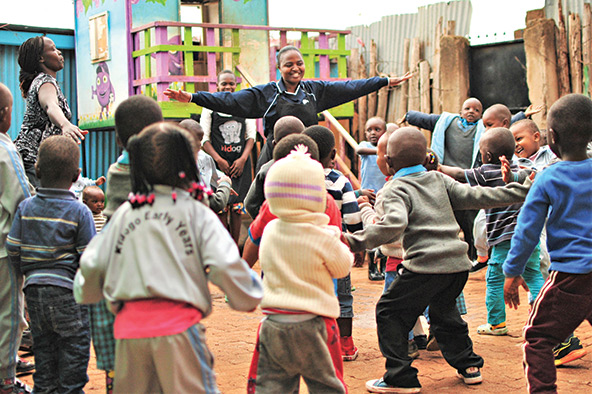
 Children enjoy outdoor time at
one of Kidogo's childcare centers in
Nairobi, Kenya. (Photo by Daniel Macharia courtesy of Kidogo)
Children enjoy outdoor time at
one of Kidogo's childcare centers in
Nairobi, Kenya. (Photo by Daniel Macharia courtesy of Kidogo)
In his January 2019 Stanford Social Innovation Review article, “To Impact Millions, the Social Sector Needs to Scale Scaling Up,” consultant Greg Coussa writes: “The ‘scale sector’—the practices, people, and policies that make up the efforts to exponentially boost an organization’s impact—is woefully under-resourced and nascent.” This scaling crisis threatens the loftiest aspirations of the social sector. How, for instance, will we even begin to approach the United Nations’ Sustainable Development Goals (SDGs)—the 17 goals the United Nations General Assembly set to “achieve a better and more sustainable future for all” by 2030—without first figuring out how to dramatically expand the impact of our most promising ideas? How will we try to eliminate poverty (SDG 1) and hunger (SDG 2), ensure good health and well-being (SDG 3), create quality education (SDG 4), establish gender equality (SDG 5), provide clean water and sanitation (SDG 6), and produce affordable and clean energy (SDG 7) for the whole world if we cannot take whatever limited successes the social sector has seen along these lines and multiply them a thousandfold?
While the so-called “scale sector” may be under-resourced and nascent, social sector franchising is emerging as a promising approach to multiplying the impacts of social enterprises. Commercial franchising has a proven record of catalyzing business expansion. Socially minded entrepreneurs have begun turning to this model in hopes of achieving analogously large-scale growth and thereby exponentially boosting their social impact.
Imagine a world with massive numbers of franchises all over the world delivering standardized medical care, potable water, education, and clean energy, rather than hamburgers and french fries. If the success of commercial franchising could be harnessed for positive social impact, the benefits would be immense. They would include improved access to products and services for tens of millions of people; ownership opportunities at the base of the pyramid (BoP) for tens of thousands of franchisees; creation of jobs for hundreds of thousands of people employed by franchisees and franchisors; and spillover benefits, such as healthy pressure on local suppliers to improve the quality of their products and services to a level high enough to win contracts to supply franchise networks.
To be sure, multiple obstacles stand in the way of social sector franchising reaching its full potential. The practice is still fairly recent, and as practitioners, capital providers, governments, NGOs, and researchers learn more about it, solutions will emerge to overcome these obstacles. This article is an effort in that spirit.
Through the University of New Hampshire’s Social Sector Franchise Initiative, the authors had the opportunity to examine the experiences of several social sector franchises. All of us were closely involved as lead organizers of this program and as selectors and ongoing mentors of the participants. The initiative matched 13 social sector franchises with franchising experts in an eight-month executive mentorship program and convened three annual roundtables featuring a diverse cross-section of social sector franchise entrepreneurs, commercial franchise experts, impact investors, and philanthropists, plus academic researchers and select students. Through this initiative, the authors examined the experiences of social sector franchises in different industries and countries. In what follows, we highlight common issues that social sector franchises face operating across these different environments, and make special reference to four specific enterprises. We focus on the experiences of these franchises from different sectors to identify successes, challenges, and lessons that may inform this fledgling field.
Replication With Advantages
Any entrepreneur or organization whose operating model is already delivering social impact on a small scale faces a choice of how to scale that impact. One option is replication, and franchising is but one way to replicate social impact.
“Finding ways to scale an organization’s impact without scaling its size is the new frontier in the field of social innovation,” Bridgespan managing partner and cofounder Jeffrey Bradach wrote in 2010.1 The ensuing decade has spawned vast literature on scaling. Without offering an exhaustive catalog, we can simplify into four groups the options researchers and practitioners have pinpointed. First, an organization can replicate a successful operating model, including franchising and other methods that offer varying control and enforcement of standards in applying the model. These include licensing, organic growth through company-owned locations, mergers and acquisitions, and joint ventures. Second, it can align looser networks of independent organizations toward a desired outcome in a specific industry, such as agriculture, health care, or energy production. The organization can do so by providing central know-how, services, or supplies, spreading programmatic similarities with little programmatic control (e.g., cooperatives and certification programs). Third, the organization can disseminate know-how in some other way, such as by providing training, consulting, or publishing lessons or tools, or by inventing an app. Fourth, the organization can advocate for policy change using a successful demonstration or flagship operation.
For organizations that take the replication path as their way of scaling social impact, franchising offers several advantages. It provides a proven operating model with defined systems and processes, delivering a standardized product and/or service; it offers a common brand with trademark(s), owned by the franchisor and licensed to the franchisees, along with the operating system; and it generates fees that the franchisees pay to the franchisor for use of the brand, marks, and system, and for support services that the franchisor provides for the franchisees, such as training, quality control, advertising, and marketing.
Franchisees generally contribute capital, entrepreneurial skills, and local market knowledge. Franchisees may find joining a franchise system attractive because it allows them to go into business for themselves but not by themselves, as the franchise system offers a proven turnkey business that comes with support from the franchisor. Franchising is thus a powerful model to scale up a business.
The modern form of commercial franchising took off in 1950s America with the launch of companies such as McDonald’s and KFC, which are dominant franchisors today. The franchising sector has since achieved tremendous scale and economic impact, reaching more than 800,000 franchised locations in the United States and supporting 8.9 million jobs, according to the International Franchise Association (IFA). Beyond quick-service restaurants for which commercial franchising is most known, large franchise networks exist in a wide variety of industries, including tax preparation, health care, cleaning services, senior care, auto services, real estate, hotels, fitness, and car rentals.
There is no one-size-fits-all approach to franchising that ensures rapid or successful scaling. Franchisors differ wildly in their practices, including in terms of how they structure, document, and enforce deal terms with franchisees, and how they deliver supplies, training, and services for franchisees. While the best franchises offer inspiring examples of scale, some franchises, just like any other method of distribution, fail.
For the purposes of this article, we define franchising as a relationship between a franchisor and franchisee in which the franchisee acts as an independent operator with vested interest, working under and building a common brand and using an operating model prescribed by the owner of the brand, the franchisor, and paying the franchisor in some way for the continued rights to operate under the brand or system. We are particularly interested here in applications of business format franchising (as opposed to product-distribution franchising or fractional franchising). In business format franchising, a brand owner (franchisor) licenses to independent entrepreneurs (franchisees) a business format—a branded system of delivery—rather than only specific products or services (as in product-distribution franchising, such as auto dealerships or bottling companies). A franchised business format includes licensing the use of the brand, standardized operating procedures, design and merchandising specifications, accounting methods, advertising activities, and so on. Business format franchising is now the most common form of commercial franchising in the United States, accounting for almost 11 times as many establishments as product-distribution franchising and providing almost six times as many jobs, according to the IFA.
The idea of applying franchising to the social sector is not new.2 Researchers have analyzed and categorized socially focused franchising under such rubrics as social franchising, social sector franchising, fractional franchising for social purposes, and microfranchising. For the purpose of this article, to qualify as a social (or social sector) franchise, the franchise must consider social impact its primary intention; it is not sufficient to have only incidental social impact, such as job creation or economic development that might accompany a commercial franchise. Unlike business franchises, social sector franchises are driven by their social mission, which regularly affects critical choices they make about products, services, customers, employees, themselves, and their franchisors.
Social sector franchises often do not fit cleanly into the category of “for profit” or “nonprofit.” They seek financial returns but primarily as means to achieve social impact, and they target human needs, rather than simply consumer desires. Social sector franchisors often play dual roles—e.g., operating as an investable franchisor company while simultaneously and passionately raising grants and donations to facilitate the social impact the franchise is designed to make. This approach leads to hybrid organizational forms with a double bottom line of financial and social returns.
All franchisors—social sector or commercial—seek the profitability of their franchisees. But while both types of franchisors accept that unit-level profitability is the cornerstone of a sustainable franchised business, social sector franchisors often hold franchisor-level profitability as a long-term goal and in the meantime sustain the franchise by using grants and donations to supplement whatever percentage of costs the franchisor can recover from franchisees. Some social sector franchisors go further and consider such external funding a permanent state—i.e., they do not seek franchisor profitability solely through money flowing up through their franchise network.
Four Promising Franchises
A number of social sector franchises have launched over the past two decades and are having significant impacts on communities around the world. Examples of promising social sector franchises bringing vital products and services to low-income populations include Jibu, Mercado Fresco, Unjani Clinics, and Kidogo. All four enterprises participated in the University of New Hampshire’s Social Sector Franchise Initiative. We have chosen to highlight these four companies as representative of the state of the field, and we also include general insights from other participants.
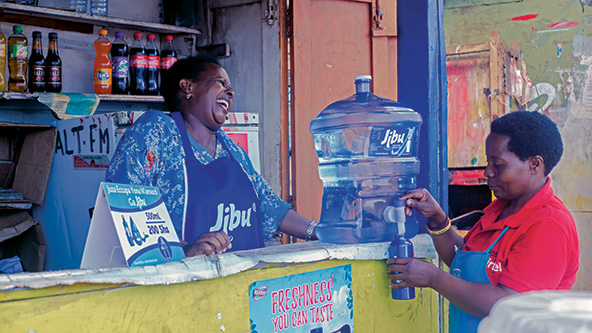 Jibu franchises sell drinking water in reusable containers. (Photo courtesy of Jibu)
The first, Jibu, equips emerging market entrepreneurs to create affordable access to drinking water and other necessities. Randy Welsch and Galen Welsch, father and son, cofounded the enterprise in 2012 after Galen’s stint in the Peace Corps and Randy’s exit from a long career in the tech industry. While neither Randy or Galen knew the water sector, both had experience in sub-Saharan Africa and a passion for how to unleash the latent potential of local entrepreneurs to serve basic necessities.
For an investment of $2,500-4,500, franchisees are equipped with Jibu’s water-purification and other equipment, branding, training, and the capital required to launch franchised locations selling drinking water at prices competitive with that of the charcoal it would cost to boil it. The franchise seeks to create profitable businesses for local entrepreneurs, employing numerous people in each community it serves while promoting social well-being, mobility, and agency for new business owners. Jibu franchise locations sell drinking water in reusable containers. Customers pay an initial deposit for the reusable water bottle, then pay only for the water when exchanging an empty container for a full bottle.
Before becoming active franchisees, potential franchisees begin as microfranchisee distributors of an existing franchisee. Approximately 700 microfranchisees are currently competing to become franchisees; Jibu picks its next franchisees from the best-performing microfranchisees. A L3C (low-profit limited liability company) with a US 501(c)(3) nonprofit partner, Jibu has launched 134 franchises in seven countries (Burundi, Kenya, Tanzania, Rwanda, Uganda, Democratic Republic of Congo, and Zambia), has distributed more than 190 million liters of water, and serves 2,248 retail points.
Mercado Fresco is a Nicaraguan franchise that makes quality, affordable food accessible to low-income communities. It operates in two formats: The first uses stores located in the homes of female microfranchise operators, and the second, carts wheeled around the city (Fresco Express). Products include fresh dairy; vegetables; bread; and traditional foods, such as rice, beans, and nacatamales, a Nicaraguan staple dish. Mercado Fresco teaches operators everything from proper food handling to customer service to money management and gives them equipment, including food baskets, signs, and calculators.
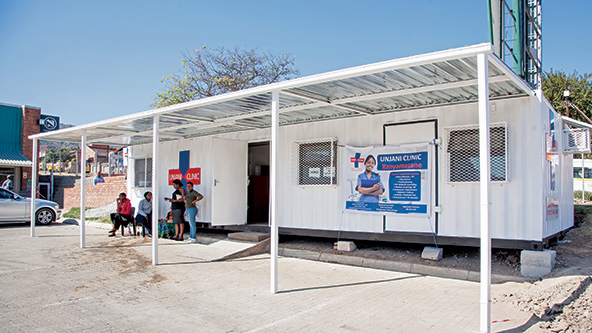 Unjani Clinics uses specially outfitted shipping containers to provide health care. (Photo courtesy of Unjani Clinic)
Mercado Fresco envisions long-term franchisor profitability through scale. The enterprise now has 95 stores in operation across Nicaragua. Through the commission that franchisees earn from their store sales, Mercado Fresco has helped raise local incomes from $0 to $2 per day to $4 to $10 per day.
Unjani Clinics is a South African network of nurse-led primary medical clinics housed in specially outfitted shipping containers. The enterprise aims to enhance access to quality, affordable primary health care. By placing the clinics in the community (at the point of need), Unjani reduces travel distances and time, decreasing cost and increasing convenience for patients. In addition, it empowers Black women professional nurses to operate and ultimately own a sustainable microenterprise and creates permanent employment in townships and rural communities.
Incorporated as a South African nonprofit company, Unjani Clinics raises funding for the $67,000 start-up investment per clinic for infrastructure and equipment and covers the initial cost of training the nurse and clinic staff. Unjani gives operational donations (working capital) to the nurse for the first two years of operation, until the clinic reaches financial viability. The nonprofit company also implements, trains, and manages both the program and the standard procurement processes, and negotiates prices for all clinics. Unjani and the nurse sign a five-year enterprise development agreement (EDA) that governs the relationship and details the responsibilities of each party. The nurse is the operational owner of the clinic from day one, but title ownership transfers only after the five-year period, based on EDA compliance.
Corporate Enterprise Development (a South African government program run through the Department of Trade and Industry), Unjani Clinics’ primary partners (including Imperial Logistics, Johnson & Johnson, Pfizer, AECI, The ELMA Foundation, and the Jobs Fund, which is an initiative of South Africa’s National Treasury), and individual donors have provided the funding to set up the current network. Unjani charges a network fee to the clinics to cover some of its operating costs. The monthly network fee escalates over the five-year period but is capped at 4 percent of clinic revenue. The network currently consists of 80 clinics, which have performed 1,667,165 consultations since 2013.
Kidogo, which means “small” in Swahili, gives families living in Kenya’s low-income communities access to high-quality, affordable childcare. Incorporated as a company limited by guarantee (CLG) in Kenya with a US 501(c)(3) nonprofit partner, the enterprise teams up with local women (“mamapreneurs”) to help them either start or grow their own childcare microbusinesses.
Prior to joining the Kidogo network, women typically operate their own informal daycares (approximately 3,500 makeshift daycares exist in Nairobi’s urban slums alone) but struggle with quality control and business management. Kidogo supports mamapreneurs (often women with only a primary-school education level) to run first-rate microbusinesses while earning a sustainable livelihood. It provides training in early childhood development and entrepreneurship, followed by continuous coaching, professional development workshops, and peer-to-peer support sessions.
Kidogo has established clear quality standards through a checklist that is simple to use and that generates ratings for each center, which are mapped to the six elements of the Kidogo Way, the organization’s proprietary approach to running a quality childcare center. All training, coaching, and support tools are based on these same elements. Mamapreneurs are encouraged to do a self-assessment every two weeks. Franchising officers also do an assessment during their coaching visit. The monitoring and evaluation team does random spot checks using the same checklist at least once a quarter to verify results. The process is mobile-phone based, generating real-time information on the mamapreneurs.
Upon meeting Kidogo’s quality standards, mamapreneurs are offered the opportunity to become franchisees, which gives them use of a management app and the Kidogo brand. The start-up investment per unit is $250-$1,000, including a renovation of the center. Almost all centers are 10-by-10-foot corrugated metal shacks with limited lighting and ventilation; renovations include adding a roof skylight, a window, and a mirror to visually expand the size of the room; providing a rug, as well as hand-washing and drinking-water containers; creating a wooden partition to separate the cooking area from the play area; and painting the space to make it more engaging. Kidogo also gives each center a starter kit with basic play materials. Through the network, Kidogo is improving the quality of care for young children while supporting working mothers to rejoin the workforce with peace of mind.
The leaders of these four organizations have used franchising—each in their own way—as a method of expansion and have significantly increased their social impact. Jibu has distributed almost 200 million liters of water. Mercado Fresco is operating close to 100 stores, providing affordable food and higher incomes. Unjani has performed more than 1.5 million consultations. Kidogo has close to 150 mamapreneurs in its network and is now Kenya’s largest childcare chain. But such growth did not come easily; these franchises overcame numerous hurdles while building their networks and client base.
Not an Easy Path
We identified several major challenges that social franchises have faced through our research into these four and other participants in the University of New Hampshire’s Social Sector Franchise Initiative. Note that we have decided to focus on the challenges unique to franchising and set aside other potential challenges, such as political instability, armed conflict, or natural disaster.
Lack of familiarity with franchising | Social sector franchisors often operate in places where franchising is not prevalent, such as rural areas and slums in low-income countries. The lack of clear models makes establishing clear expectations for franchisees difficult.
Financing for franchisees | In commercial franchising, franchisees (not franchisors) supply financing to open franchised units. Distributed ownership is fundamental to franchising. But many social sector franchisors find that their franchisees have no source of start-up capital. Banks are leery of lending to franchisees without relevant credit histories and collateral. This is perhaps the most serious obstacle to scaling for social sector franchises.
Franchisee candidates | To scale rapidly and significantly, social sector franchisors need a pipeline of qualified potential franchisees who have the entrepreneurial drive and skill to build an independent, viable business under the franchise system. But social sector franchisors serving low-income communities face major obstacles here, in addition to lack of financing sourced by franchisees. Highly educated franchisee candidates from middle-class communities often do not find it financially attractive to serve lower-income communities (and sometimes feel unsafe doing so or are badly positioned culturally to gain the trust of local customers); franchisee candidates from within low-income communities often lack basic skills (such as literacy, numeracy, accounting, and sales), likely have never encountered a franchise (even as consumers), and may be frequently disrupted by familial, social, or economic issues while operating as franchisees. It is not uncommon for franchisees of Mercado Fresco, for example, to face domestic violence or abuse and associated mental and physical health challenges.
Customer purchasing power and culture | Customers targeted by social sector franchises—including all those featured in this article—often have little cash to spare and often have incomes that wax and wane seasonally, or that are disrupted by urgent family needs (school fees, weddings, funerals, etc.) or by increases in the price of basic necessities, such as food. This instability can undercut the sales of franchised units, in turn threatening franchisors’ ability to generate royalties and fees necessary to sustain the overall business. Furthermore, customers may technically need goods and services that the franchise considers its core offerings (such as potable water) but hesitate to use limited cash to pay for them.
Enforcing standards | All four franchisors featured in this article set and enforce brand standards and equip franchisees to follow them. However, in various jurisdictions where they and other such franchisors (and their franchisees) operate, it is impractical or ineffective to send franchisees a default letter, terminate their contract, or take them to court. It can also be challenging to write a franchise agreement that is legally defensible and yet fair to franchisees with limited ability to comprehend lengthy legal documents. And it can be costly to operate an effective compliance system. Lastly, when contemplating revoking a franchisee’s rights when the franchisee has egregiously violated the franchise agreement, social sector franchisors sometimes worry that they will harm a local community, whose service may be disrupted.
Provision of franchise services and products | Social sector franchisors often face difficulties in standardizing build-outs of franchised units, because many franchisees work in contexts without consistent access to standardized building materials or reliable contractors. Site selection can also be problematic because of lack of market data, negotiations with landlords, unreliable quality of buildings, and lack of effective legal recourse in case of a dispute. Poor roads, inconsistent suppliers, and disproportionate expenses to distribute goods to the last mile can also make the franchise supply chain unreliable.
Friction with government(s) | Social sector franchises often do things that overlap with government functions, such as providing drinking water (Jibu) or health care (Unjani). Social franchises can therefore find themselves in high-stakes discussions with regulators, waiting for permits, navigating the changing landscapes of political administrations, giving and receiving political influence, or negotiating partnerships. This is complicated territory and introduces various risks.
Lack of legal framework | Without a basic legal framework defining and authorizing franchising to take place in a country, authorities encountering social sector franchises often lack straightforward answers to questions about taxation (Do you tax the franchisee, the franchisor, or both?), permitting, or who has the authority to speak for the business operating on the premises in case of a lease dispute. Commercial franchisors share this challenge.
Economic disparity | Social sector franchisors must often carry out some functions in large cities, which give them access to highly educated personnel, key suppliers, funders, and regulators. But the cost of living in such settings is often an order of magnitude higher than in slums or rural areas served by social sector franchisees. This steep difference makes it difficult to pay central franchisor costs with royalties and fees generated from franchisees; franchisors and franchisees are effectively operating in different economies.
Taken together, these challenges to social sector franchising become incredibly tricky. Franchises must juggle multiple salient components simultaneously and craft solutions locally to account for a host of obstacles. Furthermore, many commercial franchise networks scale not only via franchisees who own one or two units but via territory-specific developers, multiunit franchisees, or master franchisees, who might own tens or hundreds of units. But who wants to buy master franchise rights to a brand that lacks ready access to financing for franchisees, that faces regulatory risks in each new region where it operates, or that depends on piecemeal external subsidies to guarantee sufficient profitability? Finally, the same limited collection of entrepreneurs with the financial and business acumen to consider buying rights to expand a social sector franchise also usually have opportunities to invest in much more straightforward businesses emerging in their countries or regions.
Overcoming Obstacles
Jibu, Mercado Fresco, Unjani, Kidogo, and other social sector franchisors that have succeeded in converting working operating models to growing franchise systems in challenging environments have made a number of notable moves in response to these environments. These include:
Targeting specific BoP customers, rather than all BoP customers | In response to low customer purchasing power, some social sector franchisors narrow their focus to target certain categories of customers at the base of the pyramid. Unjani Clinics, for example, serves employed, uninsured customers, rather than destitute, unemployed customers. And Jibu works in urban areas, instead of rural areas, to ensure sufficient volumes for franchisees to be profitable.
Slimming the business format and simplifying systems | Aware of lack of franchisee capital, Mercado Fresco decided to slim down its business format (nutritious food stores in female entrepreneurs’ houses) to a second format, its Fresco Express carts. This lowers the barrier to entry for franchisees and increases potential customers and brand visibility. Meanwhile, Kidogo chose to convert its operating manual from words to pictures, enabling illiterate franchisees to own businesses. This move enabled Kidogo to broaden its social impact and potentially boost its bottom line by expanding its pool of potential franchisees, minimizing training costs, and documenting and distributing standardization in a clever way.
Vetting potential franchisees by results | Even in markets where potential franchisees are not exposed to franchising, social sector franchisors are developing work-arounds to ensure quality franchisees. For instance, Jibu currently has 110 franchisees and requires potential new franchisees to start by buying wholesale water from existing Jibu franchisees and then to sell the water through a branded point of sale. Jibu reviews the sales volumes of all 700 or so of such microfranchisee distributors and invites the top 10 per month to become franchisees. Jibu then conducts due diligence on these selected candidates and collects an initial, $2,500 franchise fee. This vetting system ensures that a franchisee candidate is capable and that water is selling well in the particular community where Jibu is about to invest $25,000 in a franchised store. In this way, Jibu screens out candidates unwilling to start as microfranchisee distributors (even wealthy candidates), as well as those who succeed as microfranchisee distributors but are unable to raise the initial franchise fee. (Before instituting this system, Jibu vetted potential franchisees with a set of interviews, which the organization found less effective.)
Facilitating peer-to-peer interaction between franchisees | Some social sector franchisors encourage franchisees to interact with each other in a way that benefits the system and brand as a whole. For example, Kidogo organizes its franchisees into communities of practice, where fellow franchisees meet to discuss their experiences and to make handicrafts useful to their businesses. Because toys are expensive in Kenya, Kidogo encourages mamapreneurs to create their own, such as storybooks using cardboard boxes or dolls made of old cloth. It awards points to franchisees for reporting data, attending monthly development sessions, paying the franchise fee, and maintaining other key standards.
Explicitly addressing troublesome areas of the broader social system | Social sector franchisors must respond flexibly to social issues they discern to be undermining the success of their franchisees. For example, Mercado Fresco facilitates some psychological counseling for franchisees facing difficult issues at home, having found such issues to constitute a common source of disruption. Meanwhile, Kidogo identifies and seeks the consent of important influencers, such as husbands and local chiefs, before opening a new childcare center, to reduce the risk that such people will disrupt a franchisee’s business after it opens.
Vertical integration | Some social sector franchisors overcome weaknesses in their surrounding operating environment by performing certain functions themselves, instead of depending on others. For example, Mercado Fresco found suppliers unreliable, especially as its volumes increased, so the enterprise decided to take its supply chain in-house. It now has a single central warehouse from which it distributes goods to all of its stores and carts, and it cooks some of the food (e.g., tortillas) that suppliers were not able to reliably produce in high enough volumes. Acting vertically in this manner was possibly the most expensive short-term approach to addressing its supply chain but paved the way for Mercado Fresco to achieve its long-term vision of volume-based profitability.
Leveraging existing trust | Instead of choosing sites or franchisees with no relation to the franchised business, some social-sector franchisors take advantage of existing trust to enable more intelligent site selection and franchisee selection. Kidogo, for example, has established some of its own childcare centers from scratch, and others by converting existing childcare centers to the Kidogo brand following upgrades in safety and quality standards. One benefit of converting existing childcare centers to Kidogo centers is that parents already trust the particular caregiver in the existing facility.
Selling to third-party payers | Another way in which social sector franchisors respond to low purchasing power of their targeted customers is by selling to others on their behalf. For example, Kidogo is working with two county governments in Kenya, Mombasa and Kisumu, to set up childcare centers, funded partly by parents through childcare fees and subsidized by the government. Kidogo is actively seeking companies, such as flower factories and garment factories, that employ thousands of low-income women to provide employer-supported childcare.
Forming other partnerships | Social sector franchisors sometimes turn to partners to help fill operational needs. For example, Mercado Fresco has teamed up with suppliers such as Unilever and Cargill. As the franchisor, Mercado Fresco leverages both its social mission and its buying power to qualify for volume discounts that it can pass on to franchisees. This advantage keeps prices affordable for end customers and helps franchisees maintain sufficient margins to provide a sustainable income for themselves. These companies also perform other important functions, such as helping with training.
Evolving Conditions
Apart from the lessons that social sector franchises have learned from sustaining and replicating their success, they also face broader trends that are beyond their control but that materially affect them and that they must address strategically so that they can continue to grow. We have in mind three trends in particular.
Logistics | In some places (especially rural ones), a meaningfully large percentage of the population lives beyond the reach of conventional supply chains. For a social sector franchisor, this circumstance can effectively dictate where it makes sense to locate franchised units. But locating units in underserved areas may be core to the franchisor’s mission, so the franchisor may seek or establish an alternative means of supply, which has material implications, such as the purchase or use of vehicles, software, additional personnel, and so on. Thanks to recent advances in logistics software (e.g., Logistimo, a free software application that can be used for management of supply chains and logistics in emerging markets) and distributed transportation (e.g., rideshare services via smartphone apps), social sector franchisors may jump logistical hurdles more easily.
Customer purchasing power | Various interventions and experiments related to customer purchasing power are taking place all over the world, such as restricted and unrestricted cash transfers, subsidized health insurance in various forms, output-based aid contracts, and cryptocurrency and blockchain technologies. Meanwhile, despite faltering or slower success in some places compared with others, the proliferation of technology for mobile financial services continues. This trend introduces the possibility of automated payments for utilities and community goods, for insurance, and for other goods and services. It may also lead to technologies and practices that will help smooth seasonal income and the feast-or-famine cycle of people whose income is based on local agriculture.
Financing for franchisees | Social sector franchisees need financing, because distributed ownership is a key part of franchising and franchisees frequently lack the capital required under traditional financial terms. Banks will often not lend to them, because they see franchisees as underemployed individuals with no credit history or collateral, and microfinance institutions will not lend to them because the loan size exceeds that of a microloan.
The social sector has developed some financial innovations to help franchising. For example, franchisors have raised philanthropic and/or investor capital and used it to lend start-up capital to franchisees. Other franchisors have attracted funders to partially or fully guarantee loans, to enable banks to risk lending to franchisees. Many franchisors have implemented a “manage to own” arrangement and financed store launches as those of company-operated stores, before transitioning them to franchisee owners who earn ownership over time, at a pace more realistic for their cash flow. The franchisees, of course, must maintain brand standards to become owners. Some enterprises have gone so far as to give franchisees start-up capital and accept the cost as part of making a social impact. But taking this step introduces two impediments to the very scaling the franchisor is hoping to achieve: Social franchisors need to raise even more capital and are exposed to greater risks of franchisee failures, since these franchisees have no capital to lose.
Building for the Long Term
Social sector franchising has spawned a handful of inspiring successes, but it remains a fledgling. There is not yet a long list of social sector franchise networks of 1,000 or more units distributing health care, potable water, education, clean energy, and other vital goods and services to the base of the pyramid.
This fact should not surprise. Few or none of the challenges we have described are unique to social sector franchising, and such challenges have been known for quite some time.3 Their combination presents severe obstacles to the fulfillment of social sector franchising’s promise of massively scaled impact. Yet a handful of social sector franchisors are entrepreneurially solving problems and scaling, and BoP operating environments, usually characterized by lack of opportunity, poverty, and little education and training, are changing in ways that may benefit social sector franchises.
From our extensive study of the issue and our examination of several real-life social sector franchisors, we have drawn three conclusions. First, enterprises that say they want to scale their impact via franchising must be ready to do so. They need a working operating model; a replicable system that can be documented; and leaders with the time, interest, and requisite expertise, including a deep understanding of the franchised business and a facility with franchising and related forms of branded networking. In addition, they must be able to attract and manage funds from multiple sources, ranking from commercial investors to charitable donors, whose preferences and incentives may vary or conflict. Finally, they must navigate the local environment of competitors, suppliers, regulators, and customers and be able to take advantage of emerging innovations in technology and finance.
Second, the possibilities of franchising and branded networking are diverse and encourage experimentation and opportunism. Social enterprises scaling their impact via branded networks should choose franchising when it enables them to scale their social impact more quickly, less expensively, and/or with better quality than alternative approaches. A number of persistent social sector franchisors are trying alternative tacks, such as manage-to-own arrangements and company-owned/operated units, and doing business in places where franchising is virtually unknown. Many franchises are playing roles traditionally performed by financial institutions. And many are carrying out functions that have nothing inherently to do with franchising versus other forms of branded networks, including implementing point-of-sale systems, negotiating with corporate payers and governments, and establishing central warehousing and distribution. Social enterprises seeking to scale via replication should make use of every relevant resource in their particular contexts, whether they define helpful resources as “franchising” or not. Those organizations and people supporting and advising social sector franchisors should do the same.
Third, social sector franchising is a long-term endeavor that requires patience. The practice is designed to produce (or catalyze) systemic, wide-scale social impact, which takes time. Scale and volume are crucial to making many goods and services affordable and accessible to masses of people with little purchasing power. Successful social franchisors meet challenges head-on, pivot frequently, and persistently seek long-term, creative solutions to produce scale and volume. Such ambition typically requires major adaptations to the original model to meet customer needs in diverse environments, to shift with evolving conditions, and to fill gaps by playing a patchwork of related roles provisionally or permanently.
Social sector franchising represents a diverse array of players and is a dynamic, actively evolving field. These enterprises operate all over the world in vastly different social, political, cultural, and economic environments. There are no hard and fast rules for success. Franchises may be various sizes and structured in a variety of organizational formats. More examples will emerge as investors continue to fund entrepreneurs who create solutions to local problems and seek to scale them, and they will be as different as McDonald’s is from H&R Block. If social sector franchising matures to even a fraction of the size that commercial franchising has reached, it will have achieved sufficient scale to address the essential needs of vast numbers of people at the base of the pyramid.
Read more stories by Greg Starbird, Fiona Wilson & E. Hachemi Aliouche.