


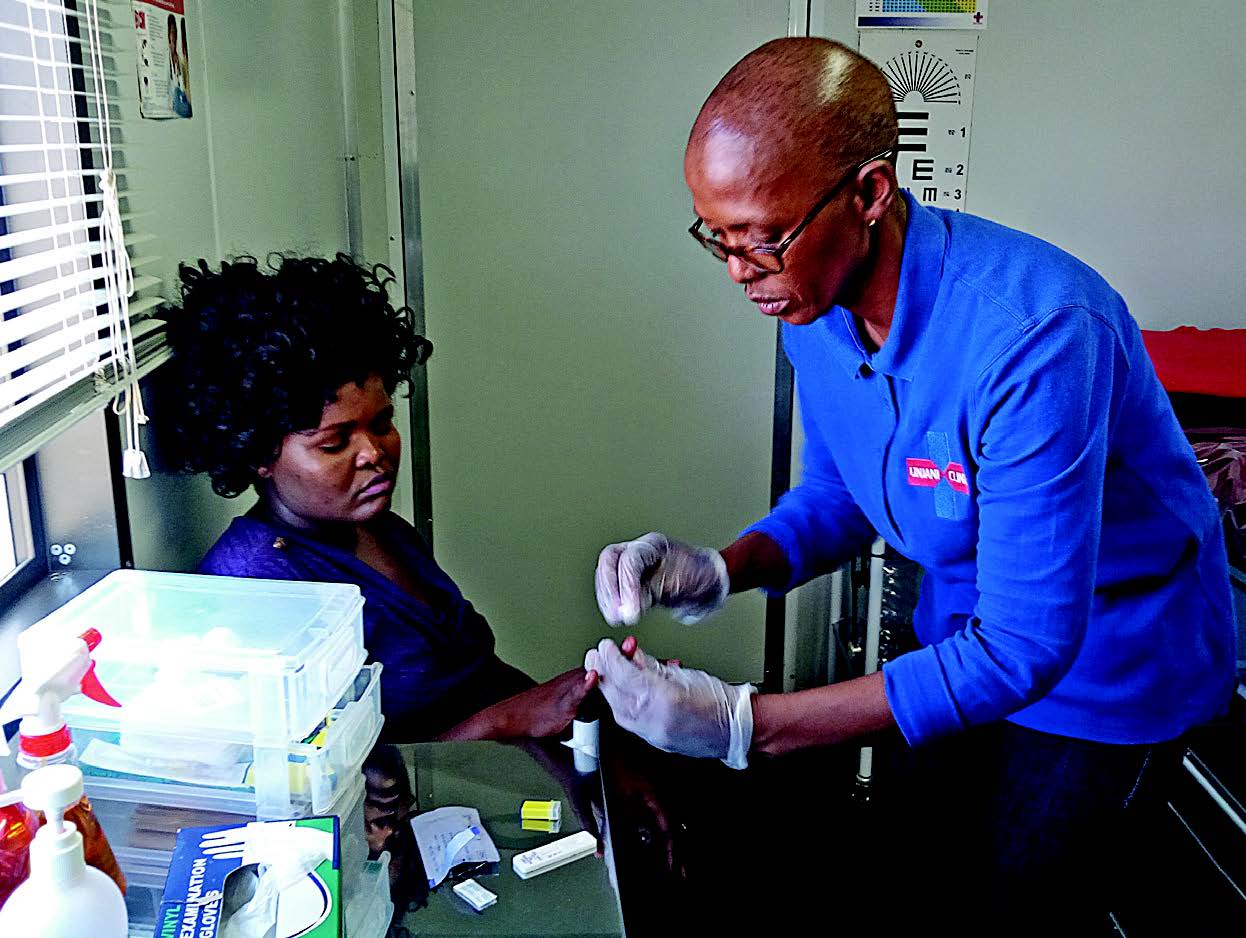
 A patient receives care
from Sister Sonto on World
Aids Day at the Unjani
Moutse Mall (Limpopo)
location.
A patient receives care
from Sister Sonto on World
Aids Day at the Unjani
Moutse Mall (Limpopo)
location.
Virginia Ndimande and Sizakele Nkosi arrive at their respective health clinics by 7:30 a.m. Although their facilities do not open until the top of the hour, each nurse often sees familiar faces already queuing up. On their way to their front doors, they greet their patients with “Hello” and “How are you?”
“How are you?” in Zulu is “Unjani,” from which South Africa’s Unjani Non Profit Corporation, which helped Ndimande and Nkosi open their clinics, derives its name. The question asks not just about one’s health, but about one’s overall well-being and state of mind, says Lynda Toussaint, Unjani’s CEO. The operation was launched in 2011 as an enterprise development initiative of the Imperial Group, a South African logistics company. In starting the venture, the creators tried to answer the following question: “How do you provide quality primary health care affordably, conveniently, and sustainably at a community level where it never existed before?”
Unjani pursues an answer by helping nurses such as Ndimande and Nkosi to own and operate their own communityhealth businesses by providing a platform of resources to help them get started. Aspiring clinic owners typically learn of Unjani through friends and colleagues. It offers a chance for them to hatch their small business ideas.
“When I heard of the Unjani opportunity,” Ndimande recalls, “I was in the process of gathering information on how to start my own private practice on a part time basis, as I did not have the resources and funds to run a full-time business.” She opened her Unjani clinic in November 2014 in her home township of Winterveldt, approximately 65 kilometers north of Pretoria, while Nkosi had opened hers a year earlier in her husband’s township of Tembisa, 40 kilometers south of the capital.
Iain Barton, the initiative’s head and previous managing director of Imperial Health Sciences, a division of the Imperial Group, described the Unjani approach as rooted on the principle of “deal with what you can, refer what you cannot.” Only a small percentage of people seeking treatment at primary health care facilities actually need the attention of a medical doctor, and many patient services, if designed and supported properly, can be addressed by nurses without compromising quality.
This idea , at the heart of the Unjani model, is more formally known as “task shifting,” a process whereby tasks are delegated, where appropriate, to less specialized health workers. By reorganizing the workforce in this way, task shifting presents, according to the World Health Organization, “a viable solution for improving health care coverage by making more efficient use of the human resources already available and by quickly increasing capacity while training and retention programs are expanded.”
Underserved Markets
Nearly 54 million people access South Africa’s health system, which covers everything from basic primary health care to highly specialized services. The system has two tiers: public and private. Approximately 68 percent of South Africans rely entirely on the public sector for their health needs. The rest of the population covers their medical needs through the private sector, by purchasing health insurance on the market and paying out-of-pocket expenses not covered by insurance. In South Africa, where the state covers approximately 40 percent of all health expenditures but delivers services to 80 percent of the population, the public health system is strained.
Need does not necessarily generate a market, and Unjani knows this. In South Africa, approximately 8.3 million people self fund their primary health care needs by acquiring private health care services, and rely on the state for their secondary and tertiary care. This self-funded segment pays out of pocket but typically does not carry insurance, while those using the private health provision for all their medical needs are enrolled in medical insurance plans. Unjani believes that within the self-funded population there is an underserved market, and it has concentrated on providing an alternative to the no-fee public option that offers high-quality service and tremendous convenience. At ZAR 180 ($13) per consultation, half the cost of other private primary care services, Unjani clinics offer an affordable alternative to private options. In so doing, Unjani is not just gaining market share in the self-funded segment but also creating new consumers willing to pay for primary health care services.
Nurses who wish to open their own clinic sign a five-year enterprise-development agreement with Unjani. The clinics are funded, built, equipped, and shipped to the desired site by the Imperial Group. Their design is standardized and includes a waiting area, a consultation room, and a medicine room from which the nurse can dispense approximately 150 medicines. Each facility is supported by Unjani, which acts as a central management hub of the clinic network as well as an incubator by offering operational support and continuous management education to nurse-owners.
The two most important ingredients for a successful clinic, Toussaint says, are the right location and the right partner. Unjani’s selection process smartly binds partner and location objectives. It begins with prospective nurse-owners proposing a site for a new clinic. They are responsible for finding privately owned property with business rights and securing a lease with the landowner. Its terms are then reviewed by Unjani to ensure that they are fair and reasonable. The nurse-owner also conducts a community survey with a minimum of 200 respondents to determine whether there is sufficient need, community support, and a customer base. Unjani places high priority on the clinic being a community asset and on the nurse giving back to her community. This commitment is further reinforced by limiting nurses to owning only one clinic.
Unjani then conducts its own research on population demographics and the surrounding health facilities. Before opening the clinic, the nurse and her assistant undergo five days of classroom training, which includes standard operating procedures, a support or operations manual, human resources training, documentation requirements, financial administration, and systems management such as patient files, dispensing, and ordering. For the first two weeks, the network general manager joins the clinic staff to reinforce the classroom training and to assist the staff with practical implementation and support.
As owners and operators, nurses are responsible for all revenues and expenses. Understanding that success takes time, Unjani supports the clinics with stipends for the first 24 months of operation regardless of profit or loss. “The clinics are intended to empower black female professional nurses and be an engine for job creation,” Toussaint says. “It is just as important that we do not present disincentives when they are successful as much as it is to support them when they need help.” Profitability is typically achieved when clinics reach 250 patients per month, Unjani’s analysis shows. This threshold can take anywhere from 3 to 24 months, depending on the community served.
Clinics typically start with a staff of three: a registered qualified primary health care nurse, an assistant, and a maintenance worker. Nurses consult with patients and dispense medicines. Assistants manage quality control, reconcile over-the-counter sales, and keep records. Ndimande and Nkosi both hired close relatives to join their clinics as administrative assistants. “Having a trusted family member as part of the clinic gives me great peace of mind that we are caring, respectful, and professional,” Nkosi says.
Unjani clinics follow the National Department of Health’s primary health care treatment protocols and guidelines as well as their audit processes. Although the clinics do not have doctors, many of the nurses have relationships with physicians for medical consultation, general advice, and emotional support. This consultative relationship also helps doctors by optimizing their expertise and time.
Growth and Accountability
The Unjani network has expanded deliberately and cautiously, adding approximately nine clinics annually over the past three years. This pace reflects the worries that Toussaint felt from the start of her tenure in 2014.
“From the data that I had at my disposal from the six pilot clinics, I was concerned that sustainability was not being achieved, based on the patient numbers being seen,” Toussaint says. “I was also concerned that the nurse selection process was flawed, or not strict enough, and finally that simple processes and procedures needed to be put in place to ensure proper business principles were applied.”
In response, Toussaint first placed a hold on further site expansion and then initiated a yearlong review of operations. As CEO, she visited each Unjani clinic to observe and document its operations. Interviews with the nurses, clinic personnel, patients, and community leaders helped shape a clear understanding of how the clinic interacted with the community it served. Unjani’s processes were redesigned to support scaling the network, not simply adding locations. A network-wide IT system for data collection was introduced, which simplified standard operating processes, strengthened training, and improved the business intelligence of site selection.
The initiatives proved timely, as the pace of growth is set to skyrocket when South Africa’s Treasury Job Fund provides additional funding in 2017. Such accelerated scaling up brings with it a different set of considerations. Sustainable growth requires not only support but also accountability. For example, in 2015, upon learning that the Kwaggafontein clinic was charging above network pricing, Unjani quickly terminated the franchise agreement. Although the step was drastic, it underscores the belief that noncompliance damages the trust between community and the Unjani brand, upon which the whole project is based.
In 2017, Unjani expects to scale up from 26 clinics to 41. For Toussaint this effort will succeed only by choosing the right partners. “Entrepreneurship is not for everyone,” she says. “There is a significant risk that each nurse takes when joining the network, and it takes hard work, dedication, and a calling to serve the community to achieve success.”
Read more stories by Michael Seo.