


 (Illustration by Brian Stauffer)
Gatherings of nonprofit leaders and discussions of social change often treat scaling what works, systems change, and localization as separate topics. Yet for leaders seeking to drive large-scale, lasting change, these are rarely discrete pursuits. They are deeply interconnected.
Recent work in SSIR has explored the connections, from working with governments to achieve exponential scale (Kevin Starr, “Scale Really Matters,” Apr. 16, 2026) to advancing systems change through locally led, network-supported approaches (English Sall and Jeffrey C. Walker, “Locally Driven, Network-Supported Systems Change,” Aug. 23, 2021). This article adds to that conversation by examining how three locally rooted education organizations have navigated these intertwined challenges to achieve lasting influence across multiple geographies.
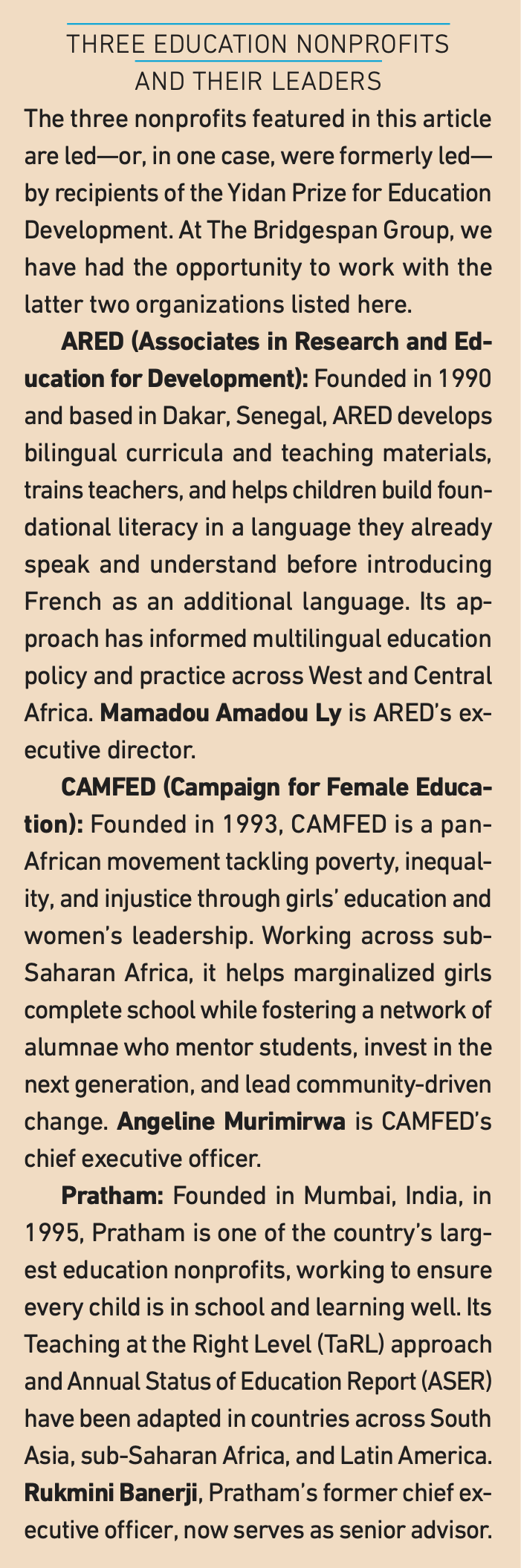
The three leaders of those organizations are Mamadou Amadou Ly of ARED, Angeline Murimirwa of CAMFED, and Rukmini Banerji of Pratham. (See sidebar below for descriptions of their work.) Their organizations are widely recognized—including as recipients of the Yidan Prize—for their distinctive and successful approaches to extending the reach of their work and improving the lives of those they serve. Their strategies and practices do not fit neatly within conventional wisdom about how social interventions spread. Although every organization and context is unique, my conversations with these leaders surfaced five observations that may be instructive for anyone seeking to foster enduring change.
Observation 1: Reject the Single, Highly Prescribed Model
A common view of scaling is that organizations spread what works by standardizing a proven model and enforcing fidelity wherever it is implemented. Pratham’s Banerji takes a different view: “It can’t be the same for everybody.” ARED’s Ly echoed the point: “We cannot have one model that is applied everywhere. Models are tweaked and adapted depending on the realities and the context in each country.”
CAMFED’s experience illustrates how much these adaptations can vary. A core element of its model is “learner guides,” or young women who help girls navigate, stay, and succeed in school and who come from backgrounds similar to the girls they support. Through their work as learner guides, they also develop their own leadership capacity. In Malawi, the government wanted to call them “learner mentors” as it scaled up the model—a relatively minor change.
The adaptation in Tanzania was more significant. As Murimirwa noted, the government made changes to the model: “They said, ‘We want young men to be taught agency and leadership, too, [and become learner guides] like the young women.’” This was a more consequential departure for an organization whose mission centers on supporting the most marginalized to learn, lead, and become role models in an unequal world, and whose website proclaims, “CAMFED catalyzes the power of the most vulnerable girls and young women to create the future they imagine.” It also required operational changes, including additional safeguarding provisions for home visits conducted by peer mentors. Murimirwa was clear about why this flexibility mattered: “We are always reinforcing that we’re starting from [where the students are].”
This does not mean anything goes. It does, however, mean having a bias toward flexibility in how outcomes are achieved. As these organizations expand across geographies—with an eye toward gaining support and adoption by different governments—scale, systems change, and localization become intertwined.
Looking across their experiences, three common patterns help explain how these organizations adapt their models without losing the results that made them worth spreading in the first place.
First, each organization was remarkably clear about the “what.” Each one identifies the kernel that needs to be preserved by, for example, employing an additive bilingual approach, organizing children by learning level instead of grade, or focusing on the most marginalized girls and breaking down the barriers that prevent them from attending school. At the same time, they allow much greater latitude on the “how.” Second, they build disciplined feedback loops that enable them to see whether adaptations are working and to adjust when they are not. Third, they cultivate commitment among stakeholders across the system. The people carrying the work forward are not simply complying with an externally prescribed model but are invested in making the approach succeed.
Murimirwa offered an apt label for this tapestry of beliefs and practices: “Sophisticated simplicity.” As she put it, “You protect the core as you flex and manage all the things that the world is throwing at you.” Banerji expressed a similar idea when she described what lies at the heart of Teaching at the Right Level (TaRL) as “understanding kids in a simple way that you can act on.”
Observation 2: Fit the Model to the Budget You Have
A common mantra in the social sector, and one I’ve used regularly, is that we need to “scale what works.” Typically, that statement is accompanied by evidence that a model works, whether from randomized trials, evaluations, or other forms of learning. We ask less often whether the model has been designed around what its eventual owner can and will pay. That may help explain why so many promising models never achieve broad adoption. All three leaders put the question of affordability front and center: Not only does a model have to work, it has to work within government budgets.
Asked what Pratham’s TaRL program should cost per child in Africa, Banerji responded, “How much are you willing to pay?” Rather than designing an ideal model and asking governments to fund it, Pratham starts with the resources already available and adapts the model accordingly. In India, for example, TaRL evolved to require no new government funding once implemented. Rather than adding resources, it reshapes the instructional design within existing schools to achieve dramatically better learning outcomes.
ARED faced a similar constraint. The organization stripped down the initial pilot version of one of its programs—which included multiple textbooks for students and a richly detailed teacher’s guide—because governments would not pay for it, and parents could not afford it.
Designing models that governments were willing to pay for was never simply a matter of keeping down costs. The three leaders believed that for results to take hold, spread, and endure, their model had to be embedded in and funded by local or national governments. All three expressed wariness about building programs around one-time grants or loans from governments or donors. As Murimirwa put it, “You have to make sure it’s not just a project decision, and that it’s not linked to a certain funding cycle or particular donor.”
To be sure, these leaders did not passively accept existing funding constraints as immutable. But neither did they build models that governments were unwilling to sustain. And they did not begin conversations with governments by asking for more money. As Banerji said, “You start with what you have.”
Observation 3: Build Trust with Government from the Beginning
A common view of scaling is that organizations external to government develop and prove a model and then ask government to adopt it. These three organizations took a different approach. From the beginning, they worked with government, seeking to build the trust needed to develop a shared understanding of challenges and possible solutions. As Ly noted, “Since the beginning, we were careful not to experiment outside of the system and then bring the results into the system. No, we worked directly with people who are inside the system … [to see] how we can work together to improve what is already in place.”
Murimirwa explained that trust was what enabled governments to speak openly with CAMFED about the system’s “underbelly,” or problems they might otherwise keep hidden because acknowledging them could make it appear as if they were failing their people. “Unless they really trust you, they’re not going to let you into that side.”
She also emphasized that building trust depends on how organizations show up: “We are not here to be condescending or to shame you. We are here for the child. We will respect you, but we will also challenge you to do well [for the child].”
Banerji observed that although COVID was devastating in so many ways, it created an opening for a more candid assessment of the challenges children faced: “You [didn’t] have to blame the system. … It was like ‘Oh no, schools were closed. Let’s help them get on track.’”
The three leaders consistently returned to two ideas: keeping children’s outcomes at the center and building relationships with government grounded in trust and respect. They saw their organizations’ role as helping government and communities work together toward those outcomes. They did not make their own organizations the focus of these conversations. Instead, they saw themselves as supporting actors.
Observation 4: Be Locally Rooted and Data Driven
A common assumption is that organizations face a choice between following rigorous evidence and listening to local communities. These leaders rejected that tradeoff. Rather than treating data and community engagement as competing priorities, they anchored their work in both, often integrating the two. ARED codevelops experiments with leaders in the formal education system. Pratham uses local community workers to collect data on educational outcomes and shares the findings back with each community. As CAMFED’s Murimirwa noted, “We always try and codesign and cocreate the terms of reference with government [because] it’s not just what the research says, it’s how you set up the research for reception and acceptance.”
All three organizations are deeply rooted in the communities where they work and shaped by local contexts. At the same time, they collaborate with world-class researchers, both in-country and internationally, and have participated in randomized controlled trials evaluating their work in different settings. These evaluations have been critical to building confidence among governments and other stakeholders that the interventions are worthy of consideration. That confidence is especially important when a model challenges entrenched norms and policies, such as Senegal’s longstanding policy of conducting all teaching in French or deeply held beliefs about whether girls’ education is as important as that of boys.
Pratham offers a particularly clear example of how data can strengthen a model as it spreads and adapts to different contexts. Its simple TaRL student-assessment tool is central to the model. It anchors reading instruction in children’s skill levels rather than grade levels, while allowing students to see their own progress, which spurs motivation. Importantly, the tool allows the organization to test whether adaptations strengthen or weaken outcomes. As Banerji put it, “You need to tinker all the time.” Without a feedback loop like this, that tinkering could easily lead to model drift.
Because the TaRL assessment tool is simple enough to use at scale, governments across many Indian states and countries in sub-Saharan Africa have incorporated it into broader instructional strategies and learning-improvement programs. In India, the Annual Status of Education Report (ASER), built on tools developed by Pratham, provides another example. ASER is a citizen-led household survey carried out in every rural district by local organizations to assess children’s progress in foundational learning. Its findings are widely used by different layers of government, non-state actors, and researchers to inform discussions, planning, and research.
Observation 5: Cultivate Commitment, Not Compliance
There is growing recognition in the literature on scale that the outcomes produced by an intervention depend heavily on the quality of its implementation (Mary Ann Bates and Rachel Glennerster, “The Generalizability Puzzle,” SSIR, Summer 2017). These leaders suggested that implementation quality, in turn, depends on something deeper: the commitment of the people responsible for carrying the work forward. All three deliberately cultivated committed people within their ranks who became champions for the work, not simply implementers of it.
That distinction mattered because the work required people to exercise judgment, not just follow instructions. People who understood the need and the underlying approach were better able to adapt the model to local circumstances while remaining faithful to its core principles. Commitment also provided the intrinsic motivation to do the work well.
As Murimirwa put it, “What I don’t want is compliance or tick the box,” referring to both officials and the people doing the work. Ly observed that a crucial factor in the spread of ARED practices is when “the decision makers in the system decide to make it their own, their own cause.” Banerji described what fuels that kind of commitment: “You have to feel the problem, you have to understand it, and then feel the thrill of saying children can learn quickly … You [have] to feel like ‘I changed this kid’s life.’ … You need to create missionaries.”
All three leaders noted the challenges posed by funders who place too much emphasis on compliance, monitoring, and evaluation. Those demands can dampen the commitment and divert the resources that are needed to deliver programs well.
This commitment did not emerge by accident. Each organization built structures to cultivate it. A vital part of the CAMFED model, for example, is its network of alumnae who volunteer as mentors. Similarly, as Pratham scaled, Banerji confronted the reality that there were too many teachers for the organization to work with directly: “There have to be some people who are between the idea and the teachers.”
Pratham responded by working with “intermediaries” within school systems and developing them into “leaders of practice,” the people responsible for supporting the program in a particular area. They might be former teachers, school inspectors, supervisors, or government staff. Whatever their role, they first have to teach a cohort of children, ideally for at least three weeks, before they can become leaders of practice. As Banerji explained, “With anything new, you should learn it from someone who’s done it themselves … and can say, ‘Let me tell you it’s a problem. And let me tell you there’s a solution. And don’t complain, because I did it!’”
Accelerating Collective Learning
These organizations operate in distinct contexts that undoubtedly shape the observations here. All three work in education, where outcomes often can be measured relatively quickly and rigorously, and all operate in contexts where governments face significant resource constraints. Each organization also has decades of experience doing, studying, and evolving its work. Nonetheless, the five patterns offer lenses for any leader seeking widespread change in a field and thinking about how to better align the imperatives of scale, systems change, and localization.
We are still learning how widespread change happens. The experiences of these leaders and the organizations they have helped build suggest that listening carefully to how successful organizations navigate these intertwined challenges can accelerate that learning.
Read more stories by Jeffrey L. Bradach.