

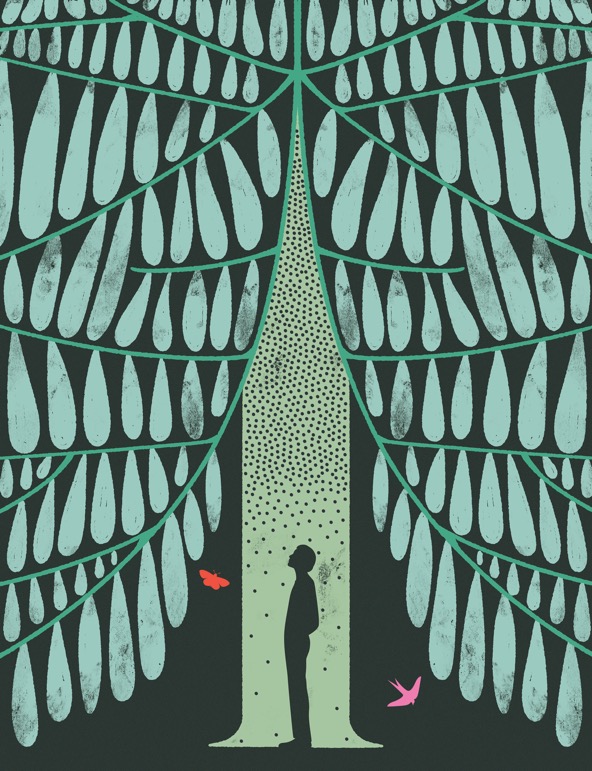
 (Illustration by Vicki Turner)
For as long as I can remember, I’ve worried about climate change. By 2020, I was having a hard time coping with my grief and fear. I felt alone and helpless, while all around me it seemed like nothing was changing, despite what so many of us knew to be true. The BESS Family Foundation had been supporting mindfulness and meditation practices for a few years, and I wondered if these practices could help me cope with my fears about the climate crisis.
Belonging to the Earth in a Changing World
At the Mind & Life Institute, we bring science, contemplative wisdom, and diverse ways of knowing into dialogue to foster insight and inspire action toward flourishing. In partnership with the BESS Family Foundation, this supplement explores Earth awareness and how a deeper understanding of our interdependence with the planet and all beings can shape how we live, relate, and act. Sponsored by the Mind & Life Institute
During the pandemic, I began exploring how contemplative practices might help address climate change. I took every contemplative course, listened to every talk on ecology and social engagement offered by the Buddhist community, and immersed myself in David Loy’s groundbreaking Ecodharma: Buddhist Teachings for the Ecological Crisis and Joanna Macy’s Work That Reconnects. Out of this inquiry, something took root: hope and a sense of purpose. The practices I encountered deepened my understanding and resolve. There are no guarantees about outcomes. No one knows what will happen. But each of us matters. Our responsibility is to do what we can to benefit all beings and the Earth itself.
These principles have shaped our approach to philanthropy at the BESS Family Foundation. Through the financial resources I steward, we support efforts that meet the ecological crisis with kindness, care, and resilience. The programs we fund help people develop the inner resources they need to navigate our interrelated challenges.
We call this work Earth awareness: an emerging area of inquiry and practice that draws on contemplative approaches to deepen awareness of our interdependence with the Earth and all beings. Earth awareness practices invite people to engage more fully in protecting and restoring the environment while fostering a sense of responsibility for the well-being of current and future generations.
Traditional climate philanthropy tends to focus on the “what”: technology, education, policy, and other external interventions. We focus on the “how”: how people relate to the Earth, to one another, and to themselves, particularly in times of profound disruption and uncertainty. Both are necessary. Capacities such as emotional resilience, moral courage, and the ability to stay engaged when feeling overwhelmed can be cultivated. Yet because they are difficult to quantify, they often remain at the margins of conventional funding strategies. At the BESS Family Foundation, they are central.
As we began exploring this work, we recognized that no single organization or tradition held all the answers. I still remember asking at one of our earliest gatherings whether a felt sense of interdependence could be cultivated through practice. Teacher Kaira Jewel Lingo responded immediately and emphatically: “Yes.” That moment reframed interdependence from an abstract concept into something experiential that people can learn, strengthen, and embody together.
Earth awareness does not belong to any one tradition or worldview. Many Indigenous communities—including Tribal Nations here on Turtle Island, or what is now called North America—have long understood human life as embedded in a reciprocal relationship with the natural world. Buddhist traditions similarly emphasize interdependence and the illusion of separateness. Across diverse cultures and wisdom traditions, we find a remarkably consistent insight: Human flourishing depends on healthy relationships with one another, with the Earth, and with the larger web of life. Our work is less about inventing something new than about remembering forms of connection that modern societies have too often forgotten.
Transformative change requires a shift in consciousness. Humans protect what they love. Earth awareness is a path that does not turn away from that which is difficult. It asks us to remain present to grief, despair, and anger in the face of ongoing and anticipated socio-ecological loss. As we live through a time of profound ecological disruption intensified by human-driven climate change, these practices offer vital resources for staying present, responsive, and connected—so that we may show up for ourselves and one another with resilience and care.
Over the past several years, I’ve been encouraged to see growing interest in these ideas across philanthropy, education, the arts, and scientific research. More people are recognizing that inner development and relational awareness are essential to meaningful social and ecological transformation. We are proud to support organizations such as the Mind & Life Institute, which is helping strengthen the emerging field of Earth awareness research and convening dialogues across disciplines and traditions. Others, such as the Thich Nhat Hanh Foundation, offer courses that cultivate insight, compassion, community, and mindful action in service of the Earth. Through our grants, chaplains learn how to support people affected by ecological disasters, mindfulness teachers develop the skills to guide students more effectively, and wildland firefighters attend restorative retreats.
In an era marked by ecological and social instability, rekindling a felt sense of connection with one another and the living world may be one of the most practical—and underfunded—forms of resilience available to us. I do not know what the future will bring, but I know that it will be shaped by how we live, relate, and care for one another and the Earth.
The essays in this series approach Earth awareness from a range of disciplines, cultures, and lived experiences. Indigenous leader Karen Waconda-Lewis reflects on relationship, reciprocity, and responsibility to future generations. Buddhist philosopher David Loy examines the relationship between the ecological crisis and our persistent illusion of separateness. Karen O’Brien invites us to reconsider human agency in a time of planetary change. Other contributors explore how these ideas are being applied in education, scientific research, leadership, law, and community practice.
Together, these essays suggest that cultivating Earth awareness is not simply another approach to environmental action, but a foundational capacity for meeting the intertwined ecological and social challenges of our time.
Read more stories by Shelly Chigier.