


Trailblazer: The Power of Business as the Greatest Platform for Change
Marc Benio and Monica Langley
272 pages, Currency, 2019
To understand Marc Benioff’s new book, Trailblazer, you have to consider it in the current context when the institutions of US society are under strain. According to the Pew Research Center, only 19 percent of Americans say they trust the US government; another Pew poll shows that 65 percent of Americans believe the economic system unfairly favors powerful interests.
Corporate America is responding. Laurence Fink, the CEO of investment management firm BlackRock, sent a letter to CEOs of public companies in 2018 telling them that they had a responsibility not only to deliver profits but also to make “a positive contribution to society.” In 2019, 200 chief executives from the Business Roundtable issued a statement that redefined “the purpose of a corporation” as investing in employees, delivering value to customers, and dealing fairly and ethically with suppliers—not solely advancing the interests of shareholders. These statements align with former Unilever CEO Paul Polman’s prognosis that capitalism is “a damaged ideology” that “needs to be reinvented for the 21st century.” Critics are waiting to see if business leaders’ actions will match their rhetoric.
Amid this swirling discontent comes Trailblazer, Benioff’s guide for how enlightened companies and CEOs can cure what ails capitalism. Coauthored by Salesforce Executive Vice President of Global Strategic Affairs Monica Langley, the book raises important questions about the role of the activist CEO in American politics.
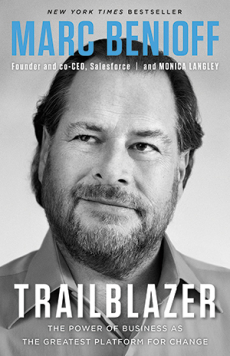
The cover—a closeup of Benioff’s face bracketed by his name and the word “Trailblazer”—suggests that the title refers to him. Instead, it refers to people who “want to learn, to better the world[;] they aren’t afraid to explore, they crave innovation and enjoy solving problems and also giving back. … They are people that care about culture and diversity.” It is the subtitle that reveals the book’s central argument: Business is the “greatest platform for change.”
Though Benioff claims the book “is not intended to be a memoir,” it is written in his voice and opens with the story of his upbringing in San Francisco, with a focus on his two most powerful family influences: his father, who left the family fur business to start Stuart’s Apparel; and his maternal grandfather, who was a lawyer and, as a San Francisco supervisor, proposed and pushed to establish the Bay Area Rapid Transit system (BART). His father taught him the value of determination and hard work. His grandfather taught him civic responsibility, whereby “no civic project mattered unless it also furthered what he saw as San Francisco’s bedrock values: opportunity, equality, and inclusion.”
The book then turns to the story of Salesforce, or, more important, Salesforce’s culture and place in the world. Benioff adapts management guru Peter Drucker’s saying that “culture eats strategy for lunch” to “culture eats everything.” As culture is shaped by values, part one of the book lays out the business case that “values create value” by examining the company’s four foundational values: trust, customer success, innovation, and equality. Each emerges out of a crisis and helps build the community. “Anyone who’s been in business a long time knows that relationships in business are just like those in life, in the sense that it’s all about connection, not transaction,” Benioff writes.
Benioff wants to create a “culture where people felt that what they did when they arrived at the office every day truly mattered, that they were consistently contributing to something other than just the company’s bottom line.” This idea of a meaningful work culture materializes in the second part of the book, where he outlines Salesforce’s 1-1-1 Model, through which the company gives 1 percent of employee time to volunteer hours, as well as 1 percent of profits and 1 percent of resources to charitable causes. This model reflects his belief in the power and value of philanthropy—he is certainly proud of his charitable giving: $20 million for homeless housing services, $10 million to the Heading Home Campaign, and $6 million to Bristol Hotel Housing Project, in addition to his foundational work at the UCSF Benioff Children’s Hospital, and the UCSF Benioff Homelessness and Housing Initiative, and the Benioff Ocean Initiative.
One chapter is titled “Ohana,” a Hawaiian word for “family” and the Salesforce concept for intentionally treating all stakeholders, including employees, as family. This idea changes the social contract between people and the company and embodies the inclusive purpose that defines Salesforce’s culture. Three other chapters delve into Benioff’s strong interest in meditation; the importance of stakeholders and the reality that “we are all connected on this planet”; and the most provocative topic in the book, the activist CEO. A cynic might dismiss these chapters as new age management tips or ploys to appeal to younger workers. But evidence proves that would be a mistake for several reasons.
For one, Benioff’s results are undeniable, at least in terms of earnings and rankings. Founded in 1999, Salesforce has a market cap of $158 billion and delivered a record $13 billion in annual revenue in 2019—faster than any enterprise software company in history. It was ranked one of the best companies to work for in 2018 and 2019 by Fortune, and one of the world’s most innovative companies every year from 2010 to 2018 by Forbes. Benioff (and Keith Block, co-CEO since 2018) received a 96 percent approval rating on Glassdoor.com, putting them in the top 20 of all CEOs. Benioff now sits on the Forbes list of richest people in the world, with a net worth of $6.5 billion in 2019.
A second reason is that Benioff has leveraged his role as activist CEO—a title he claims not to want—to become quite visible in several high-profile social issues. In 2015, Benioff led the charge to compel the Indiana Legislature and then-Governor Mike Pence to roll back the Religious Freedom Restoration Act, which threatened the legal protections of the LGBTQ community. Later, when he learned that women at Salesforce were being paid 79 percent of what men were being paid, he ordered that it be corrected, to the cost of $3 million—and then turned his attention to achieving race-based pay equity.
The two other social issues that are covered heavily in the book, however, are more problematic. In 2018, Benioff learned that Salesforce software was used by the US Customs and Border Patrol to separate immigrant families at the border and, in response, created an Office of Ethical and Humane Use of Technology to ensure that the company’s technology “drives positive social change and benefits humanity.” While Benioff describes it as a success, this action was taken only after employees penned a public letter demanding that Benioff reexamine the CBP contract. The book also discusses the decision by Benioff and Salesforce to support Proposition C, a 2018 public referendum to tax San Francisco’s largest corporations 0.5 percent to raise $300 million a year for housing and services for the homeless. The proposition passed with 60 percent of the vote.
But by stepping into the activism ring, Benioff and other business leaders have found themselves in a bind between conflicting activist ethics and corporate values. Benioff has defended his decision to maintain the lucrative CBP contracts but is facing hostility from employees as the “We Won’t Build It” movement demands an end to what they feel are morally questionable uses of their companies’ software.
Proposition C may be helpful for the homeless, but it does not address the city’s shortage of affordable housing. More important, the proposition exposes the extent to which corporations are dodging their civic responsibility: Salesforce is one of 60 profitable Fortune 500 companies nationwide that paid no federal taxes in 2018. A 0.5 percent tax hike is a drop in the bucket compared with what would be a reasonable tax bill.
Trailblazer raises challenging questions about the role of the activist CEO in political and civic discourse. Are we making some kind of Faustian bargain by displacing government politicians with corporate executives? When Benioff took his stand on LGBTQ rights, he said that some “chastised me for putting my own values ahead of shareholder value,” but he defends the action by citing data that customers will pay more for products and services from companies that drive positive social and environmental change. Yet, we should be worried if we evaluate the wisdom of corporate forays into political, social, and environmental issues on the extent to which they increase the bottom line.
With this conflict of interest, activist CEOs will not always lead wisely. This is an important consideration as more business people enter the political fray, from Donald Trump to Michael Bloomberg, Howard Schultz, and Andrew Yang. There are certainly times when business logic can make government run more efficiently. But there are also times when such logic is blind to the ethical scope of our social challenges and therefore effective solutions.
Benioff is correct when he states that business is the “greatest platform for change.” Whether or not you like this, corporations are the most powerful organizing institutions on earth because of their ability to transcend national boundaries and their largely unrestricted access to enormous resources for production. But business has outsize power that arguably threatens America’s democracy. Every step that business takes into the public sphere displaces the role and responsibility of government and public institutions, and reinforces Americans’ distrust of government.
Benioff agrees: “Let’s face it, with government and other powerful institutions getting increasingly bogged down in political partisanship, brinkmanship, and perpetual gridlock, corporate participation is becoming more necessary.” But business itself has contributed to government’s dysfunctionality, with corporate lobbying reaching $3.4 billion in 2018. The growing prominence of the activist CEO will serve to further displace the government, both in reality and in the minds of Americans.
At one point, Benioff admonishes a group of executives to “adopt a public school.” But corporate appropriation is not the answer; solutions to social problems are inadequate when undergirded by the profit motive, which values growth above all else. The activism of business leaders is effective only if they place public interest above shareholder value.
In the epilogue, Benioff writes that the future “is not about embracing new machines, or new technologies, or even new ideas—it’s about adopting a new mindset. … We need to start driving a different kind of global agenda oriented around making the world a more just and equal place, while also undoing the damage we have caused to our skies, oceans, and forests.” It is hard to distinguish whether these words come from a CEO or a presidential candidate. That seems representative of our current social upheaval. The question that Trailblazer should raise is whether that is where we want to be.