


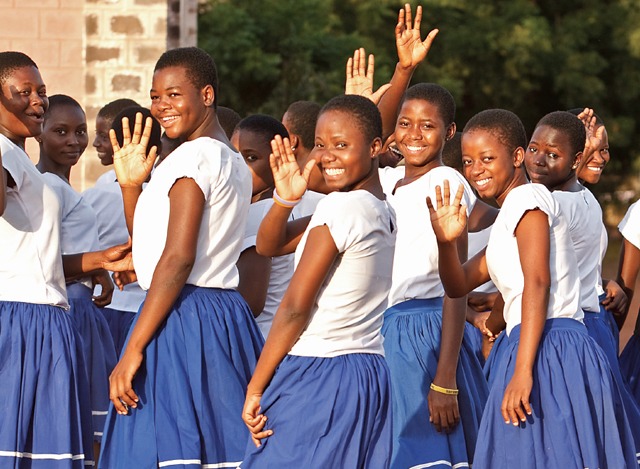
 Camfed provides high school girls, such as these in Ghana, with money for uniforms and other essentials. (Photo courtesy of Camfed)
As a little girl, Angeline Murimirwa dreamed of becoming an educated woman. When her parents, subsistence farmers in Zimbabwe, could not find the money for her school fees, her teachers smuggled her into class behind the backs of the education authorities. Sometimes teachers made her presents of pens for washing their dishes. Despite all her setbacks, Murimirwa completed primary school with top grades in every subject. She was sure that if she continued to study, she would achieve something great. But her parents’ farm produced barely enough to feed and clothe their children, let alone pay for their education. By the age of 12, Murimirwa thought her dreams were over. Her future looked bleak.
Then the Campaign for Female Education (Camfed), a nonprofit organization dedicated to eradicating poverty in Africa through the education of girls and the economic empowerment of young women, came to Murimirwa’s village. Camfed gave her a bursary to attend secondary school; it paid for her uniform and pens and paper and enabled her to have regular meals.
“For the first time, I could be a child,” says Murimirwa. “I didn’t have to think about fetching water and firewood, or where I could get food. I could even read novels, which I never had time to do at primary school because of all the worries that had become second nature to me.”
Today, Murimirwa is a regional director of Camfed and an accomplished international speaker. Most of her primary school friends have had very different lives. Many married early and became mothers in their teens. Some “took dangerous shortcuts,” sleeping with older men in order to scrape together enough money to continue school. But instead of lifting themselves out of poverty, they contracted HIV/AIDS.
Ann Cotton started Camfed in 1993, after returning to her home in Cambridge, England, following an academic field trip to rural Zimbabwe. There she witnessed young mothers, some in their early teens, weighed down by babies on their backs and water on their heads. Born into poverty, the girls were trapped in a cycle of economic dependence that rolled from mother to daughter. The only educated women in the community came from the cities, and their disparity with the residents created further problems. “None of the nurses or teachers were mother-tongue speakers of the local language,” Cotton, now president, recalls.
Today, Camfed has offices in Ghana, Malawi, Tanzania, Zambia, and Zimbabwe. The national offices are supported centrally, by Camfed Intl. in Cambridge and Camfed USA Foundation in the United States. In 2013, Camfed’s bursaries enabled more than 108,000 disadvantaged rural girls to attend secondary school. Through its Safety Net Fund, Camfed provided basic school equipment to another 158,000 primary school children, boys as well as girls, whom poverty might otherwise have forced out of school. Its former students have established CAMA, a rapidly expanding alumnae association, made up of more than 24,000 young women from poor rural backgrounds who promote education and engage in local philanthropy.
Cotton says that when Camfed began, international development experts told her that rural African families were culturally resistant to educating girls. She, however, believed that poverty, rather than prejudice, kept girls away from school. “Rural parents don’t need to be persuaded to send their daughters to school they’re already convinced. But if forced to choose which of their children to educate, they favour boys because boys have the better chance of getting paid work,” Cotton says. In 21 years, no family has refused Camfed’s offer to educate a daughter.
Led by Communities
Camfed relies on volunteers, recruited from within the rural communities it serves, to shape and operationalize its programs. This bottom-up model encourages local people to identify with its mission and enables it to extend its reach while keeping its salaried headcount low. This is crucial if the organization is going to achieve the ambitious goal that it announced in 2014 to support 1 million girls through education over the next five years.
On entering a district, Camfed’s managers (all nationals of the country) contact the district education office and invite local leaders—government officials, school authorities, police officers, and traditional leaders—to form a district committee to oversee the delivery of the Camfed program. “Sometimes people say they want to be paid, but we say ‘No, this is voluntary,’” says Cleophas Paridzira, a retired district education officer who chaired Camfed’s district committee in Wedza district, Zimbabwe, until 2012. Most people, he adds, donate their time willingly.
The district committee’s first task is to find the schools with which Camfed will work and consult the community to identify the neediest girls, those at greatest risk of dropping out of school, to whom Camfed will offer bursaries. In tandem, Camfed staff engage in capacity building: partnering with, or creating, school management boards and encouraging mothers and fathers to join or form parent support groups. Gradually, Camfed’s staff step back until the community institutions are running its operations.
The trust that Camfed places in its volunteer activists—whom it trains in financial literacy, child protection, and the promotion of gender equality—extends to financial management. For example, the local communities specify and procure the skirts, blouses, and shoes for the bursary students. Some purchase the uniforms centrally, others commission local tailors to make them to measure. That might sound expensive, but it can actually be less expensive and help the local economy, says Luxon Shumba, finance director at Camfed International. “The tailors sew at home, so they don’t have overheads, the girls receive a uniform that fits them, and the community benefits from extra employment.”
The possibility of money being misappropriated is a risk Camfed takes seriously. To ensure that funds are traceable, Shumba has created an accounting system—rooted in the principle of “accounting to the girl”—into which the names and details of every bursary student are entered. The system tracks donations from the moment they are raised to the moment the partner schools account for their use. CAMA members and teachers trained to mentor the girls file reports from smartphones, provided by Camfed, on each girl’s attendance, her academic progress, and whether she has the books, uniforms, and other items to which her bursary entitles her. The schools, in turn, are audited by Camfed’s country-based finance teams, the district committee, and Camfed’s internal auditors. Very occasionally an individual has attempted to abuse a position of trust, says Shumba. But the system’s multiple checks and balances are designed to catch such episodes early.
Lance Croffoot-Suede, a partner at the multinational law firm Linklaters, which reported in 2010, pro bono, on Camfed’s governance model, says he is impressed by Camfed’s standards of accountability. He also says that “by mobilizing local resources,” Camfed tackles the problems of poverty “holistically.” Paridzira describes an example. A group of older students from a remote village in Zimbabwe had to leave the village and lodge in adult accommodations for two years to attend school and study for university entrance exams. When several of the girls became pregnant by local businessmen, the father support group, using its own labor, built a school hostel, and the chairwoman of the mother support group volunteered to be the matron. “The national office provided some material assistance and finance and the father and mother support groups did the rest,” says Paridzira.
Self-Sustaining Growth
Many of Camfed’s alumnae work as community nurses and teachers, creating role models for their sisters and daughters to emulate. Others work in cities as government planners, doctors, and lawyers, where their knowledge of rural issues, such as the vast distances that rural children often have to travel to access education and health care, is beginning to permeate service delivery.
As its model matures, Camfed is investing more in helping young women become self-reliant once they leave school. On completing her studies, a student can apply for seed money grants of between $30 and $50 to start a business. Through CAMA, they receive training in entrepreneurship, business skills, personal health, and leadership; they are also taught how to mentor each other. The support plugs a gap that Murimirwa and her contemporaries struggled to bridge. “As the first girls in our communities to have gone so far, we thought now all the struggling will end. Then we realized [our education] was merely preparation for the next hike.”
In Zimbabwe, Tanzania, and Ghana, Camfed is collaborating with Kiva, the microfinance organization, in a program through which CAMA members can apply for interest-free loans of about $500 to expand their businesses. By providing access to finance, mentoring, and skills training, Camfed aims to build the self-confidence of its alumnae entrepreneurs. The hope is that they will become active in sectors such as solar energy, sustainable agriculture, and IT, thereby bringing needed services to their communities. “We realized that there is often a resistance to new business ideas amongst young rural women … so we have designed our programs to mitigate the [perceived] risk,” says Cotton.
In return for the loans, mentoring, and training, the young women agree to mentor Camfed’s bursary students. Marvelous Mapingu, a 27-year-old alumna from Zimbabwe, is using her loan to diversify her clothing and grocery shop by adding hardware and agricultural seeds. With her profits she is educating her five siblings, two orphaned cousins, and her two sons. She has also taken on two shop assistants and become a mentor to other young women entrepreneurs and schoolgirls.
Mapingu’s situation is not unusual. On average, Camfed’s alumnae support two to three children, outside their family, to go to school. “With the support that Camfed has given me,” says Mapingu, “I’m able to help others become educated, so that one day they will be able to plough back too.”
Read more stories by Alicia Clegg.