

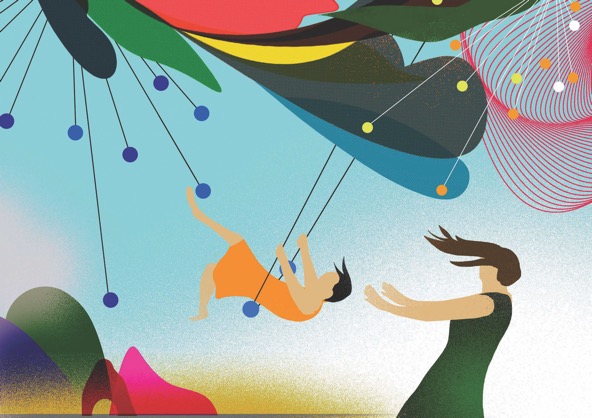
 (Illustration by Brian Stauffer)
In 2016, Charles Chen Yidan founded the Yidan Prize Foundation, whose annual Yidan Prize has become one of the world’s leading recognitions for education research and development. I first met Charles in September 2022 at a convening cohosted by the Stanford Accelerator for Learning and the Yidan Prize Foundation. Researchers, educators, philanthropists, policy makers, entrepreneurs, and students had gathered to consider a question that seemed almost timeless: How do we unlock human potential through learning?
Creating a Better World Through Education
The rise of AI is reshaping education’s purpose around meaningful relationships. From teaching displaced children in Ugandan refugee camps to redesigned high schools in Oakland, innovators are showing that scaling sustainably demands more than replication—it requires alliances that build on local knowledge, trust, and a relational infrastructure that underpins human flourishing. Featuring Yidan Prize laureates and global leaders, this supplement explores how research, practice, and philanthropy can converge to advance education. Sponsored by the Yidan Prize Foundation
Only weeks later, OpenAI released ChatGPT.
AI soon began reshaping conversations in headlines, boardrooms, classrooms, and around dinner tables. Nearly every conversation about the future of education became a conversation about technology. Looking back, I realize that our gathering at Stanford University was already wrestling with a deeper question that AI has only made more urgent: What helps human beings flourish?
What struck me most in my subsequent conversations with Charles and the foundation’s inaugural laureates, Vicky Colbert and Carol Dweck, was that none of them began with technology. They began by talking about people.
There is reason to believe that our capacity for human connection is weakening. Americans spend less time with friends today than they did a generation ago. Loneliness has become a public-health concern around the world. Parent-child reading has declined. Trust in institutions, and increasingly in one another, has eroded.
We are entering a world in which machine intelligence is abundant while human connection is becoming increasingly scarce. That imbalance raises a fundamental question about what education is for.
Education Has Always Been About People
Charles’ story begins with relationships. He often reflects on two people who shaped his life growing up in China: his grandmother, who never learned to read; and his father, who became the first university graduate in their village. Between those two generations lies the extraordinary promise of education.
Yet when Charles speaks about his grandmother, he rarely dwells on the academic opportunities she was denied. Instead, he remembers her kindness, generosity, and unwavering encouragement. She taught him to keep learning and to care for others.
Reflecting on those early experiences, Charles told me something remarkably simple: “People are the most important factor in education.” In his view, education extends far beyond the classroom. It is a lifelong process of curiosity and character formation that shapes not only individual lives but also society.
When I asked Charles who had most influenced his education, he described three kinds of teachers. The first was his family, beginning with his grandmother. The second were the teachers who accompanied him throughout childhood, who did more than simply teach subjects; they helped shape his values and character. The third surprised me. “The classics,” he said. Confucius. Buddhist thinkers. Taoist philosophers. Socrates. Plato. Reading them, he explained, is like “engaging in a dialogue with the sages themselves.” I realized that these three circles—family, educators, and humanity’s accumulated wisdom—connect us to other people, to community, and to ways of thinking that extend beyond the self.
Modern developmental science increasingly confirms what these traditions have long understood: Children’s brains develop through responsive relationships. Teacher-student relationships are strongly associated with engagement and achievement, while a sense of belonging supports motivation, resilience, and well-being. Relationships are not incidental to education. They are its foundation.
This is hardly a new insight, nor is it confined to any one culture. Across civilizations, philosophies, and faith traditions, relationships have long been understood as the foundation of human development and flourishing. These traditions begin from different premises and yet they arrive at similar conclusions. Aristotle argued that education was not merely about accumulating knowledge but about cultivating virtue through life in community, enabling people to flourish (eudaimonia). The African philosophy of Ubuntu reminds us that “I am because we are,” emphasizing that our humanity is realized through our relationships with others. Confucian thought places human relationships at the center of moral development, teaching that character is formed through obligations of care, respect, and reciprocity. Buddhist traditions emphasize compassion and our interdependence. Many Indigenous knowledge systems understand learning not as an individual achievement but as a responsibility to family, community, ancestors, the natural world, and future generations. Across these diverse traditions, education has never been solely about developing the mind. It has also been about becoming the kind of person who can live well with others.
Technology Advances, but Humanity Matters More
These reflections become even more pointed when one considers Charles’ role as a core founder of Tencent. Few people have done more to build China’s vast ecosystem of internet philanthropy. Over the past decade, Tencent’s digital philanthropy platform has facilitated 1.5 billion donations, channeling more than $4 billion to more than 137,000 charitable projects.
Yet Charles’ philosophy is human-centered. Technology matters enormously, he told me. Every era has its defining technologies. But Charles treats technology as a means of serving people rather than an end in itself.
Reflecting on Tencent’s philanthropic work, he described technology as a platform for connecting people, building trust, and mobilizing communities around shared purpose. “It all comes back to people,” he said.
Perhaps this explains why, after stepping aside from Tencent, he founded the Yidan Prize Foundation. His goal was not simply to create another international award, but to elevate education alongside fields such as science and medicine. He describes the foundation as a lighthouse. Not because it has all the answers, but because it helps illuminate the path forward through the people who dedicate their lives to learning.
Vicky Colbert and Carol Dweck are two leading lights in the search for a better future through education. In my conversation with Yidan Prize laureate Vicky Colbert, I was moved by how her five decades leading Escuela Nueva—starting from rural schools in Colombia to shaping public education systems around the world—embody a vision of education that feels more relevant than ever in the age of artificial intelligence. From the beginning, Colbert designed learning around relationships: students learning cooperatively; teachers serving as mentors rather than mere transmitters of information; democratic participation in school governance; meaningful partnerships with families; and networks of educators learning from one another.
Drawing on the pioneering work of Stanford University scholar Elizabeth Cohen, Colbert reflected on how education has become increasingly preoccupied with individualized learning while overlooking the equally essential work of learning with others. “Everybody talks about self-paced learning,” she told me. “But where’s cooperative learning?” Her answer is not to reject technological progress, but to ensure that it is matched by an equally intentional investment in the human capacities that technology cannot replace, such as seeing the world through another person’s eyes, cultivating confidence and belonging, strengthening families and communities, practicing democratic participation, and developing the relational skills needed to collaborate across differences.
As we concluded our conversation, Colbert shared a quotation by Charles Leadbeater that, she said, distills her work, which spans more than half a century:
Education should equip people to better shape an uncertain future so they can live more successful lives, on their own terms and together. They need the confidence and the capabilities to make their world together. They need an education which prepares them to be collaborative agents rather than atomized victims of change.
Across the world, another Yidan Prize laureate has transformed our understanding of the conditions under which human potential can flourish. Stanford Professor Carol Dweck’s research on motivation and growth mindset challenged the notion that intelligence is fixed. Instead, she demonstrated that abilities can be cultivated, inspiring educators, parents, and leaders to create environments in which challenge is embraced, mistakes become opportunities to learn, and every student has the opportunity to thrive.
Yet Dweck’s contribution extends beyond mindset. Her work highlights the influence of the learning environment—especially relationships between teachers and students—in shaping whether young people feel safe to take intellectual risks, persevere through setbacks, and develop confidence in their own capacity to grow. When teachers communicate both high expectations and an authentic belief in their students’ potential, they do more than improve academic outcomes. They help reshape how students see themselves and what they believe is possible.
When Vicky Colbert and Carol Dweck first met in Hong Kong to receive the inaugural Yidan Prize in 2017, it felt like a meeting of two complementary visions. Colbert had reimagined the architecture of schools around relationships, cooperation, and democratic participation. Dweck had transformed our understanding of how beliefs, expectations, and supportive relationships can unlock human potential. Though they approached education from different disciplines, both arrived at a similar conclusion: Learning is fundamentally relational.
What is remarkable is that these ideas were developed decades before today’s AI revolution. Rather than becoming outdated, they have become more urgent.
The Intelligence Between Us
For more than a century, education systems have focused on developing cognitive intelligence, often measured by IQ. The rise of emotional intelligence challenged us to recognize that success also depends on understanding ourselves and others. Today, artificial intelligence invites an even broader rethinking of human capability. As machines become increasingly adept at processing information, the capacities that distinguish us may lie less in what we know than in how we relate to one another. That is what I call relational intelligence.
Relational intelligence is the capacity to build trust, foster belonging, repair conflict, and create meaning with others. Unlike IQ, relational intelligence is not purely individual. It exists between people in families, classrooms, communities, and societies. It is an intelligence that exists between us, in families, classrooms, workplaces, communities, and societies. And increasingly, those relationships are mediated by AI. Relational intelligence must therefore evolve to include the capacity to navigate a world in which AI can shape, facilitate, and sometimes substitute for human relationships, while preserving human agency and strengthening rather than diminishing our connections to one another. Artificial intelligence may process information faster than humans ever could, but it cannot experience belonging, build mutual trust, or create communities grounded in shared responsibility. Those remain human capacities.
Relationships, Not Algorithms
This brings me back to the Yidan Prize Foundation. What strikes me is that the foundation is not simply recognizing exceptional educators. It is also building a global community. When I asked Charles about this, he explained that community was never an afterthought. It was built into the foundation from the beginning.
“The strength of an individual is limited,” Charles told me. The real power comes from the community that grows over time. Each new laureate expands the network, creating relationships that can generate new ideas, collaboration, and impact far beyond the reach of any individual prize.
Colbert sees even greater potential. She dreams of the foundation becoming not only a network but also a catalyst for partnerships, helping remarkable educators and researchers collaborate across countries and disciplines.
Both perspectives point toward the same idea: Innovation spreads through relationships, and knowledge travels through trust.
Increasingly, I think of this as relational infrastructure: the networks, institutions, and communities that enable people to learn together, solve problems together, and build shared futures.
At the close of our conversation, Charles offered two simple metaphors. One was “heart connecting with another heart.” The other was “one tree moving another tree.” Those images have stayed with me.
Artificial intelligence will undoubtedly transform education. It will personalize instruction, accelerate research, expand access, support teachers, and create extraordinary new opportunities for learning. But it may also remind us of something education has always known: Human flourishing depends on human relationships.
The defining challenge of the 20th century was, in many respects, expanding access to education. The defining challenge of the early 21st century has been expanding access to information. The defining challenge of the AI era may be something different altogether: Strengthening our capacity to build trust, foster belonging, and learn across differences.
It may be our relationships, not our algorithms, that determine whether humanity flourishes.
Read more stories by Isabelle C. Hau.