

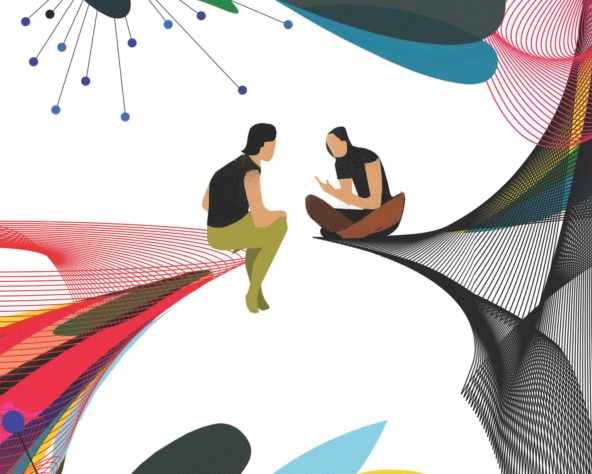
 (Illustration by Brian Stauffer)
For most of the last century, we had a confident answer to the question of what education is for. Education built human capital: It equipped people with knowledge and cognitive skills that generated economic returns. Our measurement systems were built around this premise. We tested what students knew, held school systems accountable for what they learned, and certified professionals against established standards. We measured procedural reasoning and structured problem-solving, precisely the capabilities that economies rewarded.
Creating a Better World Through Education

The rise of AI is reshaping education’s purpose around meaningful relationships. From teaching displaced children in Ugandan refugee camps to redesigned high schools in Oakland, innovators are showing that scaling sustainably demands more than replication—it requires alliances that build on local knowledge, trust, and a relational infrastructure that underpins human flourishing. Featuring Yidan Prize laureates and global leaders, this supplement explores how research, practice, and philanthropy can converge to advance education. Sponsored by the Yidan Prize Foundation
In the age of AI, that answer is no longer enough. Generative AI can draft complex documents, write software, produce analytical reports, and synthesize vast amounts of knowledge. Until recently, these tasks defined advanced human expertise. Now AI is absorbing more and more of our cognitive labor, making the future of work increasingly uncertain. Yet education continues to emphasize capabilities whose distinctly human value is diminishing, while the capabilities that are becoming more valuable are often taken for granted and left unmeasured.
In her spring 2026 cover article for Stanford Social Innovation Review, “Welcome to the Era of Relational Intelligence,” Isabelle Hau argues that relational intelligence is the defining human capability of our time. She describes it as a deeply human capacity to build trust, navigate tension, repair ruptures, and create meaning with others. Empathy, communication, collaboration, ethical judgment, and adaptive leadership may be where our most enduring human comparative advantage lies.
We develop these capacities through thousands of imperfect encounters with caregivers, teachers, and peers. We learn how to sustain personal bonds through friction, recognize when we have misread one another, recalibrate, and repair breaches of trust. The brain continually adapts to experience, and children’s capacities take shape through their relationships, rather than along a predetermined track. Human attachment develops through repeated cycles of closeness, conflict, and reconciliation. That is why the environments we design for children and young people—including classrooms—matter so much.
Relational Intelligence Builds Stronger Societies
Relational intelligence may be one of the rare development levers on which the poorest regions are not uniformly starting from behind, if it can be measured and cultivated. As AI drives down the cost of delivering cognitive content, the relational capacities AI cannot supply become increasingly decisive human contributions—in Dhaka and Lagos no less than in London and Singapore. To read another’s intentions charitably rather than with hostility, keep a commitment, or mend a quarrel: These are the small acts on which the trust that macroeconomists measure across whole societies depends. Relational intelligence is, plausibly, one of the foundations on which social capital is built.
A society’s capacity to cooperate, sustain trust, and coordinate across differences is not simply a soft byproduct of development; there is good reason to think it is one of its engines. The social-science literature bears this out. Low-trust environments depress investment because when people cannot rely on one another’s word, they divert resources into verifying claims and enforcing contracts. On some accounts, very low-trust societies can fall into a poverty trap in which distrust suppresses the investment needed to build trust-generating institutions. Cross-country evidence is consistent with the idea that trust contributes to prosperity, rather than reflecting it, although the direction of causation remains contested.
There are also measurable labor-market returns to related traits. In work with Dileni Gunewardena using labor-market surveys across 13 middle-income countries, I found that traits such as openness and emotional stability show positive returns, while a tendency to assume hostility—close to the opposite of reading others charitably—shows a negative one. These traits are imperfect proxies for the fuller construct of relational intelligence: Openness is not empathy. Still, they suggest that labor markets reward more than cognitive skills: They also reward the capacity to engage constructively with other people.
Cooperation may depend less on similarity than on the ability to find shared stories. Historian Yuval Noah Harari argues in his 2024 book Nexus that the precondition for working together is the ability to exchange information. In a historian’s language, this points to a dimension of relational intelligence: The human capacity to make meaning together, and to use that shared meaning as a basis for cooperation.
I want to be careful not to overclaim. I am not asserting a proven causal chain from relational capacity to peace and prosperity. The record on deliberately building social capital through participation is genuinely mixed. Rigorous evaluations of community monitoring, community-driven development, and community involvement in Indonesia, the Philippines, and India caution against assuming that social capital can simply be engineered. Participation tended to deliver good results only when scaffolded or paired with an external audit or resources tied to local decisions. Relational capacity is not a substitute for institutions. It is a complement, and its effects depend on the conditions in which it is exercised.
My modest claim is this: The gravest challenges we face—inequality, social fragmentation, and conflict—are bound up with the erosion of human connection in society after society. Communities with stronger relational foundations, under the right institutional conditions, appear better able to govern shared resources, sustain cooperation, and weather shocks. That is a direction worth committing to, and a hypothesis we should learn to evaluate.
What does all this have to do with education? Trust is not conjured at the level of nations. It is built, or fails to be built, in countless small interactions in which students learn whether others can be relied upon. Those interactions begin in families and communities and continue in classrooms.
The Classroom Is More Powerful Than Our Metrics Let Us See
2021 Yidan Prize laureate Eric Hanushek has shown, with Ludger Woessmann, that the measured cognitive skills of a population are far more strongly associated with individual earnings and economic growth than the number of years people spend in school. That finding is among the strongest arguments for my case: What we can measure well, we can act on. The relational capacities that develop between people rather than within them simply have not been measured to the same standard.
This reframes the kind of educational investment we need. Cognitive infrastructure, such as trained teachers, well-equipped classrooms, modern devices, and reliable connectivity, is enormously expensive. But developing the capacity to build trust, cooperate, and resolve conflict is far less capital-intensive, and it draws on something even the most resource-constrained communities are often rich in: dense social ties and traditions of mutual reliance.
In this context, we need to reconsider the relationship between a teacher’s impact and the education outcomes we traditionally measure. Kirabo Jackson found one answer to the question “What do test scores miss?” in administrative data on ninth graders in North Carolina. He estimated teachers’ effects not only on test scores but also on student behaviors, including absences, suspensions, grades, and on-time progression, which he combined into a proxy for noncognitive skills. Teachers had meaningful effects on both sets of outcomes, but there was little correlation between their effects on test scores and their effects on behavior. In other words, the teachers who raise test scores are, to a striking degree, not the same teachers who shape this other dimension of students’ development.
And that dimension matters enormously. A teacher’s effect on student behavior predicted high school completion far more strongly than the same teacher’s effect on test scores. The pattern held for grade progression and the likelihood of going to college. Adding behavioral measures to test-score measures more than doubled the variation in teachers’ longer-run impacts that we can predict.
As Jackson himself emphasizes, attendance and conduct are proxies. They are not empathy, trust, or relational intelligence. But by finding a way to measure this dimension using data schools already collect, Jackson brought an otherwise overlooked aspect of teaching into view. If a crude proxy can reveal effects this consequential, what might we learn by deliberately measuring relational capacity?
In a 50-state analysis, 2022 Yidan Prize laureate Linda Darling-Hammond found measures of teacher preparation and certification to be among the strongest correlates of student achievement in reading and mathematics, both before and after controlling for student poverty and language status. Her later synthesis of the evidence points in the same direction: Sustained mentoring, feedback grounded in classroom observation rather than test results alone, and structures that allow teachers to learn from one another are what raise teaching quality over a career.
These findings suggest that teachers can be trained to improve their interactions with students. Can teachers also be prepared to see themselves not only as purveyors of knowledge but also as developers of their students’ capacity to understand themselves and connect with others? That means treating relational development as part of the craft of teaching—something supported and measured rather than left to temperament—and doing so in partnership with parents, who are a child’s first teachers of trust.
The best teachers are quite likely already shaping relational intelligence in every classroom, but much of this work goes unmeasured and unsupported. The question is whether we will give them the vision, tools, and recognition to do it deliberately. If we want to do that across an entire education system, we first have to learn to see the work.
Measuring What We Value
An alternative approach to measurement needs to operate at both the classroom and system levels: A coaching tool that gives educators formative feedback they can use to improve student behavior, alongside an index that aggregates data to help systems learn over time.
This would change what we measure. Instead of relying only on static snapshots of student performance, we would move toward dynamic, behavioral, and process-based measures. Most existing indices rely on self-reported surveys captured at a single point in time. They offer a retrospective snapshot and tell us little about the process through which relational capacity develops. Social-desirability bias, recall bias, and culturally patterned response styles also make cross-country comparisons difficult.
Most are designed to benchmark and rank systems rather than to diagnose what a teacher might do differently on Monday morning. The work of 2019 Yidan Prize laureate Usha Goswami is an important caution here. Her cross-language research on reading development shows that language and writing systems impose different developmental constraints, suggesting that measures developed in one linguistic context cannot simply be exported to another without adaptation.
The challenge is even greater for a construct as culturally embedded as relational intelligence. An alternative index should therefore build upward from the coaching tool, drawing on the richer behavioral data it generates rather than beginning with thin self-report measures.
Developing such a tool will require education researchers to look beyond their usual disciplinary boundaries. Immersive and generative AI environments, for example, may allow us to capture how students engage in the moment rather than what they report afterward. The psychology of motivation offers another source of insight. Research associated with 2017 Yidan Prize laureate Carol Dweck has shown how students’ beliefs about their own ability can be measured, and how those beliefs shape their responses to failure. Precision medicine provides models of diagnostic feedback; sports analytics has developed sophisticated approaches to continuous performance tracking; and process-data science has methods for analyzing patterns of fine-grained interaction.
Of course, measurement needs guardrails. Four cautions are worth keeping in mind:
Construct validity: Conceptually rich constructs are often the most vulnerable to becoming so broad that they end up measuring everything and therefore nothing.
Cultural validity: Agency, resilience, and trust are expressed differently across settings. We can’t validate an instrument in one setting and export it as a global standard. Local validation is critical.
Reliability: 2018 Yidan Prize laureate Larry Hedges showed that unreliable instruments in education research make real effects look smaller than they are. A noisy relational measure will understate the very thing we want it to reveal.
Predictive validity: Do these measures actually predict what we care about: well-being, learning, and earnings? These questions should not deflate the agenda but strengthen it.
The Task Before Us
Smart technologies have made the deliberate cultivation of relational intelligence more difficult for schools. A generation is learning to converse partly with machines that simulate understanding without possessing it, and to interact through interfaces that strip away friction, and with it, some of the everyday work of building trust.
Children develop relational intelligence through the density of human contact. This is why the school’s role grows more important in the age of AI, not less. The classroom, in an increasingly automated world, is one of the few institutions designed to bring diverse young people into sustained, face-to-face relationships at scale. That may become one of school’s most important comparative advantages.
This raises two challenges and points to two aspirations:
How can schools make the cultivation of relational intelligence central to their purpose rather than peripheral? This means preparing teachers, in partnership with parents, to deliberately develop these capacities.
How do those of us who build the measures by which education is judged construct a credible, developmental measure of relational intelligence? We must be honest about its limits, design it to guide practice rather than merely rank systems, and validate it across the diverse cultures in which children grow up.
Schools will not reorganize around a capacity they cannot see, and even the best measure is inert unless schools act on what it reveals. The task, then, is to build the capacity to see and measure what we most deeply value about being human, and by seeing it, give ourselves a better chance of cultivating it deliberately, everywhere, and especially where it is needed most.
Read more stories by Elizabeth M. King.