


In March 2002, I led a group that incorporated the first food bank in Japan—Second Harvest Japan. Right away, we faced three critical challenges. First, we were pioneering a model that no one had ever tried to implement in that country. Second, the Japanese nonprofit sector was, and remains, small and underdeveloped. Until 1998, when the country enacted its NPO Law, citizens could not easily launch a nonprofit. In 2001, there were only 20,000 incorporated nonprofits, and less than 20 percent of them (fewer than 4,000) had any paid staff members. Overall, the average Japanese nonprofit had just 1.5 full-time-equivalent employees. There was also a lack of funding in the nonprofit sector. Annual giving per household in Japan is about $35, compared with $1,300 per household in the United States.
Third, our proposed core activity would rely on close cooperation with the Japanese food industry, which is highly resistant to change. Although the government and for-profit sectors in Japan work closely together, that pattern does not extend to the nonprofit sector. People in the for-profit sector tend to assume that the nonprofit sector consists primarily of amateurs and do-gooders, and therefore they distrust it.
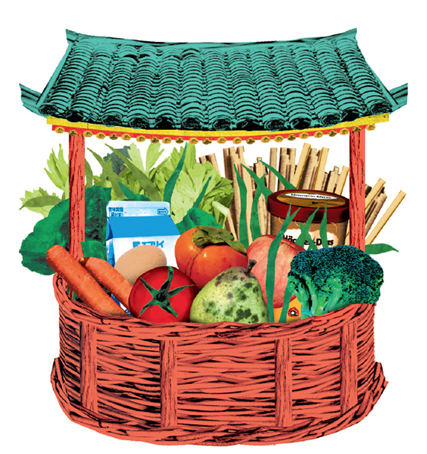 (Illustration by Dough Chayka)
Yet the deepest challenge that we faced was cultural. Japan is, in many ways, a risk-averse society. The Japanese food industry not only reflects that quality but also magnifies it. If a product is not pristine and presentable, it will not go on the market. And that standard applies not just to the final product but also to the cases used to transport it. As a result, the food industry destroys 3 million to 5 million metric tons of perfectly safe, unexpired food each year.
Despite these challenges, we have made tremendous progress over the past 12 years. Since 2002, we have received $8.9 million in cash donations and $45 million in food donations, and we have helped companies save $15 million in waste and disposal costs. But one aspect of our operations sets us apart from every other food bank in the world: We do no fundraising, and we make no solicitations for in-kind donations. In fact, we will turn down cash and food donations if they do not match our needs.
Many factors have contributed to our success, but by far the most crucial factor has been our ability to create social capital. Social capital isn’t a panacea. To overcome resistance and to access resources, we still need to have good people, a sound plan, and an ability to execute that plan. But nurturing close relationships has enabled us to produce strong results.
Connections Precede Donations
The political theorist Francis Fukuyama defines “social capital” as “the instantiated informal norm that promotes cooperation between two or more individuals.” Building on Fukuyama’s framework, I have broken social capital into three attributes—trust, proximity, and reciprocity.
Trust | Whenever people from a food company meet with us to negotiate a donation, I will say to them at some point, “I’m not interested in your food. I’m interested in a mutually beneficial, trusting relationship. To create that relationship, we will match your pace.” Then I see the surprised look on the faces across the table. “But we thought you wanted our food,” they say. I do want their food, I tell them, but I want something else first: their trust.
We use several tools to create trust. One tool is a letter of agreement that we exchange with each donor that spells out the rights, obligations, and expectations of both parties. Even before we enter into an agreement, we assure potential partners that we will match their pace. We understand that they will need time to develop an internal consensus. We tell them about one large food company that took three weeks to reach an agreement with us, and then about another company that took five years. This approach shows donors that we aren’t going to put pressure on them and that our focus is on creating trust.
Another tool that we use involves encouraging prospective donors to join us in delivering food to welfare agencies. For many of them, it’s the first time they have set foot inside that kind of institution. We have found that this experience profoundly affects them, and they come away from it more motivated to enter a relationship with us. That’s because they now have faces to put on those who will consume their food.
A third tool is our Food Advisory Board (FAB), which we created in 2007. It’s a study group made up of professionals in the food and logistics industries, and it meets several times per year. We invite both current donors and potential donors to attend FAB meetings. Everything is off the record, and we do not solicit donations from attendees. We find the FAB to be an invaluable resource for us, and it gives potential donors a chance to speak with current donors about the experience of working with us. It also creates a place where trust can grow naturally.
Reciprocity | Whenever I enter into a negotiation, I keep in mind that we are offering people on the other side of the table a solution to one of their problems. That approach helps me frame the discussion and define who we are. We are not merely a nonprofit that is seeking resources; we are a potential partner who can provide something of value. People in the food industry take no joy in destroying food. But they have to consider the risks associated with various alternatives. Framing our relationship with them as a reciprocal one helps build deeper engagement on both sides of the negotiating table. After all, if people feel that they’re getting something out of a relationship, they’re more likely to continue it.
By working with us, people from food companies gain a trusted partner who will work with them to achieve a positive social impact. That adds tremendous value for them. They know that community engagement increases employee morale and fosters a stronger connection to their own core values. Here’s an example. During a visit to Häagen Dazs, a long-time supporter of our organization, a representative of the company brought in its president and told him this story: “You know that we have been donating to Second Harvest Japan for many years. Did you know that our product goes to a hospice? When patients are near death, it is very difficult for them to eat—so the hospice gives them our ice cream.” The president was visibly moved. No amount of market research, I believe, could have topped the emotional impact of that story.
Proximity | In Japan, people work hard to foster both physical and social proximity. Examples of that tendency range from communal sleeping and co-bathing in families to daily morning meetings and after-hours drinking in the work world. One way that businesspeople foster proximity is by conducting “formal visits.” In early January of each year, when business resumes after a holiday break, businesspeople go from company to company to meet with clients, vendors, and partners. These formal visits are highly scripted and last, in most cases, less than 15 minutes. No business is done; the focus is on reaffirming a relationship. In spite of their brevity and formality, such visits do create a sense of connection, and they set a positive tone for the coming year. Not making such a visit to a trusted partner would be unthinkable.
Social capital plays many roles for us. Most important, it serves as an insurance policy that we can use when we encounter difficulties.
But formal visits take place on other occasions, too. Several years ago, a video production company spent two months filming our team for a national TV program that would also include a live appearance by me. About one week before the program would air, we learned that the people from the production company had broken our trust. So we pulled out of the arrangement. It was not an easy decision, but I remained firm about it. About a week later, the producer of the program asked if he could come by and share a beer with me. His company was clearly in the wrong, and I don’t even drink—but I agreed to the meeting. I did so because I understood how important it was for this person to retain a sense of proximity with us.
Trust Begets Trust
Social capital plays many roles for us. It leads to both in-kind and financial donations. It helps me to see how we can increase our cooperation with specific companies by looking at which attribute we lack in our relationship with them. Most important, it serves as an insurance policy that we can use when we encounter difficulties.
In the fall of 2010, we faced a crisis when it became apparent that our expenses were outpacing our revenue. In February 2011, I forecast that we would need to shut down operations by May or June if our circumstances did not dramatically change. Then, on March 11, the Triple Disaster—an earthquake, followed by a tsunami, followed by explosions at Fukushima Daiichi nuclear plant—struck Japan. Shortly afterward, our donors contacted us to ask about the level of financial support we needed. I told them that we had to wait and see how the situation played out. For three weeks in April, we posted a message on our website announcing that we would not accept large donations until we had determined the true extent of our need. Several times during the disaster recovery period, funders said to us, “You guys are different. You don’t accept funding unless you can use it.” In short, this experience confirmed what I had already believed: We enjoyed a tremendous amount of social capital. And by declining donations, we actually increased our supply of that essential resource. At the end of 2011, our revenue was five times as high as it had been in 2010.
Read more stories by Charles E. McJilton.