


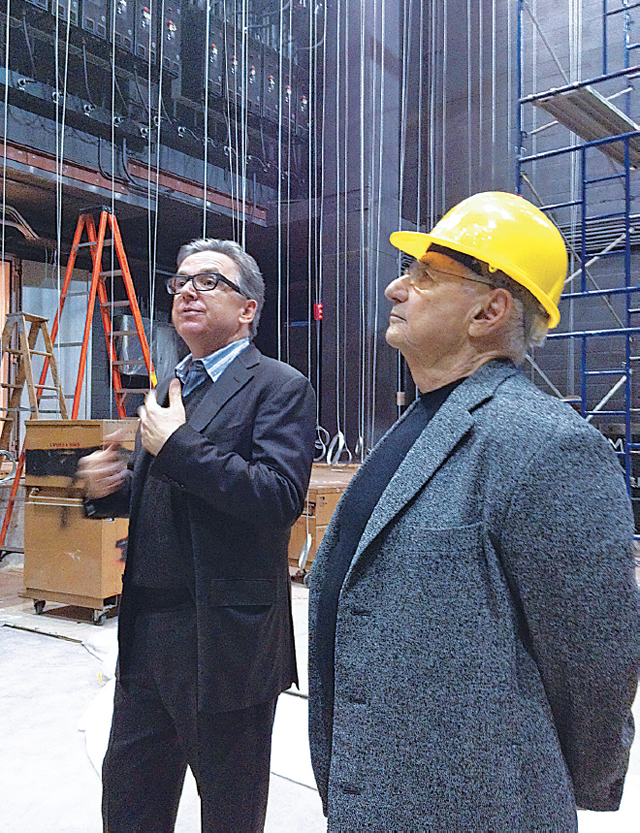
 Signature Theatre founder James Houghton (left) tours his company's facility with architect Frank Gehry in 2011. (Photo by Elliott Forrest)
The Pershing Square Signature Center, located on a spit of West 42nd Street that abuts the Lincoln Tunnel in New York City, is a study in contrasts. It occupies the first two floors of a 63-story glass building whose upper stories house an “ultra luxury” condominium complex. Much of the surrounding landscape—including a commuter thoroughfare dotted with budget inns and beige office buildings—suggests a neighborhood unaccustomed to being in the spotlight.
The center is home to the Signature Theatre Company, an Off-Broadway outfit. Yet this facility, which opened in 2012, isn’t a typical Off-Broadway venue. Designed by the famed architect Frank Gehry, it is a 70,000-square-foot space that includes three theaters, a large lobby, a cafe and bookstore area, and two rehearsal studios, along with a clutch of administrative offices. It’s the largest nonprofit performing arts center to be built in New York since the construction of Lincoln Center in the 1960s. Signature employs more than 40 full-time staff members, and an additional 400 people work part time at the theater.
The lobby takes up a sizable chunk of square footage at Signature. The room is cavernous but seems almost intimate. The Gehry design includes plywood panels that hang from the ceiling at various levels and angles, and the space is lit by fixtures that resemble large glowing cubes. A single staircase leads from the street to the lobby, and from there visitors can access the three performance spaces: the Griffin, a 191-seat jewel-box theater modeled after a traditional opera house; the Linney, a flexible 199- to 250-seat courtyard theater; and the Diamond, a more traditional theater space with 294 seats. By design, the lobby has only one entrance. “There’s no stage door for actors or back exit for the administrative offices. It’s a shared egalitarian space,” says Meghan Pressman, former director of development at Signature. The ideal of shared space extends to the individual theaters, which Signature books in overlapping timeframes so that audience members who attend different shows can mingle as they head to and from their seats. The goal, Pressman adds, is to create “orchestrated collisions.” She attributes that phrase—and that idea—to Jim Houghton, founder and artistic director of Signature.
Houghton, who also serves as director of the drama division at the Juilliard School, has a vision for Signature that is at once artistic and commercial. The Gehry-designed facility, built at a cost of $70 million, embodies that vision. To raise that sum, and to sustain the company’s theatrical operations, Houghton has learned to act like a social entrepreneur. He doesn’t have recourse to the tools (inflated ticket prices, extensive merchandising) that for-profit theater companies use to generate revenue. Instead, he has focused on building relationships—relationships with city officials and pivotal donors, with the artists who help create Signature productions, and with the audience members who buy Signature tickets. “People assume there’s a lack of creativity in business, which is so far from the truth,” says Houghton. “The arts world and the business world are intertwined,” he adds. “Both require tremendous creativity.”
Putting on a Show
Houghton moved to New York City in 1986, after receiving a master of fine arts degree in acting from Southern Methodist University. He had grown disenchanted with standard theater productions. “I worked with a lot of dead writers,” he recalls. But soon after he settled in New York, he had an opportunity to work directly with the playwright Romulus Linney. “There was something spontaneous about the experience. Anything could happen in that room,” Houghton says. He started Signature Theatre in 1991, and from the beginning its core mission was to enable both actors and audience members to experience multiple works by the same playwright. Houghton draws an analogy from another artistic medium: “You walk through a gallery of Picassos and understand that [Picasso] had a Blue Period.” At Signature, writers provide far more than just the words in a script: They become central to the creative process that occurs as actors bring a play to life onstage.
In its first season, Signature featured a retrospective of six plays by Linney. In that first incarnation, the group used space in a Japanese cultural center located in the city’s East Village neighborhood. It was the quintessential Off-Off-Broadway operation: Alongside space devoted to calligraphy classes, Signature staged works by playwrights such as Edward Albee and Horton Foote.
Over the next decade, Houghton began to expand the scope of his vision. To supplement the program that showcases one playwright per season (a program that came to be known as Residency One), he aimed to undertake two other initiatives. First, he envisioned a program (now called Legacy) in which previously featured playwrights would come back for a season to develop new work. Second, he wanted to launch a program (now called Residency Five) in which a playwright in residence would produce three new works over a five-year period. “Those ideas didn’t exist in the theater world before,” says Houghton.
Implementing those ideas would require space—a scarce commodity in New York. By this time, Signature had moved into a storefront in a building near Times Square, but it wasn’t large enough to accommodate Houghton’s vision. So in 2004, when the chance arose to submit a proposal for a new performing arts center to be built at the World Trade Center site, Houghton grabbed it. More than 130 other applicants, including the New York City Opera, vied for the right to use that site. Against considerable odds, the Signature proposal won. Gehry signed on to design the new theater space.
Four years later, the World Trade Center project fell through. The financial and logistical challenges of realizing Houghton’s vision at that site had proven to be too high. But Signature had a staunch ally in the city’s mayor, Michael Bloomberg, and Gehry remained on board as well. As it happens, a real estate firm called Related was starting to develop a condominium complex just a block from Signature’s then-current site. To qualify for a “zoning bonus” from the city, Related had to include a performance space in its structure. The firm had been pursuing Cirque du Soleil as a potential tenant, but city officials pushed for Signature to occupy the site instead. “The city turned the screws a little bit on Related,” says Erika Mallin, executive director of Signature. Signature, in contrast to Cirque du Soleil, represented “legitimate” theater. “The rationale for New York funding nonprofit culture is public service, and Signature was certainly doing a tremendous job of providing that,” says Kate Levin, who was then head of the New York City Department of Cultural Affairs.
Houghton signed the deal for the space in August 2008, right before the financial crisis of that year. “All the cranes in the city stopped moving, and the building hadn’t started yet,” he says. “We had to go into a very different strategy to raise the money.” Signature received a loan from Related and drew financial support from members of its board. Houghton also took advantage of connections that he had forged with people in the New York theater community. The actor Edward Norton, an old friend of his whom he had cast in an early Signature production, helped lead a capital campaign. “We were raising money as we built the building,” Mallin says.
Getting the Price Right
“Arts organizations are the original social enterprises, typically earning one-third to one-half of their income,” says Laura Callanan, senior deputy chair of the National Endowment for the Arts, who helped write a Harvard Business School case study on Signature. “The notion that artists are not good businesspeople or are not practical is very misguided.” Signature, for example, brings in extra revenue by renting out its lobby space to corporate and nonprofit organizations at times when the theater is dark. “Like most nonprofit theaters of our size, we are kind of run like a baby hedge fund,” says Mallin. “We start at zero every year, and every year is a risk.”
Somewhat counterintuitively, Signature bases part of its business model on underpricing its product. Roughly half of its annual operating budget of $12 million comes from ticket sales. Under its “ticket initiative,” however, the company charges the same price—$25—for all tickets to first-run performances. (At big-box Broadway theaters, by contrast, prices routinely top several hundred dollars per seat.) Signature sets the market price of each seat at $75, and the company raises money to cover that $50 gap. Most notably, the Pershing Square Foundation has pledged $1 million per year for 20 years to subsidize the ticket initiative.
The initiative has the effect of boosting donations overall, according to Houghton: Many people who can afford to pay more than $25 per seat will do so, he says; you just have to ask them. Pricing tickets at this level also helps Signature serve a civic mission by making it easier for students and other low-income people to enjoy live theater. That, in turn, enables the organization to gain support from other sources. The city put $ 27.5 million toward building the new facility, for example, and donors such as the Andrew W. Mellon, Ford, and Time Warner foundations have supported Signature as well.
Another benefit of the ticket initiative is that it helps create a more welcoming environment for the theater’s productions. Previously, Houghton says, “you had people sitting in the theater with this attitude—‘This better be good!’—even if they weren’t aware that they were doing it.” Offering more-affordable tickets reshapes expectations, he explains: “Suddenly, every seat is full, there’s a line down the block, and the dynamics have shifted so that work is received in a more sympathetic way.”
Read more stories by Adrienne Day.