


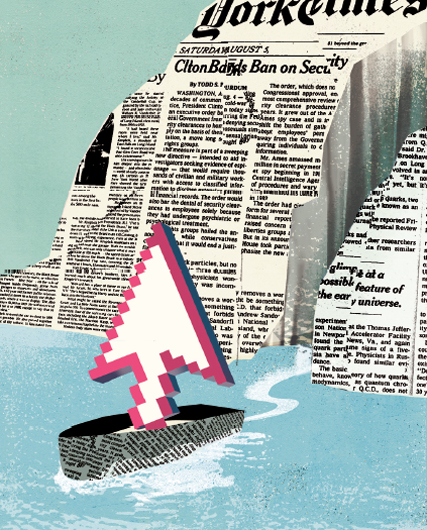
 (Illustration by Justin Gabbard)
On July 2, 2007, the financially troubled San Jose Mercury News told all its employees to stay home and wait for a phone call. At 8:09 a.m. the next day, reporter Janice Rombeck’s phone rang. “Janice, we’re going to have to lay you off,” said the voice on the other end. Rombeck, 59, started at The Wichita Eagle in Kansas in 1974 as a copy editor and then went to the San Jose Mercury News in 1985. In the decade before she was laid off, she covered City Hall decisions through the reportorial lens of residents and neighborhoods.
Rombeck was devastated by the news, but she wasn’t alone. In the subsequent four years, the Mercury News would fire almost 300 other reporters and editors. Those laid-off employees were just one small slice of the nationwide pie. According to US Bureau of Labor Statistics data, 36 percent of newspaper jobs have disappeared in the past decade, a level that suggests journalists are experiencing a prolonged, sector-specific economic depression, one that has no end in sight. I myself was laid off from my job as a magazine editor in 2009, and it was truly scary to discover the dearth of writing and editing positions on job websites.
These personal dramas are just one—and not even the most important—dimension of a larger crisis: As a result of the contraction of both mainstream and alternative media (a distinction that seems increasingly quaint), there are simply fewer trained eyes on city halls, police departments, and schools. As Ken Doctor writes in the Newsonomics blog for the Nieman Journalism Lab at Harvard University, “That news gathering … is what’s key to community information and understanding, fairly prerequisite in our struggling little democracy.”
It’s a social time bomb with an economic fuse. From 2006 to 2010, according to the Project for Excellence in Journalism, ad revenue for US newspapers fell 48 percent—largely because online businesses such as Craigslist, Groupon, and Google ate their lunch. Contrary to what many people believe, news audiences have not diminished—only news revenue.
But journalists like Rombeck are not fading into unemployment lines. Instead, they are collaborating with each other and pioneering new editorial and business models, as Rombeck did last year when she launched NeighborWebSJ, which turns her old beat at the Mercury News into a new media venture that combines for-profit and nonprofit methods.
As a John S. Knight Journalism Fellow at Stanford University, I discovered that Rombeck’s story is becoming increasingly commonplace—and that in many ways, the economic crisis has brought out the best in journalism. I surveyed 170 journalists online about how they are financing investigative, explanatory, watchdog, and analytical stories, projects I put under the umbrella of “meaningful journalism.” I surveyed another 200 about how they see their careers unfolding over the next 10 years. I also combed through the raw numbers of a detailed study of San Francisco Bay Area journalist employment, released in April 2011 by the North Valley Job Training Consortium.
My findings suggested that journalism is becoming a form of social entrepreneurship—an endeavor that combines commercial and nonprofit methods to achieve social change.
Participants in my surveys overwhelmingly cited a desire to change the world as their primary motivation for doing journalism, with financial motivations coming in last by a wide margin. “If I were driven by money, I would not be in journalism,” said one survey participant. Another said he was a journalist to expose corruption and prevent “attempted corruption.”
A stunning 71 percent of participants said that over the next five years, traditional commercial media would become even less important to meaningful journalism, and 84 percent said social ventures like NeighborWebSJ would become more important. Participants described a dizzying array of nonprofit and for-profit funding streams for their projects and their personal incomes: advertising, micro-payments, donations, grants, product sales, and more. The combined financial contribution of grants, donations, and nonprofit media to spcific investigative, explanatory, and watchdog projects dwarfed that of commercial media by a factor of three to one.
As one survey participant wrote, “We are trying to reinvent the newspaper business on the public broadcasting business model—noncommercial funding and public interest reporting about underreported topics for underserved communities. We need to sustain community journalism in an era in which the commercial model is failing.” Another participant put it this way: “Commercial media’s profit margins are so thin—or, are getting so much thinner—that they are more and more focused on making money than on meaningful journalism. Nonprofit media will have to fill the void.” Responses like these recurred through both my surveys.
COLLABORATIVE AND CROWD-FUNDED
The case of NeighborWebSJ illustrates how social startups are stepping into the information gap created by the contraction of traditional news media—even as they struggle to expand their audiences and develop revenue streams.
“Janice Rombeck did a really fine job when she was at the Mercury News,” says Joan Rivas-Cosby, chair of the Neighborhood Action Coalition in San Jose’s Five Wounds/Brookwood Terrace community. Rombeck’s stories brought people out to meetings and focused attention on issues that otherwise would have been invisible, says Rivas- Cosby, as when a 2003 gang-related shooting brought elected officials and community members together in an effort that ultimately resulted in founding Selma Olinder Park. When the Mercury News started shedding reporters, “it lost a lot of credibility with people. Now there’s very little going out to the streets and finding out what’s happening in the neighborhoods,” says Rivas-Cosby.
With seed money from the John S. and James L. Knight Foundation’s New Voices program, Rombeck says launching NeighborWebSJ has required her to expand her skill set dramatically. She is now learning how to raise and manage nonprofit funds, build a website, and market it to a local audience. “No one is writing about what I used to write about,” says Rombeck. “No one gets down to the grassroots level in a comprehensive way. They cover the city budget, but they don’t cover the impact of cuts on neighborhoods. I cover low-income communities that don’t get covered anywhere else.”
NeighborWebSJ is filling a hole left by the Mercury News, albeit on a smaller scale, says Rivas-Cosby. “Janice’s new project is really helping to keep people connected—and she’s done a really good job of doing some in-depth stories,” such as ongoing nuts-and-bolts coverage of the city’s 2011-12 budget process, which has proposed deep cuts to neighborhood services like libraries.
Joint ventures are also serving a crucial role in injecting meaningful journalism back into troubled traditional media. The Mercury News, like the San Francisco Chronicle and many other Bay Area dailies, actively partners with nonprofits such as California Watch, a project of the Center for Investigative Reporting, which raises money for long-term investigative projects and shares the results with many media outlets, each customizing the story for its audience.
In April 2011 California Watch’s “On Shaky Ground” investigation of tens of thousands of seismically unfit California schools, which cost $550,000 and took 20 months to complete, appeared in six English-language dailies, four foreign-language newspapers, and 125 Patch.com suburban mini-sites, as well as on ABC-affiliate broadcasters and public radio stations in the Bay Area and Los Angeles. Within two weeks of the series’s publication, the California Legislature scheduled hearings on the issue.
My own most meaningful journalism projects since my layoff have been collaborative and crowd-funded. As editor of the nonprofit site Shareable.net, I worked with the nonprofit news agency San Francisco Public Press and the journalistic micro-donation project Spot.us to finance an extensive investigation into the Treasure Island redevelopment in San Francisco, which later won an award for explanatory excellence from the Society of Professional Journalists. This year, I worked with the same team to produce a package on the social impact of the Bay Area media meltdown (on which this essay is based). Both projects would not have been possible without thousands of dollars of small donations made through Spot.us.
“As the commercial press cuts back, more and more of these ad hoc arrangements are going to emerge,” says Public Press Executive Director Michael Stoll, who helped run the NOVA study. “The challenge is to find ways—through a combination of sustainable funding sources and distributed work responsibility—to make this kind of project scalable and repeatable.”
Despite the layoffs and the economic uncertainty, journalism is far from dead. In fact, the field is seething with innovation and entrepreneurship—and according to my surveys, it is those who are operating outside of traditional commercial media who are the most optimistic about both their careers and the field as a whole. For example, 75 percent of self-described entrepreneurs were optimistic about their careers, compared to 53 percent of full-time employees.
Rombeck told me that in many ways, she’s never been happier. “I think this is the next wave of journalism. I’ve never believed in something so much in my life as NeighborWebSJ, where I feel like I can be part of the solution in a way I couldn’t be at the Mercury News.”
Even so, the future remains murky, as NeighborWebSJ struggles to achieve financial sustainability. “The final chapter isn’t written,” says Rombeck. “I don’t know what I’ll be doing a year from now.”
Read more stories by Jeremy Adam Smith.