


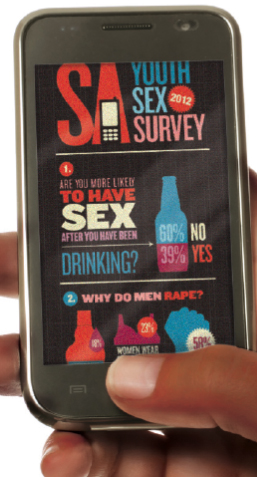
 (Screen image courtesy of the Praekelt Foundation, photo by Denis Zbukarev/iStockPhoto)
The Johannesburg, south africa-based Praekelt Foundation, which since 2007 has been putting mobile phones to new uses in the fields of health, education, and governance, is now asking What if an NGO could prove to a government or donor that X amount of money will change Y amount of lives?
Sinan Aral, an expert on social networks and social media and an assistant professor at New York University’s Stern School of Business, has been working with Praekelt for two years to design a randomized, controlled study of how messages and incentives change behavior, a question that has long bedeviled both social development workers and social scientists. Aral has already done studies showing that peers counseling peers can change behavior. He says that Praekelt brings expertise in using technology to reach young Africans, allowing him to take his research to a new continent and apply it to the problem of persuading people to be tested for the virus that causes AIDS. The results could help NGOs and governments determine how best to spend money on AIDS education.
Once researchers have raised the last of the $250,000 that Aral estimates the study will cost, they’ll be streaming mobile phone text messages that offer air time and other prizes to people who have been tested, and more if the subjects use text messages to persuade friends to be tested as well. YoungAfricaLive, a website developed by Praekelt that can be accessed only by mobile phone, will likely be used to get the word out about the project, Aral says.
Gustav Praekelt says he started his foundation to improve lives. “Now, it’s that,” he says, “but it’s also breakthrough science.”
Praekelt, a computer scientist and entrepreneur, says personal experience gave him insight into how young Africans were taking ownership of their mobile phones and got him thinking about how the simple, now ubiquitous devices were becoming tools for changing lives. That experience led him to create the foundation.
Praekelt, who was born in Germany and raised in South Africa, was in Tanzania on holiday. “I was walking around Dar es Salaam, and everybody had mobile phones,” he recalls. “But they were not speaking on the phones. They were all texting.”
Texting, or the short message service known as SMS, had been developed for telecommunication service providers to communicate with customers. By embracing SMS as a way to share information among themselves, users were essentially hacking the technology. “What I love about it,” says Praekelt, “is how technology sometimes gets used for intelligent, interesting acts in ways for which it wasn’t originally intended.”
Africa, a continent of some 1 billion people, has 475 million mobile phone users, nearly 40 times the number of fixed line connections, estimates Groupe Speciale Mobile Association. The association says that demand for mobile phones in Africa is growing almost 50 percent a year, faster than in any other region in the world, and that mobile Internet traffic on the continent is expected to increase 25 times over the next four years. Already, mobile devices account for nearly 58 percent of all Web traffic in Nigeria.
Creating Praekelt Foundation
Praekelt, 41, graduated in 1992 from the University of Pretoria, in South Africa’s capital, with a degree in computer science and philosophy. Soon after, he helped establish Delapse, one of Africa’s first digital, interactive studios. He’s now CEO of Praekelt Digital, a commercial company that helps multinational companies like Coca Cola and Unilever use mobile and social media networks to reach customers. He’s also chairman of his foundation, which he cofounded with Robin Miller.
The two organizations have separate staff and separate boards, but they sometimes share facilities. Initially the commercial company fully funded the foundation. Now the foundation gets about a quarter of its funding from Praekelt Digital, and the rest comes from other sources. UNICEF, for example, in 2011 gave the foundation a grant of more than 2 million rand (about $220,000) to test whether sending SMS reminders to expectant mothers to come in for checkups could reduce the rate of mother-to-child HIV transmission. In 2010, the foundation received a three-year, $825,000 grant from the Omidyar Network, intended in part to help the foundation reach more people with its programs.
“What drives a techie or geek is the hard problems, that sense of enjoyment and pleasure you get from solving really tough problems,” says Praekelt. “The toughest problems are the ones that we face in the majority world, in Africa. Your challenge is you’ve got a billion people in Africa, most of whom are terribly resource constrained, in environments where there’s no electricity. People have no disposable cash. They have a mobile phone—it’s a great opportunity. But it’s a really tough problem to solve: How do you get lifesaving information to them? That is a challenge.”
One of the first projects launched by the foundation, in 2009, was the mobile-phone-only YoungAfricaLive site. Marcha Neethling, the Praekelt Foundation’s business development manager, says most YoungAfricaLive users have what are called feature phones. Although the phones are not as sophisticated as smart phones, they are able to access the Internet.
YoungAfricaLive users chat and comment on articles and blogs as Facebook users might. Praekelt persuaded South Africa’s Vodacom to allow users to download videos, read articles, and take part in polls on YoungAfricaLive without charge.
YoungAfricaLive was initially devised as a place for young South Africans to get information about HIV, the virus that causes AIDS and infects more people in South Africa than in any other country. YoungAfricaLive is now also available in Kenya and Tanzania. In the first year it reached 250,000 unique users. By the second year, that had tripled to 750,000. At the end of 2012, it was more than 1 million.
Changing Young People’s Behavior
The foundation says the main goals of YoungAfricaLive are sharing information (on where to find HIV clinics, for example), sparking discussion, and promoting HIV testing. It has twice surveyed its users, a way to track effectiveness, though the surveys were not scientific. Troublingly, in both 2011 and 2012, about one-third of respondents said they had not been tested for HIV because they did not want to know their status.
Neethling’s team packs information into bright graphics, edgy animation, and lively videos, all made for tiny phone screens. “True or false?” begins one item on an interactive quiz, “HIV is a life sentence, not a death sentence.” Click “True,” and reassuring text appears: “Correct! Many people with HIV can live full lives with the right medication and a healthy lifestyle.”
Neethling credits Tamsen de Beer, YoungAfricaLive’s 40-yearold content editor, with keeping the material fresh and relevant. “The patriarchal way of just pushing information at people and walking away is so wrong,” says Neethling. “There must be a call to action and there must be something that sparks a conversation. Otherwise, you’re just spamming people.”
De Beer has a team of bloggers who are between the ages of 18 and 24, making them the peers of YoungAfricaLive’s target audience. “It’s no use being middle-aged and white and living in a leafy suburb and writing for an audience that is young and black and urban,” says Neethling.
As its audience has grown, the scope of information available at YoungAfricaLive also has broadened, from facts on AIDS to answers to questions about sex, questions that young Africans may find hard to put to their elders in their traditional societies.
An example of the type of conversation that takes place at YoungAfricaLive is a brief but compelling blog that prompted a reader to type a response on her mobile phone: “After reading this story about sexual abuse in the family, I realized that I was exposed to this myself and need to go seek help,” the reader wrote.
Even before Neethling’s moderators could step in, other users—they call themselves “Yalers”—were offering the young woman advice on where she could find counseling. “It’s amazing to see how they’ve taken that ownership, and even created a name for themselves,” says Neethling. “Yalers is not a word that we conceived.” (It’s a variation on YAL, an acronym for YoungAfricaLive.)
Aral, the social media expert, says: “YoungAfricaLive is a pretty amazing network. It’s amazing how engaged the young users are.”
At the request of YoungAfricaLive users, the Praekelt Foundation started Ummeli, a website where young people can search a jobs database and share tips on how to find work. Youth unemployment is high across Africa.
“Most of our projects actually come from just listening to our audiences,” Praekelt says. “The best innovations come from solving real problems, and you find them by talking to real people.” He adds: “We believe in frugal systems, not over-engineering—building small solutions that can have impact.” Even so, Praekelt notes, “we certainly don’t think it’s a solution you can apply to everything.”
A project that Praekelt says exemplifies his foundation’s approach, but also illustrates the limitations of the frugal solution, is a collaboration with the Wikimedia Foundation, which operates the free online crowdsourced encyclopedia Wikipedia. Praekelt and Wikimedia have designed a way for users to send requests via SMS for Wikipedia articles to be delivered to their mobile phones. It’s a limited way to consult Wikipedia, but it opens up a universe of information to people who otherwise wouldn’t have such access.
The foundation also developed a product called Vumi, an engine for delivering SMS and chat messages, including reminders to take AIDS medication. The Mobile Alliance for Maternal Action, or MAMA, uses Vumi to send guidance to new mothers. MAMA’s partners include USAID, consumer products giant Johnson & Johnson, and mHealth Alliance.
Patricia Mechael, executive director of mHealth Alliance, says the Praekelt Foundation was among the first to recognize and exploit the potential that mobile phone technology holds for those working in the health sector. Praekelt’s strengths, she says, include the organization’s grasp of the technology and of marketing, due in part to the previous experience many of the foundation’s staff had in the commercial sector.
“They have a really good approach, in terms of trying to understand what the problems are and trying to understand how people interact with the health sector and with technology,” says Mechael. “I just have a lot of respect for Gustav and his vision and what he has built.
Read more stories by Donna Bryson.