


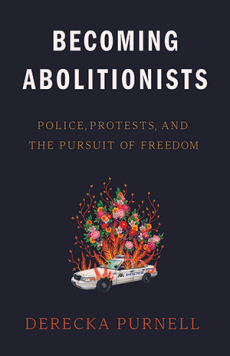
Becoming Abolitionists: Police, Protests, and the Pursuit of Freedom
Derecka Purnell
320 pages, Astra House, 2021
The chants of “Black lives matter” that have come to express the racial justice movement were replaced during last summer’s uprisings by calls to “defund the police”—the demand to reduce and ultimately eliminate policing as an institution. Within a year, Black activists have effectively changed the conversation, forcing the idea of abolition into mainstream American culture.
For many Americans, however, the concept of abolition seems anachronistic to today’s conversations about racial injustice and instead remains a relic of US slavery that was legally dismantled after the Civil War.
Yet, the institutional vestiges of slavery—prisons and policing—prove that the work of abolition is not done. “There is an unbroken line of police violence in the United States that takes us all the way back to the days of slavery, the aftermath of slavery, the development of the Ku Klux Klan,” scholar and activist Angela Davis says of the historical trajectory of systemic racism in the United States.
Despite this fact, the current popular opinion in the United States is that abolition—abolishing systems and institutions of oppression—is both unrealistic and implausible. It is from this perspective that human rights lawyer and grassroots organizer Derecka Purnell begins her journey in Becoming Abolitionists: Police, Protests, and the Pursuit of Freedom. Like many self-identified progressives, she was skeptical of activists’ demands to eliminate both prisons and policing. “Initially,” Purnell confesses, “the notion of ‘police abolition’ repulsed me. The idea seemed like it was created by white activists who did not know the violence that I knew, that I have felt,” she says, explaining that she was raised to “[call] 911 for almost everything.”
But, over time, Purnell realized that “the police were a placebo. … Police couldn’t do what we really needed. They could not heal relationships or provide jobs. They did not interrupt violence; they escalated it.” In Becoming Abolitionists, Purnell argues for abolition through describing her own journey to this political view—that police reform is not enough. “Reforms only make police polite managers of inequality,” she says, explaining that abolition isn’t simply eradicating institutions. “Abolition,” she adds, “was a bigger idea than firing cops and closing prisons; it included eliminating the reasons people think they need cops and prisons in the first place.”
Part memoir and part sociological study, Purnell effortlessly weaves together her personal, political, and philosophical experiences and knowledge to show that abolition is not only possible but necessary for the future of the United States. Purnell’s journey is informed by her expertise as a legal scholar and lawyer. However, arguably more influential to her book are her roles as mother, sister, activist, and organizer. She shares personal stories about her family, friends, and experiences as a young Black mother. Purnell describes how the acquittal of George Zimmerman, who fatally shot unarmed Black teenager Trayvon Martin in 2012, compelled her to reveal to her mother that she was pregnant.
“My mother already knew that her six Black children were vulnerable in the United States, and she had little expectation of the courts to do the right thing,” she writes. “What she did not know on the day of the verdict was that I was pregnant. I should not have said it. There’s an unwritten rule that people are supposed to make it through the first trimester before telling anyone. But I was in Boston, terrified, alone, and angry. Would we be able to protect our children? Would we be able to protect ourselves?” This intimate storytelling is intentional—Purnell refuses to engage in a purely intellectual conversation about abolition because she wants to connect to her reader on a personal level.
By writing this book as a journey, Purnell invites the reader to walk alongside her. This approach and positioning are efforts to share power and earn the reader’s trust. She encourages the reader to consider “prison and police abolition as one paradigm, as one way to think about and experiment with problems and solutions.” One way that Purnell situates herself alongside her reader is to ask questions on their behalf. “When people come across police abolition for the first time, they tend to dismiss abolitionists for not caring about neighborhood safety or the victims of violence,” Purnell explains. “They tend to forget that often we are those victims, those survivors of violence, too.” By engaging with objections to abolition, Purnell expands the scope of the question to reveal the broader contextual landscape of the issue.
“Who chose to have police?” she asks, in a rhetorical move to explore the origins of the police in the United States. “Originally, kings, colonizers, and capitalists. They chose police to protect their power to rule over people who had less. We must never forget that.” Policing in the United States has its origin in the slave patrols that were established to catch runaways, suppress slave revolts, facilitate the genocide of Indigenous peoples, and repress labor organizing. Purnell argues that the protection of property—including enslaved Black people—has always been the primary focus of policing, and therefore it should be no surprise that the police continue to be the custodians of violence and genocide.
While her personal story drives the argument, Purnell focuses each chapter on specific subjects to show how various issues—from the climate crisis to disability—intersect with and further justify abolition. She contends that capitalism is the root cause connecting all these issues that must be unfurled in the fight for abolition. “Capitalism creates concentrated poverty, especially for people who are Black, Indigenous, disabled, women, migrants, or young,” she explains. “The [United States] has been responsible for the deaths of millions upon millions to preserve capitalism through slavery, war, environmental degradation, prison violence, police violence, and state-sanctioned violence through mass shootings and extra-judicial killings by white people.”
To unpack why abolition is necessary, Purnell examines long-cherished ideals like justice, heralded as the moral justification for both policing and prisons. However, she claims, “justice is built upon maintaining the suffering of everyone else.” In her experience in the courtroom, and as legal scholar Erwin Chemerinsky documents in Presumed Guilty: How the Supreme Court Empowered the Police and Subverted Civil Rights, she has learned that justice is not delivered by the police. Justice demands judgment, and in the United States this takes place in the criminal justice system—the very system that has historically and wrongly criminalized Black people and has propped up the prison system and policing.
Instead, Purnell suggests that we take up the pursuit of freedom to guide the work of repairing and preventing harm. This is because true abolition is “a daily practice” that requires continued, collective diligence. She evokes the words of Black feminists like Fannie Lou Hamer and Audre Lorde—that our freedoms are intertwined and interdependent—as well as the “freedom dreams” that inspired the resistance of enslaved Africans to present “freedom” as the opposite of “oppression.” Diving into America’s history, Purnell acknowledges the complexities of freedom and how the fight for it often resulted in the loss of jobs, the loss of security, and the loss of life for Black people. “Freedom,” she explains, “was not for all Black people, just those who could run, physically toil, and prove their worth as human beings in a capitalist society.” Freedom from one system of oppression doesn’t foreclose the possibility of being oppressed and exploited by another.
Freedom work is our collective responsibility, which means that even the smallest individual acts can show us that we do not need to rely on policing.
Advised by historian Robin D. G. Kelley to dedicate her time to “love, study, and struggle,” Purnell cocreated a political education practice with Black and brown organizers who are a part of the nonprofit Dream Defenders, which trains youth on civic engagement and civil disobedience, necessary in the journey of abolition and to building movements more generally. Freedom work is our collective responsibility, which means that even the smallest individual acts can show us that we do not need to rely on policing and prisons to improve society.
For example, Purnell recalls her participation in the Reclaim HLS campaign, which began in 2016 to address structural racism and inequality at the university. She and other Harvard Law School (HLS) students staged a resistance to reclaim a space without the university’s permission. They renamed the law school lounge Belinda Hall, in honor of Belinda Sutton, a Black woman who was once enslaved and owned by Isaac Royall, a major HLS benefactor. Sutton was one of the first people to fight for her pension in the courts, and she won reparations. Organizers brought home comforts into Belinda Hall, such as art and decor to create a sense of belonging. Leaders maintained a daily schedule of programming that included readings, speeches, and other performances. This ceremonial and symbolic demonstration is an example of how resistance is available and accessible to everyone if we commit to the journey of abolition.
The storytelling makes the book’s concepts and ideas accessible, relatable, and in many cases irrefutable—because the stories are rooted in lived experience. At times, the style verges on manifesto-like broad strokes. Yet this can be attributed to the urgency of Purnell’s message. The longer we postpone abolition, the more people suffer and die.
So, what does a world without policing and prisons look like? Purnell says that she imagines this world on a community level. She proposes that “every neighborhood would have five quality features: a neighborhood council; 24-hour childcare; art, conflict, and mediation centers; a free health clinic; and a green team” that attends to the environmental health of that neighborhood.
Again invoking “freedom dreams,” Purnell offers a sixth feature: “dream centers” where people can imagine “the world that we want and deserve”—because, she adds, “the greatest threats to our freedom are hopelessness, helplessness, and the criminalization of rebellion. Dreaming and joining others fights hopelessness because it reminds us that we develop the world that we want.”
Drawing upon a Black radical tradition of social movements, Becoming Abolitionists reveals the power of self-study, collective political education, and resistance to reform efforts to inspire a new generation of activists. Purnell offers a persuasive and warm invitation to us all to deliver on the promise and potential of abolition.