


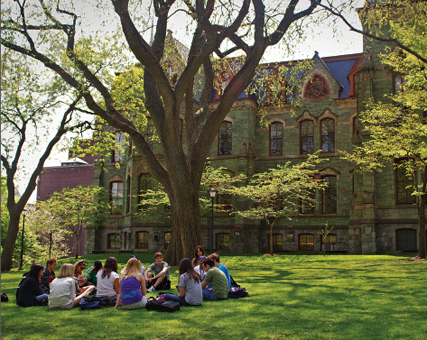
 Social Finance Inc. helps students at institutions such as the University of Pennsylvania (pictured here) to lower loan costs. (Photo courtesy of the University of Pennsylvania)
After borrowing his way through business school at the University of Chicago, Benny Joseph emerged with an MBA, the spark of an entrepreneurial idea, and $115,000 in debt. Even with interest rates at all-time lows, he couldn’t find traditional lenders willing to refinance his student loans. Instead he tapped a network of deep-pocketed alumni. They offered him a lower interest rate along with access to a community of savvy business advisers.
SoFi, or Social Finance Inc., is one of the newest entrants in the trillion-dollar student loan market. The San Francisco-based startup is not a bank. It’s not a nonprofit. And it doesn’t pretend to offer something for everyone.
Unlike government-sponsored student loan programs that take all comers, SoFi lends only to borrowers from top-tier colleges and graduate schools. Investors are alumni of the same selective institutions. They create lending pools dedicated to borrowers from their alma maters. SoFi member schools currently include 78 institutions of varying sizes, both private (Stanford, Harvard, Bryn Mawr) and public (University of California, University of Michigan).
Alumni loyalty is one factor that’s expected to keep default rates low. “Not paying on time would harm the alumni community, which is a key asset people get from going to college,” says Adam Boyden, COO of SoFi and a Stanford MBA.
Another factor is the earning potential of SoFi borrowers. With government-sponsored student loans, Boyden says, “it doesn’t matter who the borrower is. Whether you’re going to Stanford or to a for-profit college, everyone is charged the same.” SoFi can offer lower rates (currently 5.99 percent vs. 7.5 percent for government-sponsored student loan programs), because it anticipates default rates near 1 percent.
SoFi, founded by four Stanford Graduate School of Business students, ramped up in 2012 after a successful pilot. By March 2013, SoFi loans totaled $90 million. The concept has attracted equity capital from investors such as Joe Chen, CEO of Renren, and Baseline Ventures. Accredited alumni investors, meanwhile, are earning returns “comparable to fixed-income securities with equivalent risk profile,” Boyden says.
Along with lower interest rates, SoFi borrowers also gain access to alumni willing to share expertise and open up business opportunities. Boyden expects to launch an online social network for borrowers and alumni later this year. Meanwhile, a more formal mentoring opportunity is available to borrowers who have entrepreneurial ideas. They can qualify for a six-month grace period on loan repayments, along with business advice from the SoFi community.
One of the first qualifiers for SoFi’s Entrepreneurship Program is Benny Joseph. He is moving ahead with plans for a new venture called Good April, an online software solution that offers taxpayers real-time tax forecasts and identifies tax-saving opportunities. Along with a reprieve on his loan repayments, he has received helpful feedback on his pitch and “warm introductions” to potential investors. “We’re in a much better place than we’d be,” he says, “without this advice.” Already Joseph can envision returning the favor in the future “to help the next generation of entrepreneurs.”
By cherry-picking the most attractive borrowers, could SoFi push up the cost of student loans for those attending less prestigious institutions? “We’d have to be a mega-corporation to have that kind of impact,” Boyden says.
Student loans “represent a huge area that needs help,” Boyden adds. (In fact, they are the largest form of unsecured debt in the United States.) “SoFi is just one solution.”
Read more stories by Suzie Boss.