


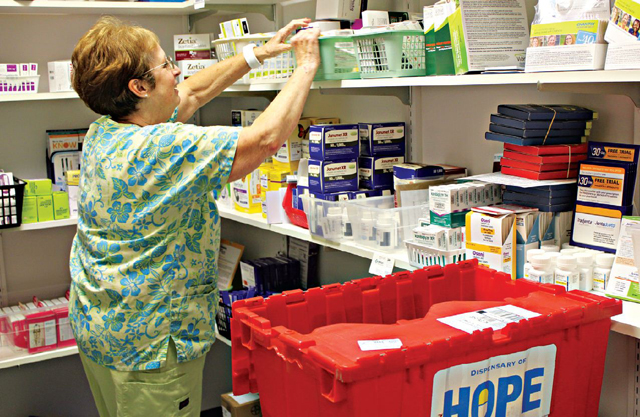
 A nurse’s assistant in a North Carolina medical office prepares a
Hope box for shipment. (Photo courtesy of the Dispensary of Hope)
A nurse’s assistant in a North Carolina medical office prepares a
Hope box for shipment. (Photo courtesy of the Dispensary of Hope)
Picture a bright red plastic box. It hardly looks like a piece of life-changing health-care equipment. And yet this humble-looking container, roughly the size of a banker’s box, is the core component of an ingenious operation that enables a growing number of people to treat or manage a wide range of conditions and diseases.
The architect of the system is the Dispensary of Hope, a 10-year-old social enterprise based in Nashville. It functions much like a food bank, except that the bounty it collects and distributes consists of unopened packages of prescription medication. Every month, the organization sends out “Hope boxes” to physician practices that participate in the system. Each box comes with a pre-paid UPS shipping label and a set of zip ties to close it securely. “We have volunteers who call up the physicians and remind them that it’s time to donate,” says Julie Granillo, director of donor outreach for the Dispensary of Hope. “All their staff has to do is go into the sample closet, pull any medications that have reached the six-month mark, throw the samples in the box, and sign a shipping manifest.”
The pharmaceutical industry distributes an immense quantity of sample drugs to US doctors. (As of 2004, according to one study, the total annual value of pharmaceutical samples came to $16.4 billion.) Many of those products simply expire as they sit on shelves in physicians’ offices. A big part of the Dispensary of Hope model, therefore, involves encouraging physicians to donate samples that are six months away from hitting their expiration date. (The industry term for such drugs is “short-dated.”)
After filling a Hope box with samples, staff members in a physician’s office send it on to the Dispensary of Hope’s 10,000-square-foot warehouse in Nashville. Along with short-dated products that come in from physician practices, the Dispensary of Hope receives donations from makers of generic drugs. And it all adds up. In 2013, according to Granillo, the organization was on track to receive $14 million in donated samples from physicians and $49 million in surplus pharmaceuticals from generic manufacturers. Measured by volume, those donations are the equivalent of nearly 1.5 million 30-day prescriptions.
At the warehouse, interns from a local pharmacy school sort the incoming medications, and people from the Dispensary of Hope log data about each medication into the organization’s online inventory system. “When a physician sends us short-dated samples, it takes two days to get them to us via UPS,” says Chris Palombo, CEO of the Dispensary of Hope. “We process them in five days at our facility, and it takes another two days to get them out to one of our access sites. So in less than ten days, we can get that medication back out there, where it will be used to treat patients.”
But the goal here isn’t just to allocate surplus products on an ad hoc or one-off basis. What distinguishes the Dispensary of Hope from most other organizations of its kind is that it has created a system—a comprehensive, scalable, and sustainable way to collect and redistribute soon-to-expire pharmaceuticals. Because it aggregates medications from a continuously expanding network of donors, the Dispensary of Hope can predictably offer a wide range of medications. The organization also pursues an earned-income model that results in other advantages. Nonprofit clinics and pharmacies pay a fee to join the Dispensary of Hope system, and that revenue gives the organization the resources that it needs to provide a reliable service—week after week, year after year. “A lot of nonprofits live and die by the grant,” says Granillo. “We really focus on being a sustainable supplier of medications for the clinics we work with.”
Logistics of Hope
The Dispensary of Hope grew out of the efforts of Bruce Wolf, a Nashville-based physician who organized people to collect pharmaceutical samples from local doctors for use at a free clinic where he volunteered. Despite its humanitarian origins, though, the organization is first and foremost a “logistics company,” Granillo says. Palombo elaborates on that theme: “It’s not enough to expect people to donate because it’s the right thing to do. People are thrilled to donate, but we still have to create a system that makes it easier, less risky, and cheaper to work with us than to destroy the unused medicine.”
Each year, Palombo notes, an estimated $10 billion worth of surplus medication goes to waste. And that waste, he adds, represents an important opportunity: “Across the street from where it’s going into the garbage, you may have a free clinic where a patient’s quality of life is decreasing because he can’t get the right chemicals and dosages.”
For health care providers, meanwhile, expired medications create procedural headaches. Once it was standard practice to dump unused pharmaceuticals in the trash or to flush them down the toilet. Now, because of the environmental hazards associated with those methods of disposal, state and federal regulations require physician practices to incinerate many types of unused medication. That works in the Dispensary of Hope’s favor: It isn’t cheap or easy to cremate a case of aging antibiotics. “Physician practice managers are telling us they destroy between $40,000 and $70,000 of medicine in a year,” says Palombo. “Between the staff time it takes for the inventory and de-logging process, and the destruction process itself, it can end up costing $10,000”—per year, per practice. The Dispensary of Hope offers a more economical way to deal with soon-to-expire medications. It covers the cost of shipping medication to its warehouse, and it assumes responsibility for most of the paperwork.
To an increasing degree, the Dispensary of Hope obtains medications not only via Hope boxes, but also directly from pharmaceutical companies. “We have several generic manufacturers that are opening up their entire inventory to us, not just surplus,” says Granillo. Take the example of Mylan, a company that distributes generic medications in more than 140 countries. In the past year, Mylan has contributed products to the Dispensary of Hope that have a total wholesale value of about $30 million. Leaders at Mylan see the organization as a strategic ally. “Our mission is aligned with the Dispensary of Hope’s ongoing efforts to expand access to medicine through distribution to underserved communities,” says Tony Mauro, president of North American operations at Mylan.
The Dispensary of Hope offers the same kind of predictability and value to the distribution side of the equation as it does to the supply side. For decades, entities known as medical surplus recovery organizations (MSROs) have procured and distributed unused medical equipment and pharmaceuticals. Many MSROs essentially operate in an opportunistic fashion: When a hospital or a manufacturer has devices or drugs that it no longer wants, an MSRO will redirect that material to an appropriate recipient. Typically, MSROs allocate surplus material to organizations in countries where basic medical supplies are scarce. The Dispensary of Hope, by contrast, works with US-based health-care organizations and serves as a steady, comprehensive source for specific medications. In short, it resembles a commercial pharmaceutical distributor.
A Network of Access
The Hope Dispensary of Greater Bridgeport is a joint project of two hospitals and several community health clinics located in and around Bridgeport, Conn. And, as its name suggests, its existence owes a great deal to the Dispensary of Hope. (The two organizations are separate, however.) The Hope Dispensary fills about 375 prescriptions per month, and it depends on the Dispensary of Hope to do so. Today, it gets up to 75 percent of its pharmaceutical inventory from that organization. “More and more medications are becoming available through the Dispensary of Hope,” says Christine Toni, dispensary coordinator for the Bridgeport organization.
In the United States, there are thousands of safety-net health care organizations— free clinics, community health centers, nonprofit pharmacies, and the like. The Dispensary of Hope has built its distribution network around facilities of this kind, and it has done so very selectively. The network includes about 80 “access sites” in 16 states. “We do a lot of work to qualify the sites we work with, making sure they have the right processes and controls in place,” says Granillo. Each access site pays a flat fee of $7,500 per year to join the network. In return, it receives unlimited access to the Dispensary of Hope’s inventory, which typically includes about 1,100 varieties and strengths of medication. Using the organization’s Web-based system, pharmacists at each access site place weekly orders to obtain the products that their patients need.
To finance its work, the Dispensary of Hope relies partly on grants and donor contributions. But it covers about 50 percent of its operating expenses through the fees that it collects from access sites. And as the organization adds more sites to its network— it recruits about three new ones per month—those fees will reach a level where they cover the bulk of its costs.
Increasing scale on the supply side is no less important for the Dispensary of Hope. As the organization expands its donor network, it will be able to increase the quality of service that it provides to its access sites. The potential for growth in this area is high. Today, for example, the organization works with about 1,000 physician practices—yet there are more than 98,000 such practices in the United States.
Another growth opportunity for the organization may come with the rollout of the Affordable Care Act. Because the number of people with insurance will increase, pharmaceutical companies are likely to boost their production levels—and the volume of surplus medication will go up as a result. Palombo, moreover, anticipates that between 20 million and 35 million people will remain uncovered by insurance, even after the new law goes fully into effect. “We know the surplus will be there. We know the need will be there. And at the end of the day, we’re going to be there, too,” he says.
Read more stories by Greg Beato.