


Sporting a broad grin and a baseball cap, Jason strikes a superhero pose for the camera. It’s a pose that suits him. In Edmonton, Alberta, Canada, where he lives in a group home for adults with developmental disabilities, Jason enjoys the admiration of both fellow citizens and police officers because of his crime-fighting efforts. A couple of years ago, he stopped a break-in attempt at a neighbor’s house. As a result, he earned the nickname Captain Community.
What motivates Jason to look out for his neighbors? “I have to do it,” he says. “They’re my friends.”
Jason’s story inspired the creation of “Captain Community,” a video narrative of his exploits. It’s illustrated with graphic-novel-style artwork that plays on the superhero theme, and it features interviews with Jason and his friends on the Edmonton police force. “Captain Community” is one of 45 short video segments that appear on the website of Project Citizenship. The site is part of a broad effort to help people with disabilities explore their capacity for citizenship—for becoming active participants in their community. A related aim of the project is to reset other people’s understanding of what citizenship means, both for people with disabilities and for themselves. To further those goals, the creators of Project Citizenship use community forums, design thinking, and, above all, storytelling.
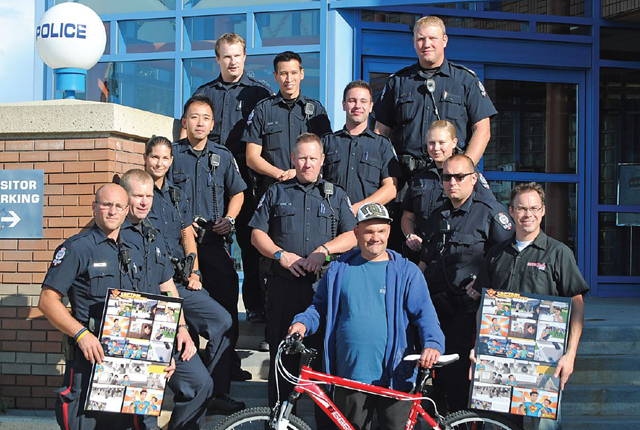 Officers of the law stand in solidarity with Jason, otherwise known as Captain Community. (Photo courtesy of Project Citizenship)
“Our change agent is the medium of story,” says Ben Weinlick. He directs Project Citizenship as senior leader of research and organizational learning at the SKILLS Society, a nonprofit that provides direct services to adults with disabilities in Edmonton. “We hope the stories will not just be inspiring but also lead to better practices in human services,” Weinlick says. “We’re trying to help people be happier with their lives.”
Project Citizenship started in 2011 as a two-year partnership grant between the SKILLS Society and the Community Service-Learning program at the University of Alberta (UA). A core goal of the project was to bring together people whose paths might not otherwise cross: adults like Jason and other SKILLS clients, on the one hand, and UA students, on the other. Using video, illustration, and other media, people from both groups collaborated to craft stories that highlight citizenship activity by people with disabilities. “This is the kind of project that breaks down walls,” says Sara Dorow, a sociology professor who headed the UA Community Service-Learning program during the early stages of Project Citizenship. “It came along as kind of a magical thing. From the beginning, we understood that it was going to be a learning process—and, through that, we’d all be trying to change the culture.”
Carmen Norris took part in Project Citizenship as a UA student and later decided to study the initiative for her master’s thesis. The video segments created by project participants “aren’t just human-interest stories,” she says. “These are cool stories about people contributing to their communities in different ways. They don’t inspire pity; they inspire you to think differently.”
One video features a woman named Devon, who has built on her love of animals to create a neighborhood dog-walking business. To promote her new enterprise, Devon had to overcome her sense of shyness. “Citizenship,” she explains, “means for people with disabilities [like me] to get out there more in the community.”
Although the initial grant for Project Citizenship has ended, the overall effort—along with the outlook that inspired it—has a permanent home within SKILLS. “Storytelling has become part of our practice,” says Weinlick.
Beyond “Inclusion”
The SKILLS Society serves 350 adults with disabilities by offering a wide range of community-based services. Founded in the early 1980s, the organization has been a pioneer in the disability rights movement—a movement that has a long history in Canada. In 1982, with enactment of the Canadian Charter of Rights and Freedoms, that country became the first in the world to prohibit discrimination on the basis of physical or mental disability.
Community-based care reflects a sea change in how social institutions treat people with disabilities. Some SKILLS clients are old enough to remember being sent away to training schools. In Alberta, moreover, it was once common for the powers-that-be to sterilize people who had what was then called a mental disability. Between 1928 and 1970, about 2,800 citizens underwent forced sterilization. The provincial government later apologized for the entire episode, calling it “a very sad chapter of Alberta history,” and paid out $142 million in settlements to surviving victims.
Debbie Reid, senior manager of community support at SKILLS, owns a tangible reminder of that not-so-distant past. In her office, she keeps a red brick that came from an asylum in Calgary that once housed people with disabilities. “It was a scary place,” Reid recalls. She belonged to a group that successfully rallied in the 1980s to have the building torn down, so that those who lived there could return to their home communities. “It felt like [it was] my generation’s job to take on this liberation work and help people recover from atrocious lives,” she says.
After four decades of advocating for disability rights, Reid sees more work yet to be done. “We need to shake up people’s thinking. We need to think with new words,” she says. “We’ve long had the language of ‘inclusion’ and ‘integration,’ but that keeps us in a silo.” Reid says. The challenge today, she suggests, is to change how we talk about adults with disabilities—and how we talk with them.
“Citizenship can be a difficult concept for people to grab onto,” says Nancy Spencer-Cavaliere, an assistant professor of physical education and recreation at UA. “It’s much more than voting. It’s about being part of the fabric of society.” Spencer-Cavaliere, who served as lead researcher for Project Citizenship, credits the project with changing the perceptions of UA students who took part in it. “They recognized that they have more in common with people [who have disabilities] than they think,” she says.
The next frontier in social services might well involve “citizenship-oriented care,” to use a term put forth by Michael Rowe, a Yale University sociologist. In doing outreach work among homeless people in New Haven, Conn., Rowe has developed a framework of citizenship that includes five elements: rights, responsibilities, roles (in particular, the roles that society values), resources, and relationships. “If you don’t have a strong connection to all five,” he says, “you will have a hard time being—and perceiving of yourself as—a full member of your community.”
Rowe’s research touches on many of the themes that animate Project Citizenship stories. “There are lots of ways to contribute to society. A valued role doesn’t have to be about paid employment,” Rowe says. That point is especially relevant to marginalized citizens, he adds: “The desire to give back is so prominent. Telling your story can be a real contribution.”
How Good Stories Happen
In addition to sponsoring digital storytelling work, Project Citizenship hosts a forum called Community Action Hall. Each Friday afternoon, a diverse group of participants—academics, college students, people with disabilities, social service providers—gathers on the UA campus to study issues related to civic rights and community diversity. In some cases, adults with disabilities take the lead on small-group activities, such as making “vision boards” that explore the future that they imagine for themselves. Devon, for example, can trace her small business idea (and her first customer) to a Community Action Hall discussion. “What’s radical about this approach,” Weinlick argues, is that it allows people with disabilities to assume the roles of “teaching others.” When SKILLS clients come to campus and sit alongside college students and professors, customary power imbalances go away. “It’s important for these conversations to happen in a valued place, inside the academy,” Reid says.
Project Citizenship, in short, has moved beyond merely documenting the aspirations and achievements of SKILLS Society clients. “We started by saying, let’s look for those stories that inspire ourselves and others,” Reid says. But another goal gradually came into focus, she explains: “If we don’t find the stories we’re looking for, then our job is to make them happen.” One strategy for doing so involves a practice called the Think Tank. It borrows from design thinking and creativity research, and it brings people together to focus on the needs of a specific client.
In a Think Tank discussion, members of the SKILLS team engage in structured brainstorming activities. On occasion, they also invite people from outside the human services field to help them generate novel ideas. “We don’t want to offer a menu of services. That’s old-school,” Weinlick says. “So the challenge is, how do we design custom experiences and services to fit individual needs? How do we connect our clients with others in the community who share their passions?”
A recent Think Tank effort focused on a woman with Down syndrome who is fascinated by fashion. “We started by looking at her gifts,” Weinlick says. “She has binders full of designs that she has drawn. How can we help her have an experience where she’s connected with professional designers?” There’s more work ahead to make that connection happen, but Weinlick and his colleagues now have a game plan for enriching the life of this client.
Thinking differently—and telling different kinds of stories—are activities that have come to define the SKILLS team. “They are able to step back, despite the pressures of providing day-to-day care, and push that big-picture thinking,” says Spencer-Cavaliere. “That’s a special thing in the human services field.”
Read more stories by Suzie Boss.