


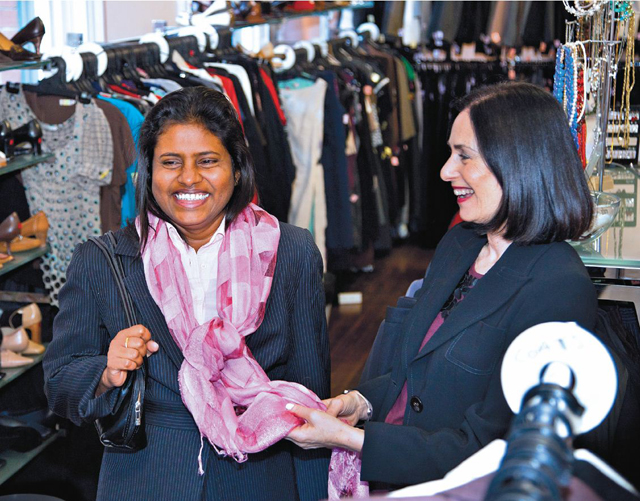
 Volunteer Gayle Philipp helps a Fitted for Work client to update her wardrobe. (Photo courtesy of Fitted for Work)
When Karen Diegan arrived at a clothing boutique in Melbourne, Australia, she was tired from her hour-long train ride. She was also a little nervous. Diegan, a single mom, had spent three years looking for work as a receptionist. She needed a new summer wardrobe to use on interviews, but she couldn’t afford to buy clothes. Two sales associates quickly put her at ease and showed her around the store. Sunlight splashed into the boutique, huge mirrors hung on its pink walls, and jewelry filled its shelves. The only thing missing was a cash register.
The boutique is operated by Fitted for Work (FFW), a career services organization for women that helps outfit its clients in more ways than one. Some of the women who come to FFW are escaping domestic violence or homelessness. Others are in poor health, or are recently widowed or divorced. Many are single mothers. But all of them are eager to find work.
With help and encouragement from the sales associates, Diegan picked out some summer shirts, a pair of black dress pants, and a black handbag. She paid nothing. She also took advantage of the free job-training program that FFW offers, and before long she landed a job as a receptionist—at FFW. “I love working here,” she says. “I feel I have a sense of purpose now and have been able to utilize my computer skills and be part of a wonderful team.”
FFW offers an array of services to women like Diegan. In the boutique, volunteers not only provide clients with interview clothing, but also coach them on how to succeed in an interview. The organization provides more extensive employment training services through its Transition to Work program. To generate income, FFW also operates a retail business that sells high-quality second- hand clothing.
Founded in 2005, FFW has served more than 12,500 Australian women in its brief history. Today, 75 percent of the women who receive wardrobe support and interview coaching from FFW, and 74 percent of the women who enroll in Transition to Work, find employment within three months of completing one of those programs. In comparison, according to Job Services Australia, only about 48 percent of women who rely on Australian federal job agencies are able to find work within a three-month period.
A commitment to serving women, and only women, lies at the core of FFW’s mission. “When you know that women in Australia earn just 83 cents to the male dollar, and are two and a half times more likely to live in poverty in their old age than men, it becomes apparent that women need support to participate, and participate equally, in the workforce,” says Amanda Carlile, national client services manager at FFW. Nationwide, 40 percent of women who are 15 years of age and older aren’t in the labor force. In contrast, 28 percent of men fall into that category.
FFW’s emphasis on equipping women for the work world has far-reaching consequences. In Australia, 22 percent of families with children have only one parent, and women head roughly 90 percent of those families, according to the Australian Bureau of Statistics. “If you assist women, you also assist the community,” says Jane Hunt, CEO of FFW. “By being gender specific, we knew we’d make a better impact.”
A Fitting Approach
FFW takes inspiration from an organization called Bottomless Closet. Based in New York City, Bottomless Closet provides women with donated business attire, both used and new, and with professional development services. Like that organization, FFW follows a model that’s tailored to fit the distinctive needs of its client base.
Preparing women to enter the workforce requires care and sophistication. It’s not enough just to offer them interviewing tips or to help them spruce up their résumé. It’s also important to help build their self-esteem. “Women will struggle if they don’t feel good about themselves,” Hunt says. For women who attend an FFW fitting service, the significance of the clothing and makeup that they receive is far from superficial. According to FFW, 98 percent of clients feel a boost in confidence after their fitting.
When an FFW client puts on a suit and looks in the mirror, she sees a new image of who she wants to be. “We have had clients who express a wish to wear the clothes home from a fitting,” says Carlile. These women want “to stand at the [train] station with other women who are dressed for work and feel connected,” she explains. “For many of the women we help, this is the first time that they have taken time out for themselves.”
FFW’s programs have evolved over the years. The basic dressing and interview coaching service was popular from the start. But FFW leaders discovered that many women needed a higher level of assistance than that service could give them. In response, Hunt and her team developed Transition to Work, a program that pairs clients with mentors who work with them to hone skills such as résumé writing and money management. Clients in that program also meet with human resources professionals and gain experience by spending up to six months in a workplace. In some cases, FFW adapts the program to serve particular groups, including Aboriginal women, women with disabilities, and single mothers.
Further research revealed that many clients find it difficult to maintain employment for more than two years. To serve those clients better, FFW has developed a new program called Staying Employed. Launched this past August, Staying Employed focuses on providing long-term career development. Over the course of a year, 50 clients will consult with volunteer mentors, attend workshops on topics that range from building vocational skills to working in teams, and develop career plans in conjunction with their employers.
There’s no shortage of demand for these services. More than 300 organizations routinely refer women to FFW. What’s more, 33 percent of clients who come to FFW have already been job-hunting for a year or longer.
“Obviously, there’s a big need,” says Lisa Waldron, senior advisor at the Westpac Foundation, a primary funder of FFW. (Westpac is one of the largest banks in Australia.) Waldron argues that FFW is especially well suited to serve this need. “A similar program run through the government would be a more expensive model and wouldn’t be able to galvanize volunteers,” she says. “It certainly wouldn’t have a social enterprise to fund itself.”
That enterprise is Dear Gladys, FFW’s high-end retail store. Dear Gladys sells vintage and modern clothing, accessories, and home goods, both through a storefront in Melbourne and through its website. Over the past three years, the boutique has brought in $280,000, and today it accounts for 20 percent of FFW’s total income. The remainder comes from foundation grants and private donations. In addition, FFW receives about $600,000 worth of clothing annually from individual donors, and it receives in-kind donations from companies as well. Recently, for instance, the Heat Group gave FFW $60,000 worth of beauty products. (All currency figures here refer to Australian dollars.)
A Network of Support
FFW aims to help 5,000 women find work annually by 2015. To help the organization reach that size, Hunt and her colleagues rely on a network of 120 corporations that support FFW financially and with volunteer labor. Frequently, FFW’s relationship with a company starts when a few women who work there decide to run a clothing drive. The experience of contributing to a drive then inspires coworkers to learn more about FFW and its volunteer opportunities. “It just builds,” says Hunt. “Once a company sees that their business won’t be disrupted, they see the value in supporting us.”
Take the example of Westpac. A women’s banking group at Westpac raised $100,000 for FFW. The bank has also run clothing drives and held black-tie events with private clients on behalf of the organization. “It’s so easy to support them on an ongoing basis, because they’ve infiltrated other aspects of Westpac,” Waldron says.
Every year, about 250 volunteers log a total of 12,000 hours at FFW. Managing those volunteers presents a sizable challenge, but Hunt has a system that works. Each new volunteer sits down with a staff member to discuss his or her skills and interests. Staff members then match the volunteer to a specific organizational need. “If you find out what motivates a volunteer first, you can set expectations,” says Hunt. “Volunteers have a psychological contract—some want a lot of recognition for their work—and you can get in a lot of hot water if you don’t give them what they expect.”
Leigh Powell went through the organization’s four-week mentor training program, and since then he has mentored two clients. He notes that the organization puts a great deal of faith in its volunteers’ ability to manage the mentoring process. “As demand grows, Fitted for Work will be challenged to monitor the progress of many more mentor and mentee assignments,” he says.
For now, the organization runs smoothly with support from its network of volunteers. “Every Wednesday, I come into work, and it’s the highlight of my week,” says Gayle Philipp, a volunteer who has been outfitting women at the FFW boutique for three years. “We love what we do, helping women on their journey to get back to work. This is about them, not us.”
To do their job well, volunteers like Philipp need to display both skill and compassion. They must take into account not only each client’s body shape and color preferences, but also her career field and her professional aspirations. Above all, they must treat clients with respect. “We want them to walk out feeling like the most important people in the world,” Hunt says.
Read more stories by Corey Binns.