


 (Photo courtesy
Clnl—Tata Trusts)
(Photo courtesy
Clnl—Tata Trusts)
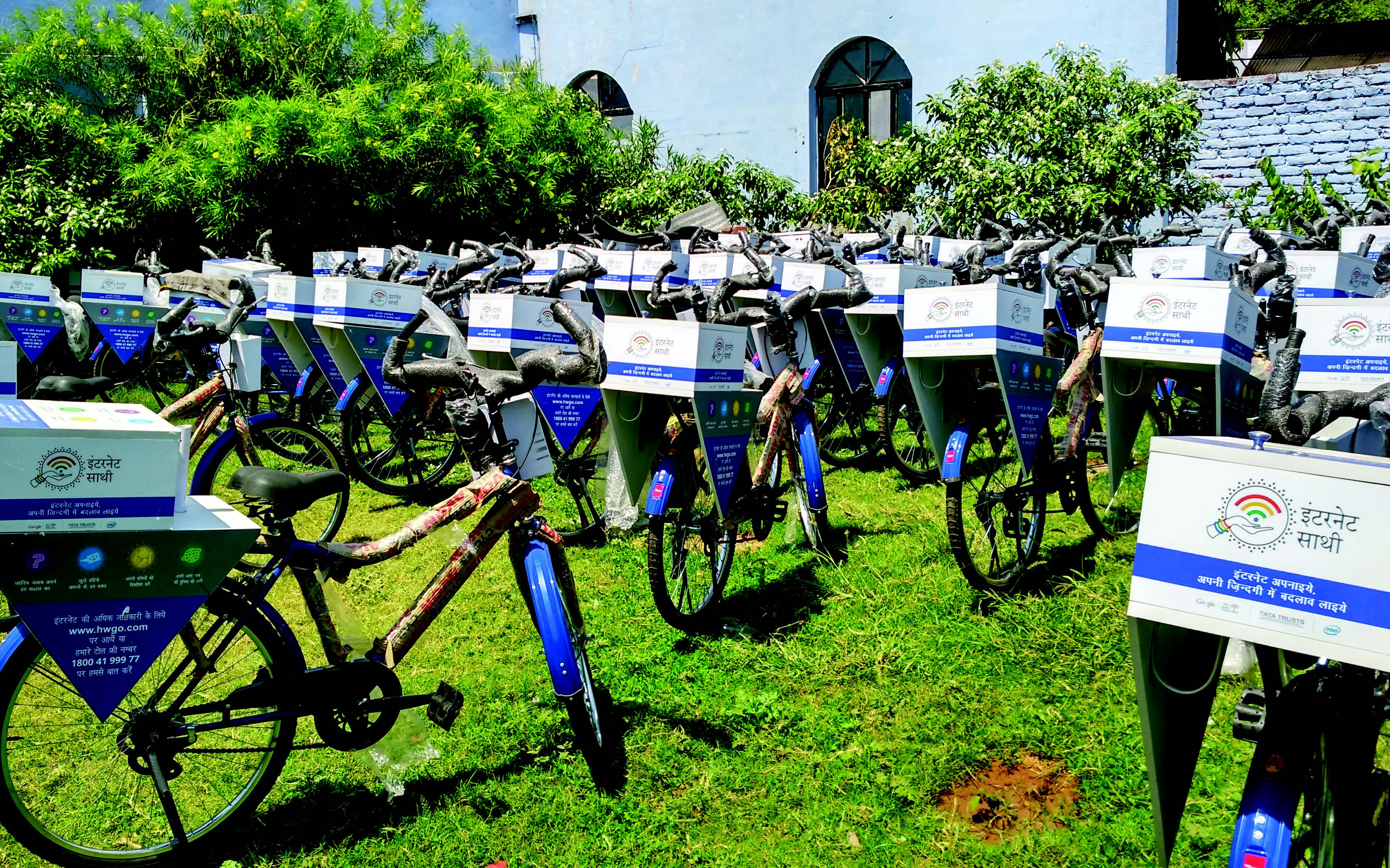
Many developing-world countries have made significant progress toward providing their people with Internet access. In China, 65 percent of adults have Internet access, and in Brazil it’s 60 percent. But in India, according to the Pew Research Center, only 22 percent of adults have access to the Internet. There are several reasons for this. One is that many rural areas simply don’t have wired or wireless Internet coverage. Another is that many poor people can’t afford to buy a computer, tablet, or smartphone, or purchase Internet access where it’s available. And a third reason is that about one quarter of Indians are illiterate, and so they have a difficult time even navigating the Web. Google and Tata Trusts have set out to solve these problems. Their solution is to train women as Internet guides and send them out to rural villages on special bicycles outfitted as mobile Internet kiosks (such as the ones shown in the photograph above). When a Saathi (Hindi for “friend”) arrives in a village, she teaches other women how to use a smartphone and tablet, and also goes online to find answers to any immediate questions that local women might have, such as when to immunize their child or how to obtain a loan for school. As of last summer, Saathis had visited 18,500 villages in nine Indian states and reached more than 300,000 women. The goal is to visit 105,000 villages by the end of March 2017.
Read more stories by Eric Nee.