


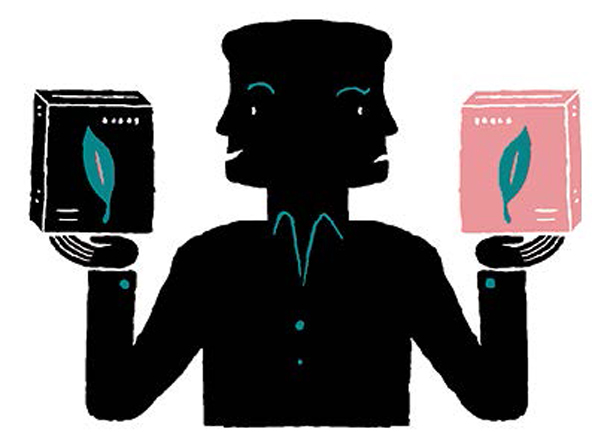
 (Illustration by Adam McCauley)
Men are far less inclined toward eco-friendly behavior and environmental consciousness than women, researchers have found. Men litter more, recycle less, and are less likely to buy green products and less likely to feel guilty about it. This is an important phenomenon to understand, if protecting the environment is too important to leave to just half the population.
The green gender gap has been attributed by researchers to male-female personality differences. But James Wilkie, an assistant professor of marketing at the University of Notre Dame, and colleagues believe that an additional dynamic may be at work: Men’s resistance may also stem from prevailing stereotypes that tie green products and behavior to femininity. Since men tend to be more careful than women about gender-identity maintenance, these stereotypes motivate them to reject eco-friendliness as too feminine.
“The associations between the feminine, nature, the body, and, in turn, care for the environment have long been highlighted by feminists,” observes Pauline Maclaran, professor of marketing and consumer research at Royal Holloway, University of London. Wilkie’s research “shows at a more micro level [of cognition] how these underpinning assumptions play out in the marketplace for green products.”
Wilkie and colleagues designed a series of seven studies to tease out the source of men’s reluctance. Surveying university students, they established that both males and females linked green products with femininity and that shoppers were considered feminine when carrying reusable, versus disposable, grocery bags.
They also asked 389 American men to imagine shopping for various products using a gift card. Then the participants were shown either a frilly pink gift card or a birthday card that kidded them about their age. The men were less likely to choose a green product when using the gender-threatening card than with the age-teasing card—whether in person or online.
What if the men’s masculinity were actively affirmed before making choices? In another study, men who had their masculinity endorsed were more comfortable in expressing a preference for green products—about as comfortable as women usually were. “Men know they have to be careful about being perceived as feminine,” Wilkie explains. “They are actively trying to maintain a certain gender identity, more so than women—even in private, online contexts.”
Gender-based branding also made a difference. Men more willingly donated to a hypothetical group called Wilderness Rangers than to Friends of the Earth. When presented with T-shirts bearing either masculine-looking or conventional eco-logos, only women preferred the latter. And a field test at two Beijing BMW dealerships provided even more support for gender-differentiated branding. Customers were shown one ad touting the hybrid BMW i3 as an eco-friendly car and another as the “Protection” model. Men preferred the latter.
Maclaran acknowledges that such “re-gendering” can work with consumer products but cautions that changing prosocial behavior in a more permanent way might be a longer haul: “Because the associations among masculinity, femininity, and the environment run so deep and are socially constructed, there is no quick-fix solution to bring about cultural change, and marketers’ potential to bring about change is limited unless more deeper-rooted actions are taken, such as actions that will impact on gender socialization of children.”
Aaron R. Brough, James E.B. Wilkie, Jingjing Ma, Mathew S. Isaac, and David Gal, “Is Eco-Friendly Unmanly? The Green-Feminine Stereotype and Its Effect on Sustainable Consumption,” Journal of Consumer Research, 43, 2016.
Read more stories by Marilyn Harris.