


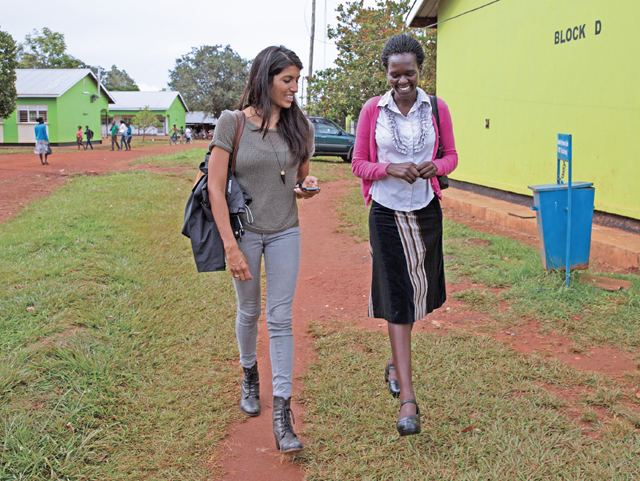
 At the source:
Leila Janah, CEO of Sama
Group (left), walks with
Samasource worker Juliet
Ayot in Gulu, Uganda. (Photo courtesy of Sama Group)
At the source:
Leila Janah, CEO of Sama
Group (left), walks with
Samasource worker Juliet
Ayot in Gulu, Uganda. (Photo courtesy of Sama Group)
Kristen Logan, a single mother with three children, was laid off from her job as a hospital administrative assistant in late 2013. It wasn’t long before she started to panic. Logan had always been able to find office work in the past, but employment opportunities had become scarce in Merced, Calif., where she lives. “I started worrying about losing our home,” she says. At a friend’s suggestion, Logan enrolled in a 10-week “boot camp” that taught her how to navigate the online freelance market. An organization now called Samaschool (formerly SamaUSA) designed the course and arranged to offer it through Merced College. Today, Logan’s home doubles as her office. Using platforms like Elance, a matching site for businesses and freelancers, Logan has built a roster of clients for whom she serves as virtual assistant. Now, more often than not, her monthly income beats her old paycheck.
About 9,000 miles away, in Gulu, Uganda, youth unemployment runs as high as 60 percent. In that community, Juliet Ayot is a rarity: a young woman with a decent job. She works at a technology center, located in a building that used to be a shipping container. Her duties include scrutinizing digital photos and tagging them with identifying labels. Thanks to her work, customers of Getty Images can browse the company’s vast photo collection and easily find a specific shot—an image of George Clooney or Kim Kardashian, for example. A local enterprise employs Ayot, but a US-based group called Samasource provides training and facilitates the arrangement with Getty. She now earns enough not only to support herself but also to send money to family members in her village.
Similar stories are playing out around the globe. Business process outsourcing (BPO) has become a $100 billion industry that encompasses a broad set of enterprises—from call centers in India to Amazon’s Mechanical Turk, an online platform where freelancers bid on digital jobs. Digital opportunities of this kind could lift millions of people out of poverty. But there’s a catch. Before the world’s most marginalized people can benefit from this trend, they need skills to compete in the global marketplace, along with connections to the companies that drive the digital economy.
“Talent is equally distributed around the world, but opportunity is not,” says Leila Janah, founder and CEO of Sama Group, a San Francisco-based family of nonprofit social enterprises. (“Sama” means “equal” in Sanskrit.) Two of those enterprises—Samasource, founded in 2008, and Samaschool, founded as SamaUSA in 2013—share a mission to bring digital employment opportunities to people who desperately need them. Samasource operates in the developing world, whereas Samaschool mainly helps workers in the United States. “Technology can help solve the problem of finding jobs for unemployed people, whether they’re in Kenya or Iowa,” says Janah. (The group launched a third enterprise, Samahope, in 2012. Samahope leverages crowdfunding to pay for medical treatments in the some of the poorest parts of the globe.)
Sama Group is a leading player in the fastgrowing field of impact sourcing—a variation on traditional outsourcing that aims to create employment opportunities in low-income areas. “We’re opening the marketplace for more people to succeed,” Janah says.
On the Job
When Janah launched Samasource, she was 25 years old. She had experience with managing a call center in India and a passion for the poverty-fighting potential of impact sourcing. She also had a vision that focused on outsourcing “microwork”: By breaking digital work into small, easy-to-teach tasks, her organization would provide work—instead of aid—to the world’s poor. In the business model that she devised, Samasource would collaborate with enterprises in the developing world to provide microwork services to paying business customers. Now she just needed to find those customers.
She cold-called Jim Fruchterman, CEO of Benetech, a nonprofit organization based in Palo Alto, Calif. He happened to be leading a large-scale expansion of Bookshare, a digital library for blind and dyslexic people that his organization maintains, and he needed proofreaders for a textbook project. Despite her lack of a track record, Janah landed a $30,000 contract with Benetech. She outsourced the work to an organization that serves disadvantaged people in Nairobi, Kenya, but handled quality control herself. “We saw that Samasource could connect us with social enterprises that would never get to California to sell their services,” says Fruchterman.
Janah parlayed that first project into a client list that includes Getty Images, Google, LinkedIn, Microsoft, and other bigname companies in the tech sector. To serve these customers, Samasource contracts with carefully selected partner organizations in Kenya, Uganda, Ghana, India, and Haiti. Those partners provide recruitment, training, and oversight services, and they also take responsibility for paying fair wages and achieving measurable social impact. To automate workflow and to maintain quality, Samasource developed its own technology platform, the SamaHub. By early 2015, the organization had created job opportunities for more than 6,500 workers.
Impact sourcing was a relatively unknown practice when Samasource got under way. Now it’s a growth industry that accounts for 12 percent of the total BPO market. Digital Jobs Africa, a $100 million initiative launched by the Rockefeller Foundation in 2013, will help drive further growth. Sarah Troup, associate director of the foundation, says that the initiative aims to connect 250,000 African young people with work opportunities by 2020. “We’re working the supply side, the demand side, and the enabling environment to get to scale,” she explains.
The Rockefeller Foundation, an early backer of Samasource, this year made a new $1 million grant to the organization as part of Digital Jobs Africa. That funding comes with ambitious targets: Samasource aims to enable employment for 12,000 workers in Africa by the end of 2015. But Janah and her team are ready for the challenge. “We’d like to hit 100,000 [worldwide] in the next two years,” she says. “We have a model that works. Now we need to execute on it.”
In 2013, Janah and her team created Sama Group to serve as an umbrella organization for their growing operation. Taking that step has brought stability and shared efficiencies across the Sama family of enterprises, which together employ 75 people. To finance its expansion, the group relies on support from funders like the California Endowment and Google.org, as well as the Rockefeller Foundation. It also holds a glitzy annual fundraiser called SamaGala. In 2014, through efforts such as the gala, Sama enterprises raised $1 million from individual donations.
Back in the USA
After she started Samasource, Janah began fielding requests to bring impact sourcing to high-poverty communities in the United States. In online forums, commenters have criticized the organization for shipping jobs overseas. “I understand their frustration,” Janah says. The fair solution, she argues, is not to limit opportunities in developing countries, but to “show that our model can work in the US.” She and her team launched SamaUSA—or Samaschool, as it’s now called—to do just that.
Samaschool doesn’t follow the model of its older sibling, Samasource. “The challenges for Americans in poverty are different from those in East Africa or India,” says Tess Posner, managing director of Samaschool. That organization prepares workers to become digital freelancers who can compete for self-employment opportunities via online platforms. Instead of going to work in a technology center, they work from home or in a Wi-Fi-equipped coffee shop. “They’re entrepreneurs, going out and getting contracts themselves,” Posner says.
Working in partnership with community colleges and other local organizations, Samaschool develops and delivers intensive training services. “We teach hard skills, soft skills, and work readiness,” Posner says. In a typical course, students go through the entire process of building an online freelancing business—from writing a profile and bidding on a job to preparing an invoice and asking for a recommendation. They pay no fees for the course, and many of them qualify to receive a laptop that they can keep once they complete their training.
Six US partner sites were in place by March 2015, and other partnerships are now in development. The sites range from urban areas with high youth unemployment—Bayview Hunters Point YMCA in San Francisco, for example—to rural communities with ailing economies, such as Dumas, Ark. (In November 2014, the organization began offering a training program in Kenya. Early this year, in conjunction with expanding beyond the United States, SamaUSA was rebranded as Samaschool.)
“It’s beautiful here, but remote. We’re definitely a community in transition,” says Amy Schulz, a faculty member and project director at Feather River College in Plumas County, Calif. Lumber industry jobs that once sustained the local economy have largely disappeared. When Janah explained the Samaschool concept to her, Schulz was intrigued by it. “The idea of connecting people to work, without having to relocate or build facilities here, was a fantastic fit for our community,” Schulz says.
When the college offered its first Samaschool course in the spring of 2014, there were more baby boomers than twentysomethings in the class. “They [the older students] tended to be women approaching retirement age who weren’t sure they had enough money saved,” Schulz says. “They had marketable skills but didn’t know how to connect with jobs using technology. That’s exactly what we taught them.” Graduates of the course have found freelance work in fields that range from blogging to consulting.
Janah and her team are now exploring ways to replicate the Samaschool program. They might pursue a franchising model, for example. “We don’t have the bandwidth to set up shop everywhere, but we can give tools to local partners,” Janah says. “Teaching people how not to be at a disadvantage on digital platforms—that’s relevant the world over.”
Read more stories by Suzie Boss.