


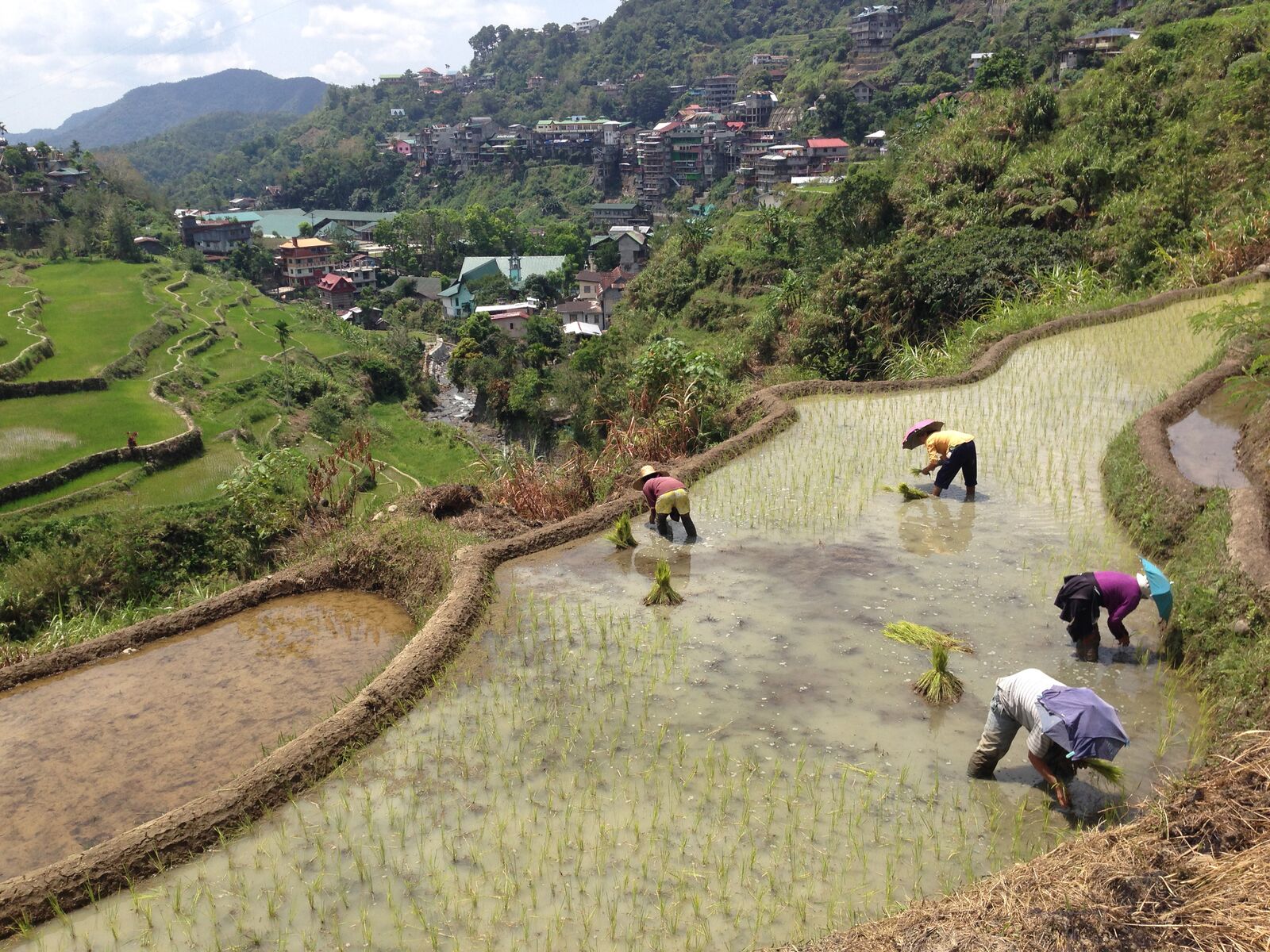
 In the Philippine Cordillera, near
the town of Banaue, farmers
transplant rice from seedbeds
to terraced fields. (Photograph courtesy of Eighth Wonder)
In the Philippine Cordillera, near
the town of Banaue, farmers
transplant rice from seedbeds
to terraced fields. (Photograph courtesy of Eighth Wonder)
Upon entering the home of Clara Aboli, a visitor first notices the aroma. Aboli, a 33-yearold farmer and mother of four, beckons the visitor into her kitchen. She has prepared several dishes, but the visitor is drawn by the aroma that wafts from a steaming cauldron of red rice. Aboli and her family harvested the rice from the terraced fields that lie just above her house, which is located in the Cordillera mountains, a region of the Philippines.
Aboli heaps a nutty mixture of three rice varieties—Jekot, Ulikan, and Unoy—onto the visitor’s plate. She smiles as she answers a few questions about the rice. In the past few years, she’s grown accustomed to people treating this humble mountain staple as a delicacy. On her farm, she grows two rice crops per year. “The first one we eat, and the second one is for Eighth Wonder,” she says. Eighth Wonder is a fair trade company that buys the heirloom rice grown by farmers like Aboli. “I try to do what I can to earn a little money for my kids,” says Aboli. “What if they want to go to school?” The income that she gains from selling her crop to Eighth Wonder helps her answer that question.
On the surface, Eighth Wonder functions like any other fair trade company. It buys rice directly from farmer cooperatives and then sells it at a premium to North American consumers. These consumers appreciate the grain’s unique taste and its arsenic-free, high-antioxidant content. The revenue from that transaction allows farmers to better their lives—and the lives of their children. For all parties, it seems like a fair and beneficial exchange.
But from its beginnings, Eighth Wonder set its sights on achieving a more transformative goal. Founded in 2006 by Mary Hensley, the company arose from a vision for saving a mode of agrarian life that had flourished for centuries in the Cordillera mountains. In 1995, the rice terraces of the Philippine Cordillera had gained recognition as a Unesco World Heritage site. But the economics of rice production in the late 20th century threatened the survival of rice farms in that region. “I’d been hearing that young men were leaving the mountains to look for work, that a quarter of the terraces had already been abandoned,” Hensley recalls. “I figured it was now or never.”
Hensley joined forces with Vicky Garcia, a Filipina civil servant and the founder of Revitalize Indigenous Cordilleran Entrepreneurs, or RICE, Inc., a nonprofit organization that supports farmers in the region. Hensley and Garcia saw the potential not only to improve farmers’ livelihoods but also to shift how people assign value to a product like heirloom rice. Ultimately, their goal is to bring the value of Cordillera rice back to the Cordillera region.
A decade after starting their joint effort, Eighth Wonder and RICE have achieved a notable degree of success. Their partnership has injected nearly $250,000 into the Cordilleran economy. In 2015, 323 farmers sold rice to Eighth Wonder and received a total of about $40,000 for their product. So on average these farmers earned $123 from this trading relationship—enough to cover a semester’s worth of expenses at a college in the Philippines.
Rethinking Rice
Hensley first came to the Philippine Cordillera as a Peace Corps volunteer in 1976. At that time, the region’s 2,000-year-old rice terraces were still at the center of village life. When she visited terrace farms, she could watch elderly women plant and harvest according to a traditional calendar that defined the rhythm of community activities. In those days, no one applied the term “heirloom” to the hundreds of varieties of rice grown in the Cordillera mountains. Villagers knew them simply as their local rice.
To many outsiders, though, the farmers of the Cordillera were “backward,” and their rice held little value. Following the lead of international development experts, the Philippine government encouraged farmers to compete in the global marketplace by growing high-yield crops. Farmers, the experts said, should migrate to lowland regions where conditions were optimal for that kind of agriculture. Yet the limits of this model eventually became clear: By the turn of the millennium, 30 million Filipinos were living in poverty—and the Philippines had become the world’s third-largest importer of rice.
In 2001, Hensley was working as a travel agent. She quit that job and enrolled in a graduate program at the School for International Training. Her goal was to learn about social enterprise, and she had a specific interest in applying social enterprise methods to Cordillera rice farming. On a visit to the Philippines in 2002, she became convinced that a fair trade project could help address the region’s challenges.
Hensley returned to the Cordillera in 2005 to conduct a listening tour with farmers. She emerged from that experience with a radical plan to promote economic sustainability by following a simple formula: lower volume, higher value. If farmers maintained traditional growing systems and sold only their excess rice—and sold it at a premium—they could make enough money to pay for their children’s education. In addition, they could still grow other crops and thereby support a diverse diet for their families. People of the Cordillera embraced the project. “More than one person told me that they could die in peace, knowing that the rice would live on,” Hensley says. “It was unspeakably moving.” She named her effort after a colloquial designation for the Cordillera rice terraces: “the Eighth Wonder of the World.”
Garcia, who had met Hensley at the School for International Training, joined her on the 2005 listening tour. That year, Garcia launched RICE. Among other activities, RICE organizes farmer cooperatives and provides technical assistance to cooperative members. Together, Hensley and Garcia developed a comprehensive fair trade model: Democratically governed farmer cooperatives decide how rice much to sell, to whom, and at what price. And Eighth Wonder commits to buying a portion of what they grow.
The idea of basing local food security on a system of national and even international trade may seem paradoxical, but it’s not. “Fair trade export can actually contribute to relocalizing the food system,” says Chris Bacon, associate professor of environmental studies and sciences at Santa Clara University. “There has been trade for thousands of years. So the question is not about stopping trade. The question is, ‘On what terms is it going to happen?’”
Seeding Value
Together, Eighth Wonder and RICE have taught people to appreciate the value that emerges from the revival of Cordillera rice farming. That value takes several forms.
Most obviously, supporting the production of Cordilleran heirloom rice delivers economic value. In 2008, RICE received a $20,000 grant from the Philippine Peace and Equity Foundation to design and manufacture a set of rice-processing machines. Noticing that this relatively small investment was paying off for farmers, the Philippine Department of Agriculture began to support the effort. Over time, the department funded more than a dozen sets of similar machines. Later, it funded a series of community seed banks, and recently it helped fund a $125,000 regional processing facility.
“This heirloom rice is adapted to the area,” said Marilyn Sta. Catalina, a former official at the Philippine Department of Agriculture. (Sta. Catalina passed away recently.) Five years ago, when she became director of the department’s Cordillera Administrative Region, Sta. Catalina inherited a rice program that focused on improving crop yield. But after speaking with growers and observing their farms, Sta. Catalina came to see that heirloom rice is part of a larger food system and that no “improved” variety could ever replace it. “We don’t just sell rice,” Sta. Catalina said. “Every grain we sell is connected to the lives of the people.”
International groups, meanwhile, have started to recognize the cultural value of heirloom rice. Slow Food has added six Cordilleran rice varieties to its Ark of Taste, a catalogue of sustainably produced regional foods that are at risk of disappearing. In 2014, the Food and Agriculture Organization of the United Nations, together with the Philippine Department of Agriculture, awarded a $12 million grant to the International Rice Research Institute for a project to “enrich the legacy of heirloom or traditional rice.”
Others emphasize the environmental value of the Cordillera rice terraces. Climate change has brought stronger typhoons and colder winters to the Philippines. In their quest to improve the island nation’s resilience, scientists from government agencies have come to appreciate the importance of the Cordillera mountains ecosystem. “Supporting upland farming is a matter of supporting the watershed,” says Raymundo Apil, division manager for engineering and operations at the Philippine National Irrigation Administration. “We can’t just tell [farmers] to plant trees. We have to give them a livelihood. The practice of maintaining the rice terraces is like a civil engineering project.”
Perhaps the subtlest form of value that Eighth Wonder helps to create is social. Thanks to its efforts, there has been a shift in the status of heirloom rice—and in the status of the farmers who grow it. As recently as a decade ago, restaurants in Manila shunned terrace rice in favor of lowland and imported varieties. In effect, they regarded terrace rice as “poor people’s food.” But in the past few years, chefs in faraway places—from Amy Besa and Romy Dorotan at the Purple Yam in Brooklyn, N.Y., to Charles Olalia at the Rice Bar in Los Angeles—have bestowed accolades on Cordillera rice, and the product has steadily gained prestige. Since 2010, 18 farmers who supply Eighth Wonder have joined the Philippine delegation at Slow Food Terra Madre, a biannual event that celebrates artisanal and heritage foods. Once seen as an impediment to the nation’s progress, these farmers are now standard bearers of its culture.
Read more stories by Liz Carlisle.